
Household Chemical and Detergent Bottles: A Market Driven by Chemistry and Cost
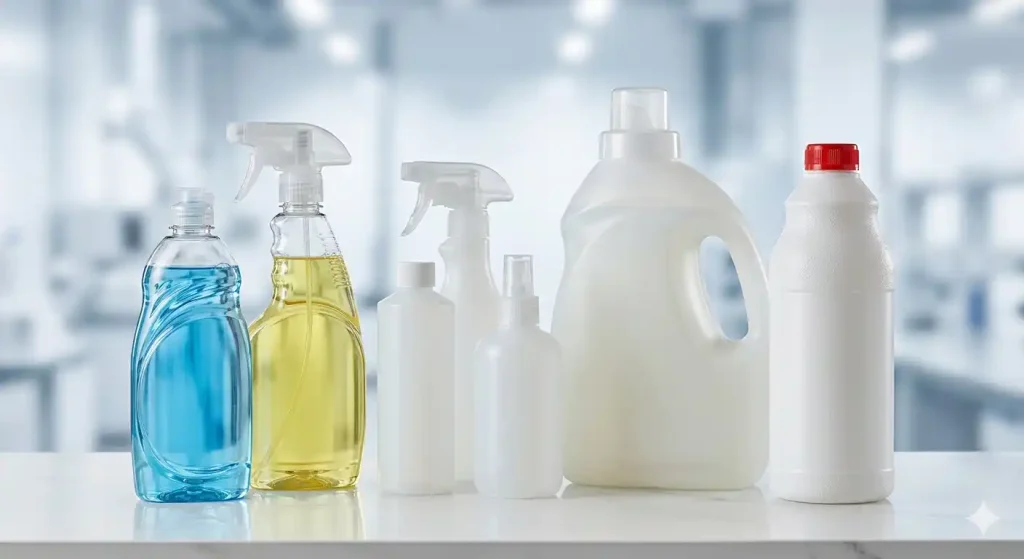
The household cleaning and detergent bottle segment is one of the most volume-intensive in plastic packaging, encompassing everything from dishwashing liquid in 500ml bottles to laundry detergent in 2L containers and bathroom cleaner sprays in 750ml trigger bottles. In 2025, the global household cleaning products packaging market exceeded USD 18 billion, with PET and PP the dominant materials across the ISBM-produced segment. Understanding the trade-offs between these two materials on ISBM equipment — including chemical compatibility, mechanical performance, cost, and sustainability profile — is essential for any manufacturer considering equipment investment or a material switch in this category.
PET for Household Chemical Bottles: Strengths and Limitations
PET has captured a substantial share of household chemical bottle production because of its optical clarity, compatibility with a wide range of common cleaning formulations, and its well-established recyclability through the global PET stream. The one-step ISBM process is particularly well suited to PET household chemical bottles because of the inherent processing advantages of PET in the ISBM cycle.
PET Chemical Compatibility in Household Products
PET performs well with a wide range of household chemical formulations, including neutral to mildly alkaline detergent liquids, fabric conditioners, mild acid-based bathroom cleaners, and alcohol-based surface disinfectants. Its established FDA food-contact status also makes it the obvious choice for products in dual-use or food-adjacent categories. However, PET has meaningful limitations in household chemical packaging:
- Strong alkalis (pH >12): Concentrated bleach, caustic drain cleaners, and heavy-duty alkaline degreasers will stress-crack PET over extended contact periods at typical storage temperatures. Stress cracking accelerates dramatically if the bottle is under residual stress from the blow molding process.
- Some organic solvents: Chlorinated solvents, ketones, and high-concentration aromatic compounds can cause environmental stress cracking in PET. Many specialty cleaning products in these categories are better suited to PP or HDPE packaging.
- Essential oils and certain fragrances: PET is permeable to some limonene-based fragrances and certain essential oils over extended shelf lives. Barrier PET grades with modified chemistry can address this in specific formulations.
PET ISBM Processing Advantages
For household chemical bottle applications where PET is chemically suitable, the ISBM process delivers compelling advantages. PET bottles produced by ISBM have higher top-load strength and drop-impact resistance than HDPE bottles of equivalent weight, allowing lightweight designs that reduce material cost and plastic consumption per bottle. The clarity of PET also supports consumer-facing product visibility — an important merchandising consideration for premium household brands where product colour differentiation is used at shelf.
PP for Household Chemical Bottles: When Chemistry Demands It
Polypropylene’s resistance to a far broader range of household chemicals than PET makes it the material of choice for the most chemically aggressive product categories. PP is resistant to concentrated bleach, strong alkalis, chlorinated solvents, and most acids — the full spectrum of household chemical formulations. Its melting point (160°C–165°C for homopolymer PP) also provides service temperature resistance important for products stored in high-temperature environments such as outdoor sheds, vehicles, and non-climate-controlled warehouses.
PP ISBM Processing Challenges
Processing PP on ISBM equipment requires meaningfully different machine configuration and process parameters compared to PET. These differences represent the primary trade-offs in selecting PP over PET for household chemical bottles:
- Processing temperature: PP requires barrel temperatures of 200°C–240°C and mold temperatures of 10°C–30°C. The processing window (temperature range producing acceptable bottles) is narrower than PET, requiring more careful process control.
- Stretch window: PP has a narrower hot-stretching window than PET. The biaxial orientation achievable in ISBM-processed PP is lower than in PET, resulting in bottles with lower transparency (PP is naturally translucent rather than water-clear) and somewhat lower barrier properties.
- Screw geometry: PP requires a different injection screw design from PET — typically a lower compression ratio (2.0:1 to 2.5:1) with a longer metering zone. Machines frequently used for both PET and PP production require interchangeable screw sets, adding to operational complexity.
- Cooling time: PP has a lower thermal conductivity than PET and cools more slowly in the blow mold. Longer cooling times increase cycle length by 15%–25% compared to equivalent PET production, reducing output rate.
- Clarity limitation: Standard PP produces milky-translucent rather than clear containers. While this is acceptable for many cleaning product categories, brands requiring crystal-clear bottles must use PET or consider PP clarifiers, which add cost and complexity.
The Decision Framework: PP vs PET for Your Household Chemical Product
The following framework provides a practical approach to the PP-versus-PET decision for household chemical bottle production on ISBM equipment.
| Factor | PET Advantage | PP Advantage |
|---|---|---|
| Optical clarity | Crystal clear | Translucent (acceptable for many products) |
| Chemical resistance (alkalis) | Limited above pH 12 | Excellent across pH range |
| Material cost | Comparable | Often lower per kg in commodity grades |
| Cycle time | Faster cooling, shorter cycles | Longer cooling required |
| Recyclability | Mature global recycling infrastructure | Growing PP recycling stream |
| Top-load strength | Higher strength per gram of material | Adequate for most applications |
| Heat resistance | Limited (Tg ~75°C for oriented PET) | Higher service temperature |
Machine Configuration for Dual-Material PP and PET Production
Some contract manufacturers and detergent brands operate ISBM machines that need to run both PET and PP, either in different production campaigns on the same machine or simultaneously on dedicated machines within the same facility. The key machine specification requirements for dual-material capability are:
- Interchangeable screw-and-barrel assemblies with different compression ratios for PET and PP processing.
- Wide-range conditioning station temperature control capable of delivering the different thermal profiles required by each material.
- Flexible cooling water circuits with independent temperature control for preform and blow molds to accommodate the different cooling rate requirements of PET and PP.
- Process recipe storage in the machine HMI, allowing rapid, documented changeover between validated PP and PET process parameters with a single operator action.
ال one-step ISBM machine range, with servo-driven axes and flexible conditioning zone temperature profiles, supports multi-material production capability when properly configured. For household chemical bottle producers managing multiple SKUs across both PET and PP substrates, this flexibility reduces the capital requirement of maintaining separate machine platforms for each material.
Sustainability and Recycled Content in Household Chemical Bottles
Retailer and brand sustainability commitments are reshaping material selection in household chemical packaging. Australian Packaging Covenant Organisation (APCO) 2025 targets — including 70% of plastic packaging being recyclable, compostable, or reusable — directly influence the packaging strategy of major household product brands in the Australian market. PET retains a strong advantage here: the APCO-recognised PET recycling rate in Australia exceeds 50%, and food-grade rPET is now commercially available at meaningful scale. rPET-compatible ISBM processing is well established for bottles with up to 50% post-consumer recycled content, with minor process parameter adjustments to account for the slightly lower intrinsic viscosity of recycled material.
PP recycling infrastructure in Australia is growing but less mature than PET. The six-station ISBM machine platform, designed for high-volume household product bottle production, supports rPET processing as standard, providing a pathway for detergent and cleaning product brands to meet recycled content commitments at scale.
The PP-vs-PET decision for household chemical bottle production on ISBM equipment is ultimately a chemistry-first decision. Evaluate your product formulation’s chemical aggressiveness first, then weigh the secondary factors of clarity, cycle time, cost, and recyclability. For most neutral-to-mild cleaning products, PET delivers better economics and sustainability metrics; for aggressive alkaline or solvent-based formulations, PP is the technically correct choice regardless of cost considerations.
المحرر: WM