
Hot Runner Systems in ISBM: The Most Misunderstood Component in the Machine
Among all the technical subsystems in an ISBM machine, the hot runner system is the one most likely to be specified as an afterthought and the one most likely to cause production problems when improperly selected or maintained. The hot runner is the heated manifold and nozzle assembly through which molten plastic travels from the injection barrel to the preform cavities. In a multi-cavity ISBM machine, the hot runner is the critical interface between a single injection source and multiple parallel preform cavities — and its ability to deliver identical melt temperature, flow velocity, and pressure to every cavity simultaneously determines whether all cavities produce identical preforms, or whether cavity-to-cavity weight variation, colour inconsistency, and dimensional deviations become persistent production headaches. This guide explains how multi-zone hot runner temperature control systems work on ISBM machines and why they matter for consistent bottle quality.
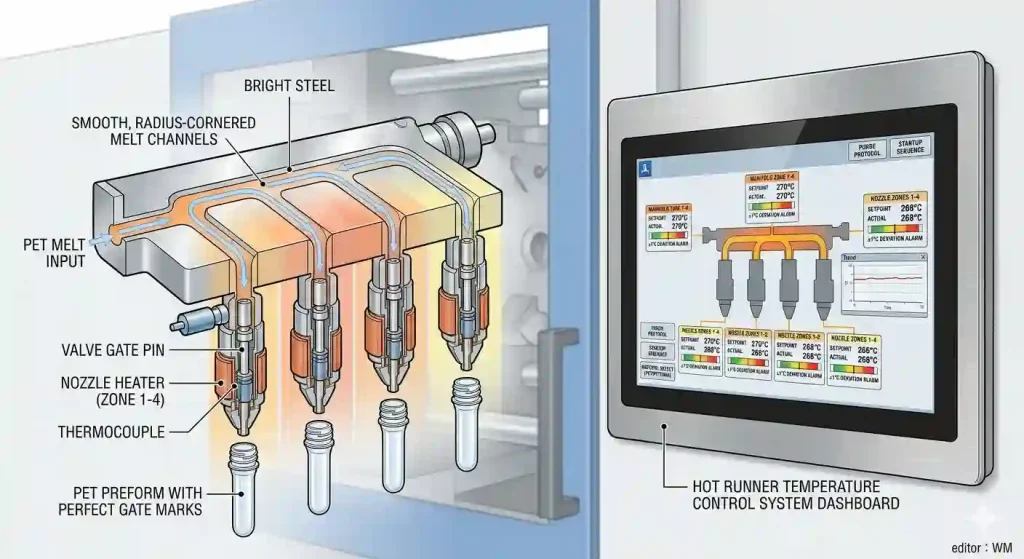
Hot Runner System Architecture in ISBM
An ISBM hot runner system consists of three principal components: the manifold, the nozzle assemblies, and the temperature control system. Each plays a distinct role in achieving cavity-to-cavity melt consistency.
The Manifold
The manifold is a machined steel block (typically P20 or H13 tool steel) containing the melt distribution channels through which molten polymer flows from the sprue (connected to the machine nozzle) to each individual cavity nozzle drop. In a well-designed ISBM hot runner manifold, the channel layout is geometrically balanced — meaning the total channel length and cross-sectional area from the sprue to every cavity is identical. This geometrical balance ensures that the flow velocity, residence time, and pressure drop experienced by the melt on its way to every cavity are equal, leading to equal filling behaviour across all cavities.
For PET and other shear-sensitive materials, the manifold channel design must also minimise dead zones — corners or pocket areas where melt can reside for extended periods at processing temperature, undergoing thermal degradation. Streamlined, radius-cornered channel profiles with smooth surface finishes are the design standard for PET hot runner manifolds. Degraded PET in the hot runner typically manifests in the bottle as yellow streaking, black specks (carbonised polymer), or elevated acetaldehyde levels.
Nozzle Assemblies
Each cavity nozzle delivers molten polymer to one preform cavity. The nozzle body is heated by a dedicated heater element, allowing its temperature to be controlled independently. The nozzle tip geometry determines the gate mark left on the preform base after the nozzle retracts at the end of each injection cycle. For ISBM preforms, the most common nozzle designs are open (non-gated) nozzles for high-throughput commodity applications and valve-gated nozzles for applications requiring a clean, vestige-free gate point. Valve gate nozzles use a servo- or pneumatically-driven pin to physically seal the gate orifice between shots, leaving a minimal, flat gate mark that is virtually invisible in the final bottle.
Valve gate nozzles are the standard specification for pharmaceutical, cosmetic, and premium food-contact bottle production where a protruding gate vestige on the bottle base would cause functional or aesthetic problems. They are also preferred for pigmented and multi-layer preforms where open-nozzle gating can cause colour mixing or layer disruption at the gate point.
Temperature Control System: Multi-Zone Architecture Explained
The temperature control system is where the quality-critical differentiation between basic and advanced hot runner systems lies. In a multi-zone hot runner temperature control system, every heater in the manifold and nozzle assemblies is controlled by an independent PID (Proportional-Integral-Derivative) controller, typically housed in a dedicated hot runner controller unit. Each zone has its own thermocouple measuring the actual temperature at that location, and the PID controller adjusts heater power output to maintain the setpoint temperature within ±1°C.
The number of independent zones in a multi-zone hot runner system correlates directly with the level of thermal control achievable. A basic system may have only 2–4 zones for a 4-cavity manifold; a fully specified system will have one zone per manifold heater plus one zone per nozzle — for a 4-cavity ISBM with a 4-zone manifold and 4 individual nozzle heaters, that is 8 independent zones. This level of zoning allows the temperature engineer to create a deliberate thermal gradient in the manifold (for example, running the manifold body hotter than the nozzle tips) to prevent gate freeze-off or to compensate for thermal asymmetries caused by machine geometry.
Why Multi-Zone Control Matters for Cavity-to-Cavity Weight Consistency
Cavity-to-cavity preform weight variation is one of the most commercially significant quality metrics in ISBM production. A variation of ±0.3g on a 20g preform represents ±1.5% of preform weight — but in the blown bottle, this translates to wall thickness variation that can put the lightest-weight bottles outside their top-load or drop-impact specification. For a 4-cavity machine producing a lightweighted bottle at the minimum acceptable wall thickness, this is a real production risk.
Multi-zone temperature control directly addresses cavity-to-cavity weight variation through two mechanisms. First, by enabling the temperature engineer to fine-tune individual nozzle zone temperatures to compensate for any remaining flow imbalances in the balanced manifold — a small temperature increase at a slow-filling cavity increases melt fluidity and flow rate, bringing it into balance with the other cavities. Second, by providing the diagnostic data — temperature monitoring records, zone deviation alarms — needed to identify when a zone heater or thermocouple is beginning to fail before it causes a quality excursion. A zone running 10°C below setpoint because of a partially failed heater wire will fill its cavity slowly, producing underweight preforms that blow into lightweight, substandard bottles.
Material-Specific Temperature Zone Profiles
Different materials processed on ISBM machines require different hot runner temperature profiles, and multi-zone control is essential for adapting to these requirements without manifold or nozzle hardware changes.
- PET (standard IV 0.80–0.84 dl/g): Manifold temperature 265°C–275°C, nozzle tips 260°C–270°C. The nozzle tip can run slightly below the manifold body to slow the flow at the gate and improve gate sealing in open-nozzle systems.
- Tritan copolyester: Manifold temperature 270°C–285°C, with nozzle tips at 265°C–280°C. Tritan’s higher processing temperature requires that the hot runner system be rated to at least 310°C for safety margin.
- PPSU: Manifold temperature 330°C–350°C, nozzle tips 325°C–345°C. PPSU hot runner systems are a specialised category requiring high-temperature materials in heater elements, thermocouples, and sealing components. Standard PET hot runner components are not rated for these temperatures.
- PP (Polypropylene): Manifold temperature 200°C–230°C, nozzle tips 195°C–220°C. PP’s lower processing temperature means that the open-nozzle tip must be tuned carefully to prevent gating issues: too hot and the PP drools between shots; too cold and the gate freezes prematurely, causing short shots or gate vestige pull-through.
Hot Runner Startup and Shutdown Protocols
Improper startup and shutdown of hot runner systems is a leading cause of hot runner damage and preform quality problems. For PET hot runner systems:
- Startup: Never inject through a hot runner that has not fully reached setpoint temperature. Cold PET in a hot runner channel will not flow properly and may cause excessive injection pressure that damages nozzle tips or manifold seals. Standard practice is to heat the hot runner to setpoint and hold for a minimum of 15 minutes before the first injection, allowing thermal expansion of the manifold to fully seat all nozzle-to-manifold interfaces.
- Shutdown (planned): Purge the hot runner with a low-molecular-weight purge compound before extended shutdowns to displace PET from the manifold channels. PET left in a hot runner at processing temperature for more than 15–20 minutes begins degrading; longer residence times cause colour build-up, AA generation, and black speck contamination on restart.
- Emergency shutdown: If power is lost suddenly and the hot runner cannot be purged, a controlled restart procedure is required — the hot runner must be brought to temperature slowly, with a soak period before any injection is attempted, to soften and re-mobilise the solidified PET in the channels without overpressuring the system.
Integration with ISBM Machine Control Systems
Modern ISBM machines integrate hot runner temperature control directly into the main machine HMI, rather than requiring a separate standalone hot runner controller unit. This integration provides several operational advantages: all process parameters are stored in a single machine recipe file (preventing hot runner setpoint mismatches when operators change other parameters), zone temperature trend data is logged alongside injection and blow parameters in the machine’s data historian (enabling root cause correlation of bottle quality issues with hot runner temperature events), and zone deviation alarms can trigger machine stop or alarm notifications through the main production monitoring system.
ال HGYS200-V4-B four-station ISBM machine features integrated multi-zone hot runner temperature control within its main control architecture, supporting up to 16 independent temperature zones to cover the full range of manifold and nozzle heating requirements for multi-cavity pharmaceutical, cosmetic, and food-contact preform production.
For manufacturers considering a new ISBM investment or a hot runner system upgrade on an existing platform, the four-station blow molding machine range includes hot runner options with valve gate nozzles and up to 16 independent temperature zones as standard configurable options — ensuring the level of thermal control needed for consistent preform quality across the full range of materials and bottle geometries that modern packaging manufacturers demand.
The hot runner system is the thermal heart of every ISBM machine. Investing in a properly specified, multi-zone temperature control hot runner — and maintaining it according to a rigorous preventive maintenance program — is the single most effective step a production manager can take to achieve consistent cavity-to-cavity preform weight, reliable gate quality, and stable long-run production performance.
المحرر: WM