
ZQ Series Deep Dive — High Output
ZQ110 & ZQ135 IBM Machines: High-Cavitation Output for Large-Scale Bottle Production
A complete specification guide and application analysis for the ZQ110 and ZQ135 — the two largest hydraulic IBM machines in the ZQ Series, designed for high-cavitation pharmaceutical, cosmetic, and packaging operations requiring maximum output from a single press.
When a pharmaceutical converter needs 15,000 pill bottles per hour from a single press, or a personal care manufacturer needs 20 cavities at 10 ml running three shifts, the ZQ110 and ZQ135 are the machines built for that scale. These are the largest hydraulic models in the ZQ Series — sitting at 1,100 kN and 1,350 kN clamping force respectively — and they represent the upper limit of what a single three-station one-step IBM machine can produce in terms of cavitation capacity and total output volume.
This article covers the specifications, cavitation reference data, key differences between the ZQ110 and ZQ135, and the production scenarios that justify each model — so large-scale buyers can match machine to production requirement with confidence before committing to tooling and infrastructure investment.
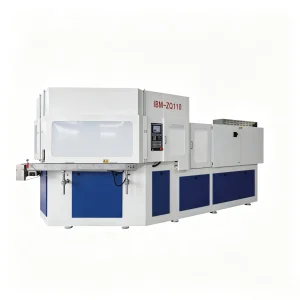
ZQ110 vs ZQ135: Specification Comparison
| Parameter | Unit | ZQ110 | ZQ135 |
|---|---|---|---|
| Screw Diameter | mm | 65 | 70 |
| Max Shot Weight | g | 540 | 650 |
| Injection Clamp Force | kN | 1,100 | 1,350 |
| Blow Clamp Force | kN | 160 | 200 |
| Max Platen Size (L×W) | mm | 780 × 560 | 900 × 620 |
| Max Cavities @ 10 ml | — | 20 | 30 |
| Max Bottle Height | mm | 350 | 400 |
| Dry Cycle | s | 4 | 4 |
| Total Power | kW | 80 | 95 |
| Machine Footprint (L×W×H) | m | 5.0×1.8×2.2 | 5.5×2.0×2.4 |
Who These Machines Are Built For
ZQ110 — Large-Scale Pharma & Cosmetics
The ZQ110 is the preferred model for large pharmaceutical bottle manufacturers who need 20-cavity production at 10 ml or 12-cavity at 50 ml — delivering over 15,000 bottles/hr at full cavitation. One confirmed ZQ110 installation is at A-IL Plastic in Korea, producing 300 ml daily-chemical containers. The 780 × 560 mm platen accommodates large-format mold footprints without the full infrastructure footprint of the ZQ135, making it the practical upper limit for most large-scale converters.
ZQ135 — Maximum Cavitation, Highest Volume
The ZQ135 is the highest-output hydraulic IBM machine in the ZQ range — the only model capable of 30 cavities at 10 ml, delivering up to 22,950 bottles per hour from a single press. Its 900 × 620 mm platen and 650 g maximum shot weight make it the correct specification for industrial-scale pharmaceutical vial production, high-volume hotel amenity lines, and large cosmetics manufacturers who operate multi-press filling lines where per-press output is the commercial bottleneck.
Cavitation & Output by Bottle Volume: ZQ110 vs ZQ135
| Volume | ZQ110 Cavities | ZQ110 Bottles/hr | ZQ135 Cavities | ZQ135 Bottles/hr |
|---|---|---|---|---|
| 10 ml | 20 | ~15,300 | 30 | ~22,950 |
| 50 ml | 12 | ~9,180 | 16 | ~12,240 |
| 100 ml | 8 | ~6,120 | 12 | ~9,180 |
| 300 ml | 4 | ~3,060 | 6 | ~4,590 |
| 1,000 ml | 2 | ~1,530 | 3 | ~2,295 |
Estimates at 4 s dry cycle and 85% line efficiency. Confirmed cavitation data provided by our engineering team against your bottle drawing.
ZQ110 or ZQ135: How to Decide
Both models run the same four-second hydraulic dry cycle, share the same three-station one-step IBM architecture, and are built on the same European-style frame. The decision between them reduces to three practical questions:
- Do you need more than 20 cavities? If your target output requires more than 20 cavities at 10 ml or equivalent cavitation at larger formats, the ZQ135 is the only model in the range that can achieve it, with 30 cavities at 10 ml. The ZQ110 caps at 20 cavities — sufficient for most large-scale operations, but a hard ceiling if your volumes require more.
- Do you need bottles taller than 350 mm? The ZQ110 supports bottle heights up to 350 mm, covering most standard pharmaceutical and cosmetic container heights. The ZQ135 extends this to 400 mm — relevant for tall condiment bottles, premium shampoo dispensers, and large-volume pharmaceutical containers that fall outside the ZQ110’s height envelope.
- Can your facility accommodate the ZQ135’s footprint and power draw? The ZQ135 measures 5.5 × 2.0 × 2.4 m and draws 95 kW total installed power. These are significant infrastructure commitments. If your production bay and electrical supply can comfortably accommodate these figures, and your output requirements are at the ceiling of the ZQ110’s capability, the ZQ135 is the correct machine. If infrastructure is a constraint, the ZQ110’s 5.0 × 1.8 × 2.2 m footprint and 80 kW draw may be the more practical choice even if it means a second machine to reach target volumes.
For buyers on the boundary between the two models, our engineering team will calculate the exact number of ZQ110 presses needed to match the output of one ZQ135, including total floor space and power comparison — helping you decide whether investing in one ZQ135 or two ZQ110s is the better long-term production strategy for your operation.
For buyers on the boundary between the two models, our engineering team will calculate the exact number of ZQ110 presses needed to match the output of one ZQ135, including total floor space and power comparison — helping you decide whether investing in one ZQ135 or two ZQ110s is the better long-term production strategy for your operation.
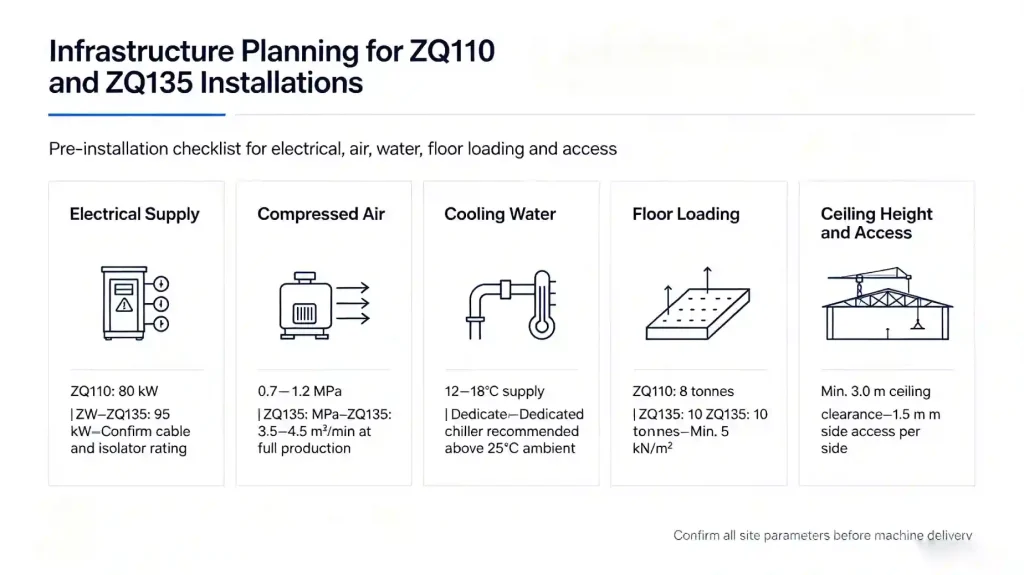
Infrastructure Planning for ZQ110 and ZQ135 Installations
Installing a ZQ110 or ZQ135 requires more pre-installation planning than entry-level IBM machines. The following infrastructure checklist covers the key preparation items for both models:
- Electrical supply: ZQ110 requires 80 kW total installed capacity with a three-phase supply at local voltage and frequency. ZQ135 requires 95 kW. Both models include a main isolator and internal distribution board — the incoming supply cable size and isolator rating should be confirmed with our electrical engineering team before installation to ensure the supply is correctly rated for startup current as well as continuous load.
- Compressed air: Both models require clean, dry compressed air at 0.7–1.2 MPa. At maximum cavitation and short cycle times, air consumption on the ZQ135 can reach 3.5–4.5 m³/min at full production. Ensure your compressor system is rated for this flow rate with adequate receiver capacity to prevent pressure drop during the blow cycle on high-cavitation molds.
- Cooling water: Mold temperature control requires cooling water supply at a consistent temperature — ideally 12–18°C supply temperature with adequate flow rate for the mold cooling circuit. For high-cavitation production in warm climates (ambient above 25°C), a dedicated industrial chiller rather than tower cooling water is recommended to maintain consistent blow-station mold temperature, which is critical for consistent wall thickness distribution at maximum cavitation.
- Floor loading: The ZQ110 weighs approximately 8 tonnes complete and the ZQ135 approximately 10 tonnes. Both require a reinforced concrete floor with minimum 5 kN/m² load-bearing capacity — confirm with your structural engineer before installation if the factory floor was not designed for heavy machinery.
- Ceiling height and access: At 2.2 m (ZQ110) and 2.4 m (ZQ135) machine height, both models require 3.0 m minimum ceiling clearance for safe crane access during mold changes. The ZQ135’s 5.5 m floor length also requires adequate side clearance (minimum 1.5 m per side) for operator access during production and maintenance.
Return on Investment: Large-Scale IBM Machine Economics
The economics of a ZQ110 or ZQ135 investment are driven by high-cavitation utilisation — the machines only deliver their full financial return when running close to maximum cavitation at high utilisation rates. Here is a simplified ROI illustration using the ZQ135 at 30-cavity 10 ml pharmaceutical vial production:
- Output: 30 cavities × 900 cycles/hr (4 s cycle at 85% efficiency) = 27,000 vials/hr. Over a 20-hour production day: 540,000 vials per day.
- Annual output: At 300 production days per year: 162,000,000 vials per year from one machine.
- Revenue at USD 0.05 per unit (typical pharma vial contract price): USD 8,100,000 per year in top-line bottle sales from one ZQ135.
- Operating cost (energy): At 95 kW total × 20 hours × USD 0.12/kWh: USD 228 per day, or approximately USD 68,400 per year.
- Payback indication: At these figures, the machine cost represents a small fraction of the first year’s revenue, and full investment recovery is typically achieved within 12–18 months for a continuously utilised ZQ135 on a pharmaceutical vial contract.
These are illustrative figures based on published industry price ranges and typical ZQ machine performance. Your actual ROI will depend on your specific contract pricing, material cost, labour cost, and production utilisation rate. Our commercial team provides a customised ROI model for each ZQ110 and ZQ135 enquiry — based on your bottle specification, market pricing, and production shift structure — at no cost as part of the technical proposal process.
High-Output IBM Machines
Request ZQ110 or ZQ135 production calculations
Send us your bottle drawing and annual output target. We will confirm which model fits and provide a detailed cavitation, power, and infrastructure analysis within 24 hours. [email protected]
المحرر: WM