
Industry Application Series — Food & Beverage Packaging
Three-Station Blow Molding Machine for Mineral Water & Drinking Water Bottles: High-Efficiency PET Beverage Bottle Production
Mineral water and drinking water bottles represent the single largest application segment for PET blow moulding globally. Every day, billions of 330 ml, 500 ml, and 1,500 ml PET water bottles are produced, filled, sealed, and distributed across every region of the world. The production system behind this scale of output must achieve exceptional cycle efficiency, consistent wall thickness at lightweight bottle specifications, flawless food-contact compliance across multiple regulatory jurisdictions, and the lowest possible per-bottle energy cost — since in the commodity water bottle sector, production cost per unit is often the primary differentiator between competing manufacturing operations.
ال ماكينة نفخ القوالب ثلاثية المحطات HGY50-V3-EV from AUS isbmblowmolding Co., Ltd is designed to compete in this demanding environment. For mid-scale water bottle producers — bottled water brands, private-label filling operations, and regional beverage manufacturers — the three-station one-step ISBM platform offers a specific set of advantages not available from two-stage RSBM systems: energy efficiency from elimination of the reheat stage, dimensional consistency from servo-controlled production, and food-contact process hygiene from the closed single-machine production environment.
What Makes Water Bottle Production Technically Demanding
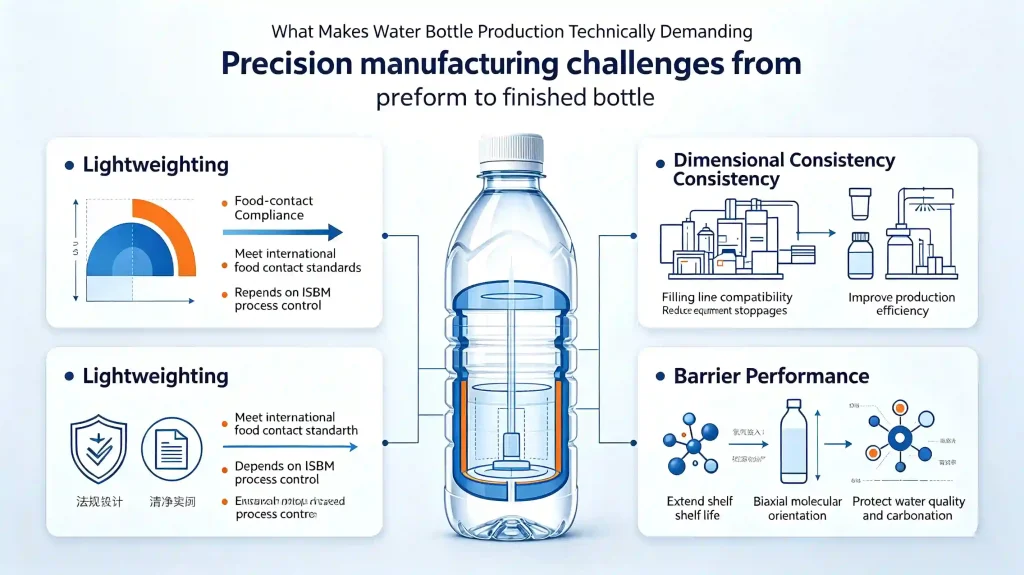
Water bottle production appears deceptively simple — a round, clear bottle and a straightforward liquid fill. In reality, producing PET water bottles at commercial scale that meet all the technical, regulatory, and commercial requirements of the modern bottled water industry is a genuine manufacturing challenge across several dimensions:
- Lightweighting: Consumer and regulatory pressure to reduce plastic use drives continuous reduction in bottle weight. A standard 500 ml water bottle that weighed 25 g in 2000 now targets 10–13 g in many markets. Achieving this while maintaining top-load strength, barrier performance, and dimensional stability requires precise control of wall thickness distribution — directly dependent on the ISBM machine’s stretch-blow parameters.
- Dimensional consistency for filling line compatibility: High-speed water filling lines operate at 10,000–50,000 bottles per hour. Any dimensional variation in bottle neck, body diameter, or height causes stoppages on automated rinsing, filling, capping, and labelling equipment, with significant production and financial consequences.
- Barrier performance for shelf life: PET water bottles must maintain barrier performance against oxygen ingress and CO₂ egress (for sparkling water) sufficient to deliver a labelled shelf life of 12–24 months. Biaxial molecular orientation during the stretch-blow stage is the primary mechanism that provides this barrier in PET.
- Food-contact compliance: Water is a food product and the bottle is a food contact material. Compliance with FSANZ (Australia), EU 10/2011, UK FSA, ANVISA (Brazil), and INVIMA (Colombia) is non-negotiable for market access.
Why the One-Step Three-Station Process Suits Mid-Scale Water Bottle Production
Energy Efficiency Advantage
The single most significant operating cost advantage of the one-step ISBM process for water bottle production is the elimination of the infrared preform reheating stage. In a two-stage RSBM system, the preform must be reheated from ambient temperature back to the blow-forming temperature (90–110°C for PET) using infrared lamps — a continuous, high-power energy load accounting for 25–40% of total energy consumption per bottle. The three-station ISBM process eliminates this entirely: the preform retains its injection heat through the blow stage, and the machine’s total installed power of 45.2 kW covers all production functions. For water bottle producers sensitive to electricity costs — a significant concern in Australia, the Netherlands, and South Korea — this saving compounds meaningfully over an annual production schedule.
No Preform Inventory or Logistics Requirement
Two-stage water bottle production requires either in-house preform injection moulding (a separate capital investment) or preform purchasing and inventory management (a supply chain complexity). The one-step three-station process loads PET pellets directly into the machine hopper and produces finished bottles in a single continuous cycle — eliminating preform procurement, storage, quality inspection, and logistics entirely. For regional water bottlers and private-label filling operations that want to control their complete packaging supply chain without additional infrastructure, this is a significant operational simplification.
Consistent Wall Distribution for Lightweighted Bottles
The five-servo control system of the HGY50-V3-EV provides the process stability required to consistently produce lightweighted water bottles at the lower end of the target weight specification. The dual servo mould-clamping system with high-pressure compensation maintains consistent clamping force throughout long production runs, ensuring that the wall thickness distribution of the 500th bottle in a run matches the first — critical for maintaining structural performance of lightweighted bottles that have minimal wall thickness margin.
Compressor Specification: High-Pressure Air Supply for Water Bottle ISBM
Water bottle production on the HGY50-V3-EV requires a reliable, clean, high-pressure compressed air supply at 25–40 bar for the blow moulding stage. The machine’s auxiliary equipment layout specifies a dedicated high-pressure air compressor and storage tank as mandatory production infrastructure.
For water bottle production, the compressed air that enters the bottle interior during the blow stage must be free of oil contamination to maintain food-contact compliance. A matched 20–40 bar micro-oil screw air compressor is the correct specification for the ISBM blow stage — delivering the pressure range required for PET water bottle blow moulding with oil content low enough to meet food contact air purity requirements. Specifying this compressor at the equipment procurement stage — rather than attempting to adapt existing lower-pressure plant air systems — ensures that food-contact compliance and bottle quality are maintained consistently from the first production cycle.
Regulatory Compliance Overview for Water Bottle PET Production
| Market | Applicable Standard | Key Requirement for PET Water Bottles |
|---|---|---|
| Australia / New Zealand | FSANZ Food Standards Code | Food-contact PET approved; overall migration limits apply |
| European Union / Netherlands | EU Regulation 10/2011 | PET listed; specific migration limits for terephthalic acid and ethylene glycol monomers |
| United Kingdom | UK SI 2012/2619 | Retained EU law framework; PET fully compliant for water contact |
| Brazil | ANVISA RDC 331/2019 | PET regulated and approved; resin supplier CoC required |
| Colombia | Resolution 683/2012 MINSALUD | PET approved for potable water contact applications |
Standard Water Bottle Formats on the HGY50-V3-EV
The machine covers the full range of standard retail water bottle formats used in global beverage markets:
330 ml
Single-serve / vending
500 ml
Standard retail — highest volume format globally
750 ml
Sports / outdoor hydration
1,000 ml
Family / household take-home
1,500 ml
Large family / multi-serve
All five formats fall within the machine’s production capability. Cavity count per cycle varies from 1–2 for 1,500 ml bottles to 4–6 for 330 ml bottles, with corresponding variation in hourly output. Our engineering team calculates specific output projections for each format as part of the equipment proposal process.
Competitive Differentiation: rPET Production for Sustainability Commitments
One of the most significant trends in the bottled water industry is the shift towards recycled PET (rPET) content in packaging, driven by regulatory requirements in the EU (Single-Use Plastics Directive), voluntary brand sustainability commitments, and consumer demand for packaging with a demonstrably lower environmental footprint. The HGY50-V3-EV can process food-contact-grade rPET at appropriate blend ratios, allowing water bottle manufacturers to meet their rPET content commitments without investing in additional production equipment.
Processing rPET in a one-step ISBM machine offers an inherent quality advantage over two-stage production: because the preform never cools to ambient temperature and is never subjected to a secondary reheating cycle, the intrinsic viscosity of the rPET polymer is better preserved through the production process — delivering more consistent mechanical and barrier performance in the finished bottle compared to rPET processed through a two-stage system where secondary reheating further degrades IV.
Build Your Water Bottle Production Line with the HGY50-V3-EV
Send us your target bottle formats, monthly volume requirements, and filling line specifications. Our engineering team will return a complete machine configuration and production economics analysis within 24 hours.
Frequently Asked Questions
editor:WM