
Industry Application Series — Household & Daily Chemical Packaging
Three-Station Blow Molding Machine for Hand Sanitizer & Disinfectant Bottles: PETG Chemical-Resistant Packaging Production
The hand sanitizer and disinfectant product category experienced unprecedented demand growth during the global pandemic period of 2020–2022, and while volumes have moderated from peak levels, this category has permanently shifted: hand sanitizer dispensers are now standard fixtures in offices, healthcare facilities, schools, transport hubs, and retail environments across Australia, the UK, the Netherlands, and every other major market. The structural demand increase for hand hygiene products has created sustained demand for the packaging that delivers them — specifically, the 250 ml to 500 ml PETG or PET pump bottles that have become the de facto format for personal and institutional hand sanitizer use.
The Hiru estazioko putz egiteko makina HGY50-V3-EV from AUS isbmblowmolding Co., Ltd is capable of producing these bottles efficiently in PETG — the material that offers the best combination of chemical resistance to alcohol-based sanitizer formulations, optical clarity for product volume visibility, and precision neck finish for the pump mechanisms used in sanitizer dispensing. This article examines the specific material and production requirements for hand sanitizer and disinfectant bottle packaging, with important technical clarifications on the role of PETG versus PET in alcohol-exposed applications.
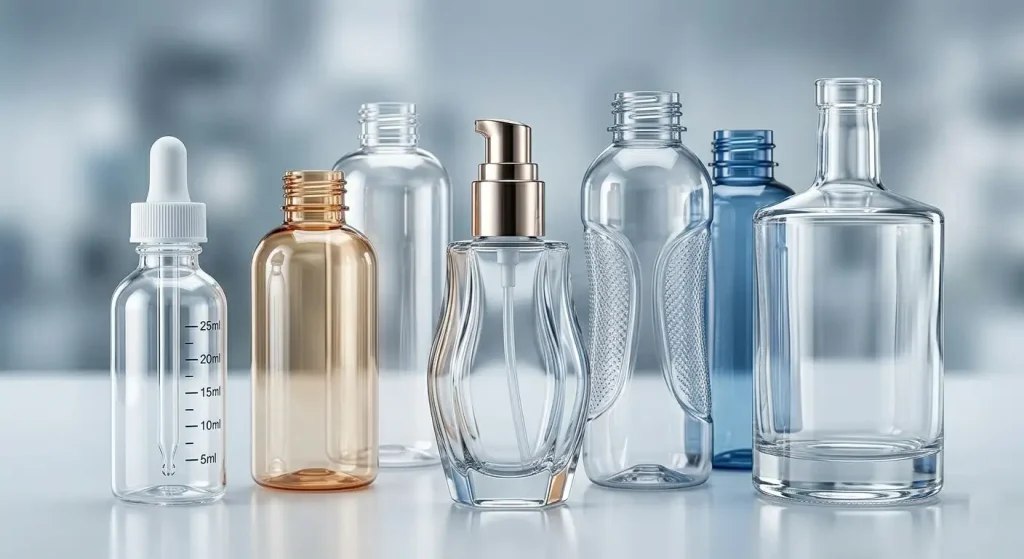
Material Selection: Why PETG is Preferred for Alcohol-Based Sanitizer Bottles
Hand sanitizer formulations typically contain 60–80% isopropyl alcohol (IPA) or ethanol as the active antimicrobial ingredient, in aqueous solution with humectants such as glycerin. The alcohol content of these formulations is substantially higher than in most cosmetic products, and this has direct implications for packaging material selection.
Standard PET (polyethylene terephthalate) can exhibit stress cracking or surface crazing when in prolonged contact with high-concentration alcohols, particularly at the stress points created by blow moulding orientation patterns or injection gate marks. This is a well-documented limitation of PET in alcohol-contact applications and explains why the industry has moved towards PETG (glycol-modified PET) for premium sanitizer bottle applications.
PETG’s modified molecular structure — the incorporation of cyclohexanedimethanol (CHDM) comonomers that disrupt PET’s crystallisation — provides significantly improved chemical resistance to alcohol contact compared to standard PET. PETG sanitizer bottles maintain their optical clarity, dimensional integrity, and structural performance throughout the product use cycle, including the repeated pump actuation and surface cleaning events that sanitizer bottles experience in professional and institutional use environments. For hand sanitizer brands positioning their products in the premium, healthcare, or institutional channel — where bottle integrity is both a functional and brand credibility requirement — PETG produced on the three-station ISBM platform is the correct specification.
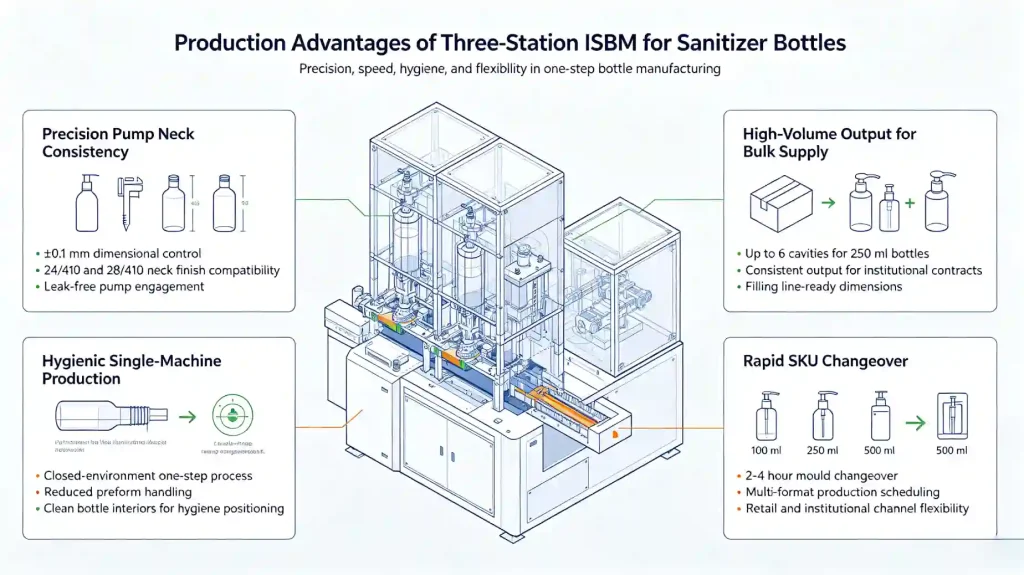
Production Advantages of Three-Station ISBM for Sanitizer Bottles
Precision Pump Neck Consistency
Sanitizer pump mechanisms (typically 24/410 or 28/410 neck finish) require dimensional precision of ±0.1 mm for leak-free, smooth-actuation pump engagement. Injection-stage neck formation in the ISBM process delivers this precision across every cycle, eliminating the pump fit issues caused by neck finish variation.
High-Volume Output for Bulk Supply
Institutional and healthcare sanitizer supply contracts require large, consistent bottle volumes. The HGY50-V3-EV’s multi-cavity configuration (up to 6 cavities for 250 ml bottles) supports the production rates required for institutional supply while maintaining the dimensional consistency that filling lines demand.
Hygienic Single-Machine Production
The closed-environment one-step production process eliminates preform handling steps that could introduce particulate contamination into bottle interiors — relevant for sanitizer products where bottle interior cleanliness directly connects to the product’s hygiene positioning.
Rapid SKU Changeover
Hand sanitizer producers often supply multiple bottle formats — 100 ml pocket size, 250 ml pump, 500 ml refill — across different retail and institutional channels. Mould changeover on the HGY50-V3-EV in 2–4 hours supports multi-format production scheduling without dedicated production lines per SKU.
Auxiliary Equipment: Clean Air Supply for Sanitizer Bottle Production
The high-pressure air supply used in the ISBM blow stage has particular importance in sanitizer bottle production. The blow air enters the bottle interior during the blow stage and must not introduce any oil contamination that could compromise the bottle’s interior cleanliness — both as a production quality issue and, in the context of sanitizer products positioned on hygiene credentials, as a brand integrity issue.
The recommended auxiliary equipment for this application is a high-pressure 8–12 bar micro-oil screw air compressor for the low-pressure circuit (mould clamping, pneumatic actuation), paired with a dedicated high-pressure compressor for the blow stage. Specifying compressors with verified low oil carry-over values — as documented in their technical data sheets — is the correct approach for sanitizer bottle production where bottle interior cleanliness is a product quality requirement.
Technical Specification: Hand Sanitizer & Disinfectant Bottle Formats
- Pocket/travel size (50 – 100 ml): Small-format PETG round bottles for individual carry-size sanitizer. High cavity count per cycle (4–6) for economical small-format production. Flip-top or twist-off closure neck finish.
- Personal use pump (200 – 300 ml): Standard personal use format. PETG round body with 24/410 or 28/410 pump neck. This is the highest-volume SKU for retail hand sanitizer. 2–4 cavities per cycle.
- Institutional pump (500 ml): Larger format for bathroom and kitchen countertop dispensers. PETG for chemical resistance. 1–2 cavities per cycle depending on bottle geometry.
- Refill/bulk (750 ml – 1 L): Economy refill format for institutional purchasers. PET or PETG depending on alcohol concentration and brand positioning. Standard screw-top or disc-top closure.
- Surface disinfectant spray (300 – 500 ml): PETG round bottles with trigger spray neck finish for surface disinfectant products. Alcohol-resistant PETG maintains clarity and integrity through the product use cycle.
Market Context: Sustained Demand for Hand Hygiene Packaging
The hand hygiene product market has undergone a structural shift since 2020 that is not reversing. Healthcare systems, building operators, transport authorities, and educational institutions have permanently incorporated hand sanitizer dispensing into their operational infrastructure — creating sustained institutional demand that was not present at pre-pandemic levels. This structural demand supports long-term investment in dedicated ISBM production capacity for hand sanitizer bottles.
In Australia, WorkSafe Australia has integrated hand sanitizer provision into workplace hygiene requirements across multiple industry sectors, creating ongoing institutional procurement demand for bulk and institutional-format sanitizer products. Australian sanitizer brands supplying these institutional channels benefit from local bottle production capacity that can respond quickly to order variations without the lead times and minimum order quantities associated with imported bottles.
In the Netherlands and wider EU, the implementation of the EU Biocidal Products Regulation (BPR) for hand sanitizers creates compliance documentation requirements that interact with packaging specifications. PETG bottles produced on the HGY50-V3-EV with documented process parameters and resin certification support the product registration documentation that EU market authorisation for biocidal hand sanitizers requires.
Scale Up Your Sanitizer Bottle Production with Three-Station ISBM
Tell us your bottle volumes, alcohol concentration range, and target markets. Our team will configure the right PETG ISBM setup and return a production proposal within 24 hours.
Frequently Asked Questions
editor:WM