
Drive Technology in 2026: Why the Servo vs Hydraulic Question Matters More Than Ever
In 2026, energy cost is no longer a secondary consideration in ISBM machine procurement decisions — it is a primary financial variable. Australian industrial electricity prices in eastern states have risen by more than 60% since 2021, and the European industrial average now exceeds €0.15/kWh. The global plastics processing industry consumed an estimated 200 TWh of electrical energy in 2024, and injection-blow molding operations are among the more energy-intensive per-kilogram-of-product segments within that total. Against this backdrop, the choice between servo-driven (all-electric or servo-hydraulic) and conventional hydraulic drive on ISBM machines carries direct, measurable implications for the cost-per-bottle economics and the carbon footprint reporting obligations that are increasingly being imposed on packaging manufacturers by brand owner customers.
How Conventional Hydraulic Drive Systems Work — and Where They Waste Energy
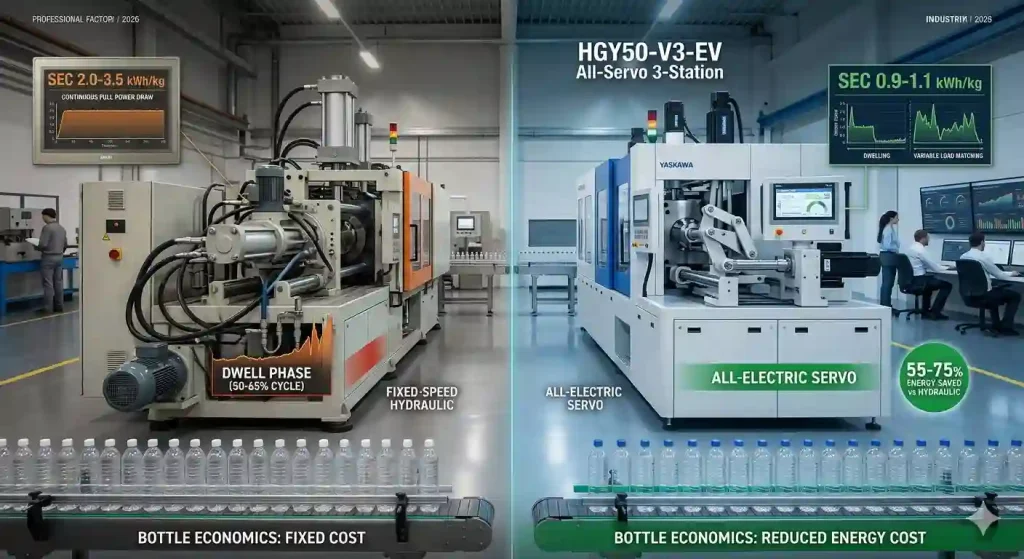
In a conventional hydraulic ISBM machine, a fixed-speed electric motor drives a hydraulic pump continuously, maintaining system pressure in a hydraulic accumulator from which all machine movements draw power. The fundamental inefficiency of this design is structural: the pump runs at full speed and full power regardless of whether the machine is performing a high-force clamping operation, a low-force indexing movement, or simply dwelling at a station with no movement at all. During the dwell phases of the ISBM cycle — which collectively represent 50%–65% of total cycle time — the hydraulic pump is consuming electrical energy while doing essentially no useful work. This energy is dissipated as heat in the hydraulic oil, which must then be removed by the oil cooling circuit, consuming additional cooling energy.
Hydraulic systems also suffer from throttle losses — energy dissipated as heat when high-pressure oil flow is throttled through control valves to achieve the lower-force, lower-speed movements that dominate most of the ISBM cycle. Every throttle valve in the system represents a continuous energy drain during operation.
Servo-Hydraulic Systems: The First Step
Servo-hydraulic systems replace the fixed-speed motor driving the hydraulic pump with a servo motor capable of variable-speed operation. The servo motor adjusts its speed — and therefore its power consumption — to match the instantaneous hydraulic demand. During dwelling phases, the servo motor decelerates to near-zero speed, consuming only a fraction of its rated power while maintaining minimum system pressure through a small accumulator.
Research published in peer-reviewed polymer processing journals demonstrates that switching from a conventional fixed-displacement hydraulic pump to a servo-driven fixed-displacement pump can reduce energy consumption by 41–50% in injection molding dry-cycle testing. In production operation — including all real cycle phases — servo-hydraulic machines typically demonstrate 30–45% energy savings versus conventional hydraulic equivalents on the same machine size and production cycle.
The additional advantage of servo-hydraulic systems is that they maintain all the force advantages of hydraulic actuators — the high clamping forces, large stroke capabilities, and robust shock resistance of hydraulic cylinders — while dramatically reducing the energy penalty. For ISBM applications requiring very high injection clamping forces (300 kN and above), or blowing clamping forces needed for large containers with wide projected areas, servo-hydraulic remains the preferred architecture because fully electric linear actuators of comparable force capacity are significantly more expensive.
All-Electric (Full Servo) ISBM Machines: Maximum Efficiency
All-electric ISBM machines replace all hydraulic actuators with servo motors and servo-driven mechanical mechanisms — typically ball screws, toggle linkages, or rack-and-pinion drives for clamping, and servo-driven extruder screws for injection. The elimination of the hydraulic system entirely removes the largest inefficiency source in the machine.
Published energy consumption benchmarks from the injection molding industry indicate that fully electric machines achieve specific energy consumption (SEC) values of 0.9–1.1 kWh/kg of plastic processed, compared to 2.0–3.5 kWh/kg for conventional hydraulic machines on equivalent applications. This represents an energy saving of 55–75% versus conventional hydraulic operation. For ISBM machines specifically, field data from installed all-servo configurations consistently show energy savings of 45–65% compared to equivalent hydraulic platforms.
Beyond energy consumption, all-electric ISBM machines offer additional operational advantages: the absence of hydraulic oil eliminates the oil contamination risk critical in pharmaceutical and food-contact bottle production, reduces maintenance requirements (no oil changes, no filter replacements, no seal leaks), and eliminates oil cooling system costs. The servo drives on all primary axes also deliver higher positional precision than hydraulic actuators, contributing to tighter shot-weight repeatability and better dimensional consistency in the finished bottle.
2026 Energy Consumption Benchmark Comparison
| Drive Type | SEC (kWh/kg) | Energy vs Hydraulic | Capital Cost | ROI Period |
|---|---|---|---|---|
| Conventional hydraulic | 2.0–3.5 | Baseline | Lowest | — |
| Servo-hydraulic | 1.1–2.1 | –30 to –45% | Low–Medium | 18–30 months |
| All-electric (full servo) | 0.9–1.1 | –55 to –75% | Higher | 24–42 months |
SEC values are indicative benchmarks based on published industry data and manufacturer field reports. Actual values vary by application, bottle size, cycle time, and ambient conditions.
ESG and Carbon Reporting Implications for ISBM Operators
The European Union’s Corporate Sustainability Reporting Directive (CSRD) — which extends mandatory carbon footprint reporting to thousands of additional companies by 2026 — is creating a new commercial driver for energy-efficient packaging equipment investment. Major brand owners in food, personal care, and household products are increasingly requiring Scope 3 emissions data from their packaging suppliers, including the energy consumption per bottle or per kilogram of packaging produced. A packaging manufacturer operating all-electric ISBM machines can report a Scope 1+2 carbon intensity per bottle that is 55–70% lower than a competitor running conventional hydraulic equipment — a differentiating capability when tendering for contracts with ESG-committed brands.
In Australia, the government’s Safeguard Mechanism reform, with its declining baseline trajectory for large industrial emitters, creates an additional regulatory incentive for energy efficiency investment in manufacturing facilities above the 25,000 tonne CO₂-equivalent threshold.
Selecting the Right Drive Technology for Your Application
The optimal drive technology selection depends on your specific production application, volume, and capital budget. The HGY50-V3-EV all-servo 3-station ISBM machine represents the all-electric architecture’s best-in-class energy efficiency, with Yaskawa servo motors across all axes delivering the lowest energy consumption per bottle of any ISBM platform in its size range. For pharmaceutical, food-contact, and premium cosmetic applications where the elimination of hydraulic oil is also a quality and compliance requirement, the all-electric architecture is the only appropriate choice regardless of the energy cost calculation.
For high-force applications — large containers above 5L, wide-mouth jars with high blow clamping force requirements, or very high-cavity-count molds — the servo-hydraulic architecture in the one-step ISBM machine range delivers the best balance of force capability and energy efficiency, capturing 35–45% of the energy savings of the all-electric option at a lower capital cost increment over conventional hydraulic platforms.
The energy economics of drive technology selection in 2026 firmly favour servo-driven ISBM machines. With global electricity costs rising and carbon reporting obligations expanding, the question is no longer whether to invest in servo technology — it is whether to invest in servo-hydraulic or all-electric based on your specific application requirements and capital budget.
editor:WM