
3-Station vs 4-Station vs 6-Station ISBM Machines: The Complete 2026 Buyer’s Guide
Pick the wrong station configuration and you either burn 30% more capex than needed, or starve your line of 40% the output it could have delivered. Here’s how to get the decision right.
Why This Choice Decides Your Next 5 Years
Every injection stretch blow molding (ISBM) machine rotates preforms through a fixed number of working stations before a finished bottle drops out. Three, four, and six stations are the three layouts you will encounter from almost every serious one-step ISBM builder worldwide — and the choice between them shapes everything downstream: cycle time, bottle wall quality, cavity count, tooling bill, energy draw, floor space, operator headcount, and the realistic ceiling on what you can produce when your business scales.
Most procurement teams we speak with start this comparison thinking it is mostly a price question. Within two weeks of research they realise it is a production-fit question. The cheapest machine that cannot meet your quality spec costs more than the pricier machine that does. A 6-station line sitting idle at 40% utilisation costs far more than a 4-station line sweating at 92% utilisation. The right answer depends on your bottle, your volume curve, and your capital runway — not on a spec-sheet beauty contest.
This guide walks through every meaningful difference between 3-station, 4-station, and 6-station one-step ISBM machines, with the numbers and applications we have seen across pharma, cosmetic, food and beverage, and household chemical clients. Use it as a working document with your engineering and finance teams.
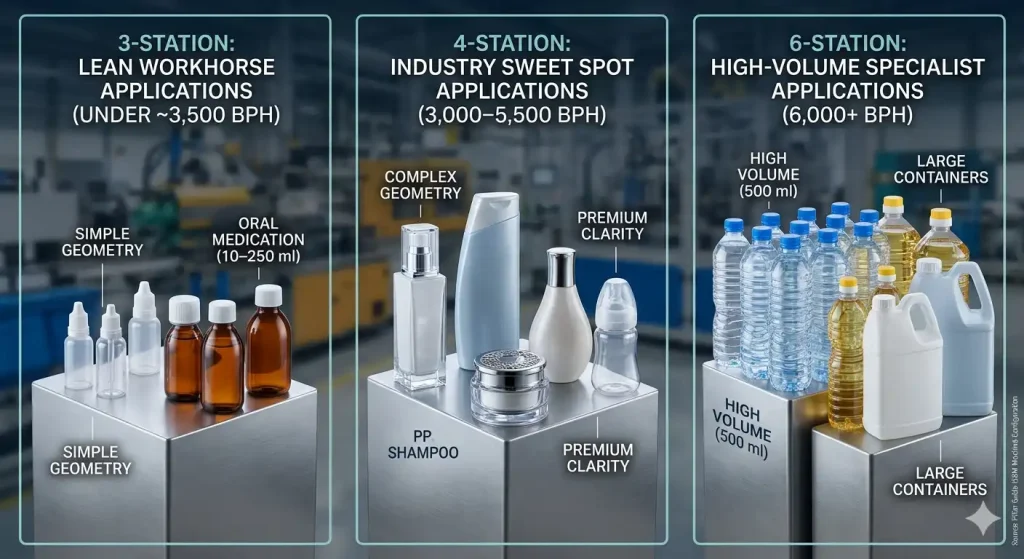
3-स्टेशन — fastest payback, simplest machine, best for short-run custom bottles and small-to-mid volume pharma/cosmetic producers under ~3,500 BPH per line.
4-स्टेशन — the sweet spot most brands land on. An added conditioning station lifts wall-thickness consistency and lets you run complex bottle geometries at 3,000–5,500 BPH. Covers roughly 80% of real-world ISBM demand.
6-स्टेशन — for high-volume beverage, water, and mass-market packaging only. Capital cost steps up 2–3× vs 4-station; ROI math only works when you run at high utilisation for 6,000+ BPH.
What a “Station” Actually Is
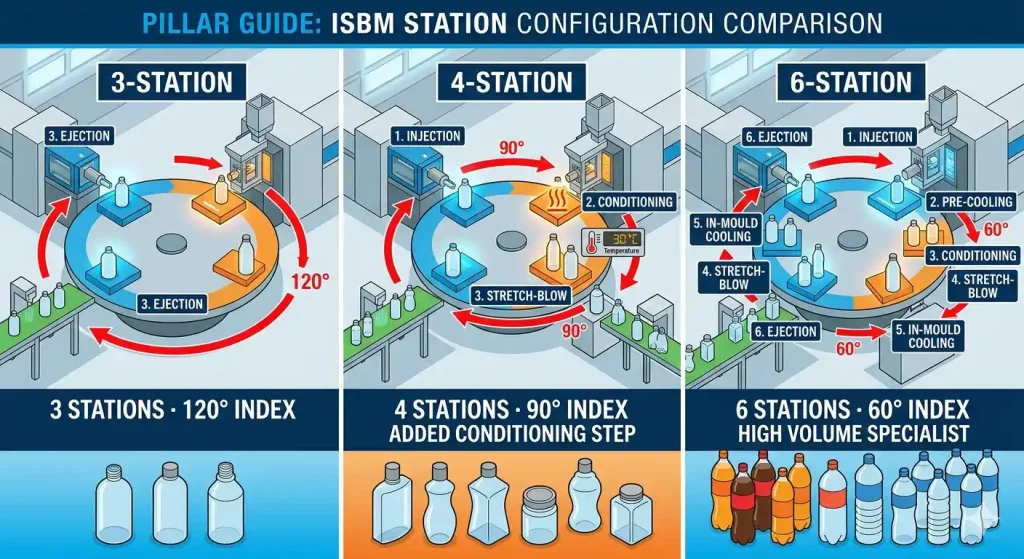
In a one-step injection stretch blow molding machine, preforms ride on a rotary indexing table or transfer plate. The table rotates by a fixed angle each cycle so that every preform visits every station in sequence. The geometry is simple: 360° ÷ number of stations = the angle between stations.
- 3 stations spaced 120° apart — injection, stretch-blow, ejection.
- 4 stations spaced 90° apart — injection, conditioning (temperature equalisation), stretch-blow, ejection.
- 6 stations spaced 60° apart — injection, pre-conditioning, conditioning, stretch-blow, cooling/trim, ejection (configurations vary by builder).
Every extra station is an extra chance to do something useful to the preform — typically to bring its temperature profile, wall distribution, or cooling curve closer to ideal. Extra stations also split the total cycle time into smaller slices, so adding stations usually shortens the time per slice and lifts throughput. But they cost more to build, consume more floor space, and add mechanical complexity.
3-Station ISBM Machines: The Lean Workhorse
How It Works
A 3-station machine carries the preform through three 120° indexes: injection (where molten resin fills the preform cavity), stretch-blow (where the preform is stretched axially and inflated radially into the final bottle shape), and ejection (where the finished bottle is discharged). Critically, a 3-station layout uses the latent heat from injection to blow the bottle — there is no separate reheat or conditioning station. This eliminates energy cost for reheating and keeps the machine compact.
Strengths
- Lowest capital cost — expect 40–55% less than a comparable 4-station line.
- Smallest footprint — 8–12 m² is typical. Good fit for retrofitted plants in Sydney, Melbourne, or SE Asia where floor space is premium.
- Lowest tooling cost — fewer cavity plates and neck plates means mould investment drops roughly 25% versus 4-station equivalents.
- Fast changeover — simpler mechanics make mould swaps quicker, which matters if you run 6–15 SKUs.
Limitations
- No conditioning step means less control over preform temperature profile — wall distribution is adequate but not excellent.
- Best suited to simpler bottle shapes. Complex geometries (sharp shoulders, asymmetric bases, wide-to-narrow transitions) are harder to hold to spec.
- Realistic upper ceiling is ~3,500 BPH per line for a 250 ml PET bottle. Scaling beyond that usually means running parallel machines.
Who Should Pick 3-Station
Startup brands, contract packagers with <2 million bottles/month total demand, pharmacy-grade oral liquid and dropper bottle producers, cosmetic sample-size bottle runs, and any facility where quick SKU switching matters more than peak throughput. This is also the smart choice when your bottle geometry is forgiving — round cylindrical, gentle shoulders, uniform wall spec.
4-Station ISBM Machines: The Industry Sweet Spot
Full disclosure: this is the configuration we build most of, because it is the one the market rewards. Here is the engineering reason why.
How It Works
A 4-station layout adds one station — the conditioning station — between injection and stretch-blow. After the preform is injected, it rotates 90° to a conditioning position where its temperature is equalised across the wall thickness. The outer skin, which cools faster after injection, is allowed to catch up with the core. Only then does the preform enter the stretch-blow station.
That extra 90° step matters more than it sounds. Preform temperature uniformity is the single largest driver of bottle wall consistency, stress whitening, burst pressure, and top-load strength. A preform blown with a 5 °C internal gradient produces a visibly different bottle from one blown with a 1 °C gradient — one passes a drop test at 1.2 m, the other fails at 0.9 m.
Strengths
- Bottle quality climbs measurably — wall thickness deviation typically drops from ±8% (3-station) to ±3–4% (4-station) on the same bottle spec.
- Handles complex geometries — asymmetric bases, pearl shapes, heart-shaped cosmetic bottles, square pharmaceutical bottles, cosmetic jars with wide shoulders are all comfortable on 4-station.
- Higher cavity counts — typical range 4 to 16 cavities depending on bottle size, vs 2 to 8 on 3-station.
- Better BPH per square metre — output per floor area is actually higher than 3-station despite the larger footprint.
- Broader material envelope — runs PET, PP, PC, PCTG, PETG, and Tritan with mould/temperature profile changes only.
Limitations
- Capital cost is higher — generally 1.8–2.2× a comparable 3-station line.
- Footprint grows to 12–18 m² for mid-sized models.
- More stations mean more cavity plates and neck rings — initial tooling investment rises accordingly.
Who Should Pick 4-Station
Premium cosmetic brands, pharmaceutical OEMs producing 3–15 million bottles/month, baby care brands requiring PPSU/Tritan with strict clarity, bottled water and juice producers in the 3,000–5,500 BPH band, and any contract manufacturer who needs the flexibility to quote both simple and complex SKUs without turning work away. If you are buying your second ISBM line and you already know you want room to scale, this is almost always the answer.
6-Station ISBM Machines: The High-Volume Specialist
How It Works
A 6-station machine splits the production cycle into six slices of 60°. Typical layouts include injection, pre-cooling, conditioning, stretch-blow, in-mould cooling/trim, and ejection. Some builders variate — for example, reserving two slots for sequential injection of multi-layer preforms, or for extended cooling of thick-walled bottles.
The payoff is parallelism. While one preform is being injected, another is being blown, another is being ejected, and so on. Cycle time per individual preform increases, but the total throughput per minute climbs steeply because six preforms are being worked on simultaneously.
Strengths
- Highest throughput — 6,000 to 12,000+ BPH on a single machine is realistic for mid-size bottles.
- Best bottle quality — the extra cooling and conditioning slots eliminate almost all thermal defects; wall deviation can hit ±2%.
- Ideal for thick-walled or large bottles — the extra cooling station lets you run 1.5–5 L containers cleanly.
- Economies of scale on labour — one operator typically oversees output that would need 2–3 smaller lines.
Limitations
- Capital cost is the deal-breaker for most buyers — typically 2.5–4× a 4-station line.
- Floor space requirement can hit 28–40 m² including auxiliaries.
- Mould and tooling costs scale up — budget 40–60% more than 4-station equivalents.
- Changeovers take longer; does not suit operations with frequent SKU switching.
- Below 60–65% utilisation, the ROI collapses — fixed costs eat the margin.
Who Should Pick 6-Station
Bottled water plants with 20M+ bottles/month, major beverage brands with dedicated lines per SKU, large-scale edible oil and household chemical producers, pharmaceutical majors serving multiple markets from a single facility, and OEMs who already run 2–3 smaller lines at near-full capacity and want to consolidate onto one high-output platform.
Head-to-Head: The Numbers That Actually Matter
1. Output & Cycle Time (250 ml PET Bottle Benchmark)
| Metric | 3-स्टेशन | 4-स्टेशन | 6-स्टेशन |
|---|---|---|---|
| सामान्य गुहा गणना | 2–8 | 4–16 | 6–24 |
| Cycle time (s) | 8–12 | 10–14 | 12–16 |
| आउटपुट (बीपीएच) | 1,500–3,500 | 3,000–5,500 | 6,000–12,000 |
| Annual capacity (3-shift, 85% uptime) | ~18–26M | ~28–42M | ~50–90M |
2. Capital Cost & Payback
Machine prices vary widely by builder country, servo/hydraulic drive choice, brand of PLC, and auxiliaries included. The ranges below are what typical APAC-origin one-step ISBM machines cost FOB in 2026, excluding moulds and freight.
| Cost Line | 3-स्टेशन | 4-स्टेशन | 6-स्टेशन |
|---|---|---|---|
| Machine (USD, FOB) | $80k–$180k | $150k–$350k | $400k–$900k+ |
| Initial mould set (8-cav equivalent) | $18k–$35k | $28k–$55k | $45k–$90k |
| Typical payback (mid-volume producer) | 10–16 months | 14–22 months | 22–36 months |
The inversion point is around 3,500 BPH average demand. Below it, the 3-station wins on ROI. Between 3,500 and 5,500 BPH, the 4-station dominates. Above 6,000 BPH sustained, the 6-station starts to justify itself.
3. Bottle Quality & Wall Distribution
| Quality Indicator | 3-स्टेशन | 4-स्टेशन | 6-स्टेशन |
|---|---|---|---|
| दीवार की मोटाई में विचलन | ±6–8% | ±3–41टीपी3टी | ±2–31टीपी3टी |
| Top-load strength consistency | Good | Very good | Excellent |
| Suitable for asymmetric geometry | Limited | Yes | Yes |
| Clarity / optical quality | Good | Excellent | Excellent |
4. Energy Consumption per 1,000 Bottles
One-step ISBM already beats two-stage reheat by a wide margin because no reheat tunnel is needed. Among one-step configurations, energy efficiency per 1,000 bottles actually improves as station count rises — because each station carries a smaller share of the cycle.
| Metric | Two-Stage (reference) | 3-Stn | 4-Stn | 6-Stn |
|---|---|---|---|---|
| kWh per 1,000 bottles | 0.55–0.75 | 0.38–0.50 | 0.32–0.44 | 0.28–0.40 |
| Installed power (kW, mid-size) | 35–55 | 18–30 | 25–45 | 45–90 |
Application Matchmaker: Which Configuration for Which Industry
3-स्टेशन for dropper, eyedropper, oral liquid, syrup bottles (10–250 ml). 4-स्टेशन when GMP demands tighter wall consistency or for wide-mouth pharma jars.
4-स्टेशन is near-universal here. Complex shapes, high clarity, branded feel all need the conditioning station.
4-स्टेशन for Tritan, PPSU, PP baby bottles. The conditioning step is essential for the clarity these brands demand.
6-स्टेशन once you cross 15M bottles/month sustained. Below that, 4-station at higher cavity count is more economical.
4-स्टेशन for 500 ml – 2 L formats; 6-स्टेशन when output sustainably exceeds 7,000 BPH.
3 or 4-station depending on viscosity of final product and bottle geometry. Complex trigger-sprayer necks push toward 4-station.
The Three-Question Decision Framework
Strip the decision down to three questions, answered honestly.
What is your sustained peak BPH demand over 12 months?
Below 3,500 → 3-station. Between 3,500–5,500 → 4-station. Above 6,000 → 6-station.
How complex is your bottle geometry?
Simple cylindrical shapes → 3-station is fine. Shaped shoulders, asymmetric bases, high clarity demands, trigger-sprayer necks → 4-station minimum.
How many SKUs will this line run in year 1?
More than 10 SKUs → 3 or 4-station (faster changeovers). One to three SKUs at high volume → 6-station economics start to make sense.
Three Real-World Scenarios
Scenario A — Melbourne cosmetic startup, 80 ml serum bottle
Monthly demand: 180,000 bottles, growing 30% YoY. 12 SKUs across the product range. Geometry is a simple cylindrical bottle with a shouldered neck. Budget is constrained and speed-to-market is critical. Recommended: 3-station with 4-cavity mould. Line runs ~2,200 BPH when active, needs only 8–12 shifts per week, capital outlay stays under $150k USD including tooling. Upgrade path to 4-station when annual volume crosses 2.5M bottles.
Scenario B — Regional Australian pharmaceutical OEM, mixed portfolio
Monthly demand: 4.2M bottles across dropper, oral liquid, syrup, and small cosmetic contracts. 22 active SKUs. Geometry complexity ranges from simple dropper to wide-mouth cosmetic jar. Quality requirements are TGA-regulated. Recommended: two 4-station lines. Gives 4,500–5,000 BPH combined output at ~88% utilisation, redundancy for planned maintenance, and the conditioning station delivers the wall-thickness consistency that passes TGA audits without argument.
Scenario C — SE Asian bottled water co-packer, 500 ml single SKU
Monthly demand: 22M bottles, single 500 ml PET SKU, extremely price-sensitive market. Recommended: 6-station with 16-cavity mould. Output ~8,500 BPH at 85% utilisation. Despite the higher capital cost, energy and labour savings per 1,000 bottles drop roughly 18% versus running two 4-station lines, and payback clears 28 months.
Five Mistakes Buyers Keep Making
- Buying for year-5 demand instead of year-2 demand. Over-sizing is more expensive than adding a second line in 24 months. Idle capacity bleeds margin daily.
- Ignoring SKU count. A 6-station line running 15 SKUs spends 20% of its time in changeover. Two 4-station lines doing the same mix lose less than half that.
- Comparing machines only on price-per-BPH. Energy per 1,000 bottles, labour per 1,000 bottles, and scrap per 1,000 bottles together dwarf capital depreciation over a 7-year machine life.
- Forgetting mould and auxiliary costs. Machine price is 55–65% of the real total investment. Dryers, chillers, compressors, moulds, and tooling spare parts often add another $50k–$150k.
- Underestimating operator training. 6-station machines reward skilled operators; they punish unskilled ones. If your talent pipeline is thin, a 4-station line running at 92% is worth more than a 6-station line running at 58%.
Frequently Asked Questions
Is a 4-station ISBM machine always better than a 3-station?
No. “Better” depends on your bottle and volume. For simple geometries below 3,500 BPH, a 3-station is faster to pay back. The 4-station wins on quality and complex shapes, not on price.
Can a 4-station machine run the same moulds as a 3-station?
Usually no. Station spacing, neck ring mounting, and plate geometry differ. Moulds are machine-specific in almost all cases — budget new tooling when you change configuration.
What is the typical lifespan of an ISBM machine?
12–18 years with routine maintenance. Cross kits, hot runners, and hydraulic seals get replaced every 3–6 years. The base frame and indexing drive typically last the full lifespan.
Do 6-station machines justify themselves for premium cosmetic brands?
Rarely. Premium cosmetic SKU volumes almost never sustain the BPH threshold needed for 6-station economics. Brand owners are better served by two or three 4-station lines with quick changeovers.
How long is the typical delivery lead time?
3-station standard builds: 60–90 days. 4-station standard builds: 75–110 days. 6-station: 110–150 days. Custom configurations add another 20–30 days.
What utilities and auxiliaries do I need alongside the machine?
A material dryer (for PET/PC/Tritan), a chiller (for mould cooling), an air compressor (for blowing — usually 30–40 bar), and compressed air treatment. For pharma applications, add HEPA filtration and cleanroom-grade enclosures.
Most buyers are best served by 4-station — here is how to confirm it for your project
Across the pharma, cosmetic, baby care, and beverage projects we have shipped from our Sydney base, roughly 80% have landed on the 4-station configuration for one honest reason: it gives the quality premium brands demand, at a capital cost that mid-sized producers can actually finance, with the flexibility to run diverse SKUs. If your annual demand sits between 25 and 40 million bottles and your geometry has any complexity at all, this is the default answer.
Send us your bottle specification, target monthly volume, and SKU list. Our engineers come back within 12 working hours with a machine recommendation (3, 4, or 6-station), a tooling quotation, a utilities checklist, and an ROI worksheet. No sales pressure, just the numbers.
- One-Step vs Two-Stage Injection Stretch Blow Molding: Full Comparison
- PET, PP, PC, Tritan: Which Resin Suits Which ISBM Machine
- ISBM Machine Buying Checklist — 17 Specs to Verify Before Signing the PO
- Cycle Time Optimization: Getting 28% More Output from a 4-Station ISBM