
Industry Application Series — Baby & Infant Product Packaging
Three-Station Blow Molding Machine for Baby Feeding Bottles: BPA-Free Tritan, PETG & PC Production with One-Step ISBM
No product category in plastic packaging carries higher safety stakes than baby feeding bottles. The bottle that delivers an infant’s daily nutrition is in direct contact with a consumer who cannot evaluate or report any material safety concerns — making the manufacturer’s and the packaging producer’s responsibility for material safety and production hygiene absolute rather than relative. When parents and procurement managers at baby product brands specify a feeding bottle, they are asking not just about aesthetics and function but about the entire material, process, and safety validation chain that stands behind the product.
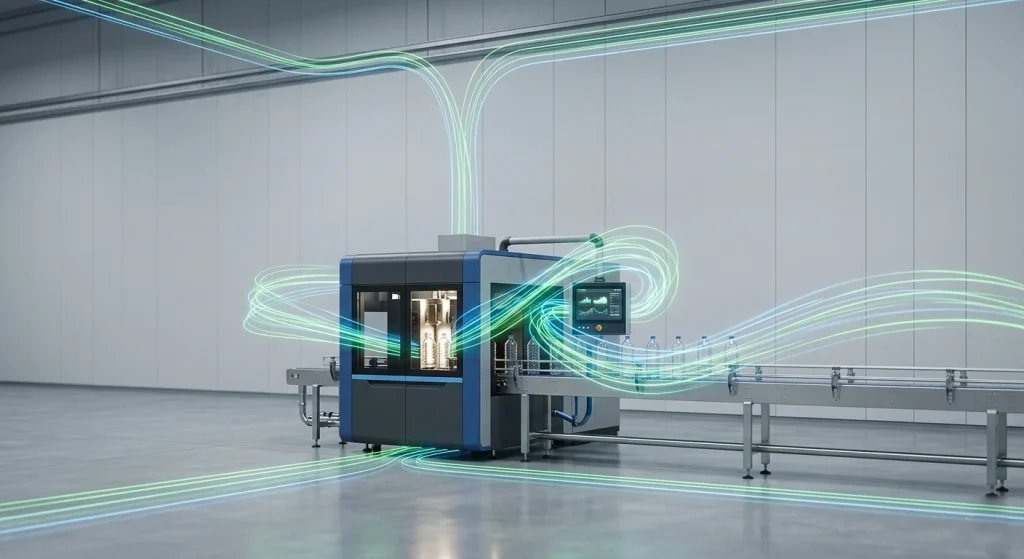
The Macchina per stampaggio a soffiaggio a tre stazioni HGY50-V3-EV from AUS isbmblowmolding Co., Ltd addresses this responsibility through its combination of BPA-free material compatibility (Tritan, PETG, PC), one-step closed-environment production that eliminates contamination exposure, and full-servo precision control that delivers the dimensional consistency required for safe, leak-free closure performance. This article provides a comprehensive technical review of three-station ISBM production for baby feeding bottles — covering material selection, safety standards, production process, and commercial considerations for manufacturers in Australia, the UK, South Korea, and other key markets.
Material Selection for Baby Bottles: Tritan, PETG, and PC Compared
The material selection decision for baby feeding bottle production is driven by the twin requirements of demonstrated BPA-freedom and documented infant safety, combined with practical performance requirements: optical clarity for volume graduation visibility, thermal resistance sufficient for sterilisation cycles, mechanical durability for repeated drop resistance, and chemical resistance to the cleaning agents used in bottle sterilisation. The three-station ISBM process supports all three of the principal materials used in modern baby bottle production.
Tritan (Eastman TX1001 / TX2001 and equivalents)
Tritan copolyester has become the de facto premium material for baby feeding bottles globally since the BPA controversy that affected polycarbonate in 2008–2012. Tritan is a non-bisphenol copolyester that is inherently free of BPA, BPS, and other bisphenol compounds — not as a material modification but as a fundamental consequence of its chemical structure. It delivers glass-like optical clarity, excellent heat resistance to 100°C (permitting steam and UV sterilisation), outstanding impact resistance for a transparent polymer, and chemical resistance to the alkaline cleaning agents (sodium hypochlorite, Milton solution) used in infant bottle sterilisation.
The three-station ISBM process is documented as being well-suited to Tritan processing. Unlike extrusion blow moulding, which can introduce thermal degradation in Tritan at the higher shear rates of an extrusion screw, the ISBM process’s controlled injection and retained-heat blow stage allows Tritan to be processed within its optimal thermal window, preserving clarity and impact strength in the finished bottle. Multiple ISBM machine manufacturers, including suppliers using the same equipment architecture as the HGY50-V3-EV, have demonstrated Tritan baby bottle production with wall thicknesses of 0.8–2.0 mm across the standard bottle volume range.
PETG
PETG is a cost-effective alternative to Tritan for entry-to-mid-range baby bottle production. It offers excellent optical clarity and is inherently BPA-free, making it compliant with EU Commission Regulation 321/2011 (which bans BPA from polycarbonate baby bottles) and equivalent regulations in Australia and South Korea. PETG’s heat resistance is lower than Tritan — typically rated to 70–75°C — meaning it is not suitable for steam sterilisation but can be used with cold-water sterilising tablets. For brands positioning their baby bottles at accessible price points in markets where cold sterilisation is the standard practice, PETG processed on the HGY50-V3-EV delivers excellent optical and mechanical performance at lower resin cost than Tritan.
Polycarbonate (PC)
While PC baby bottles have been banned in the EU, Canada, and several other markets since 2011 due to BPA migration concerns, PC remains in use for baby bottles in certain markets where regulatory frameworks have not enacted the same ban. Where PC is permitted and specified, the three-station ISBM process is capable of processing PC grades, and the material offers superior heat resistance and impact strength compared to PETG or Tritan. Manufacturers must verify current regulatory status in their target market before specifying PC for baby bottle production.
Why One-Step ISBM Is the Right Process for Baby Bottle Production
Contamination-Free Closed-Loop Production
For baby bottles, the production process hygiene standard is effectively as high as pharmaceutical packaging. The infant’s immune system is not fully developed, and the feeding bottle’s interior is in direct contact with formula or breast milk that will be consumed without further heat treatment in many feeding scenarios. Any particulate contamination deposited inside the bottle during production — resin particles, dust, oil mist — represents a direct infant safety risk.
The one-step three-station ISBM process, as implemented on the HGY50-V3-EV’s all-electric servo platform, addresses this risk systematically. There is no hydraulic oil in the system that could become aerosolised and contaminate bottle interiors. The blow air contacts the bottle interior directly during the blow stage — which is why oil-free compressed air is specified as mandatory auxiliary equipment. The closed-loop, single-machine production sequence eliminates every preform handling step that could deposit particulates on preform surfaces prior to blow moulding.
Dimensional Precision for Leak-Free Teat and Closure Engagement
A baby feeding bottle’s silicone or latex teat is attached to the bottle body by a collar ring that engages the bottle neck thread. For the teat assembly to be leak-free and for the assembly torque to be within the acceptable range for safe parental operation, the bottle neck thread dimensions must be produced to very tight tolerances — typically ±0.15 mm on all critical dimensions. The injection-stage neck formation of the ISBM process produces neck threads with this precision as a standard output, cycle after cycle, without requiring secondary machining or 100% inspection — making it the natural production process for the precision neck requirements of baby bottle production.
Volume Graduation Clarity and Wall Thickness Consistency
Baby bottles are volumetrically graduated — parents must be able to read the ml graduation markings printed or moulded into the bottle surface accurately in order to prepare feeds at the correct concentration. This requires that the bottle wall be uniformly clear and consistent in thickness across the graduation zone, so that the meniscus of the liquid inside is clearly visible and legible from the graduation marks. Inconsistent wall thickness from a poorly controlled production process creates optical distortion that makes graduation reading difficult or inaccurate — a functional safety issue in the context of infant formula preparation. The biaxial orientation achieved in the ISBM stretch-blow stage produces uniform wall thickness with substantially lower variation than extrusion-blow or unoriented moulding processes.
Regulatory Standards for Baby Bottles in Key Markets
🇦🇺 Australia — ACCC / FSANZ
Australia banned BPA in polycarbonate baby bottles in 2010 via voluntary industry phase-out enforced by ACCC action. Food Standards Australia New Zealand (FSANZ) governs migration limits for materials in contact with infant foods. Tritan and PETG comply when food-contact grade resins are used.
🇪🇺 EU / Netherlands — Reg. 321/2011
EU Commission Regulation 321/2011 prohibits BPA in polycarbonate baby bottles across all EU member states. Tritan (non-PC, non-BPA copolyester) and PETG are fully compliant. EU 10/2011 overall migration limits apply to the finished container.
🇬🇧 United Kingdom — MHRA / FSA
The UK retains the BPA ban on polycarbonate baby bottles post-Brexit. Food Standards Agency (FSA) governs food contact materials regulation, aligned with former EU framework. Tritan and PETG baby bottles are fully permitted.
🇰🇷 South Korea — MFDS
The Korean Ministry of Food and Drug Safety (MFDS) has restricted BPA in baby bottles since 2012. Korean baby bottle manufacturers and exporters must use BPA-free materials and comply with MFDS standards for plastic food contact materials. Tritan-brand copolyesters are widely used in the Korean premium baby bottle segment.
Standard Baby Bottle Production Specifications on the HGY50-V3-EV
Baby feeding bottles produced on the three-station ISBM machine cover the standard volume range for the global infant feeding market:
- Newborn stage (60 – 90 ml): Small-volume round bottles for newborn feeding. High clarity for accurate volume graduation reading. 2–4 cavities per cycle.
- Standard stage (120 – 150 ml): Mid-volume bottles for infants up to 6 months. Wide-mouth neck (typically 40–50 mm) for teat assembly attachment. Tritan or PETG material.
- Follow-on stage (250 – 330 ml): Larger bottles for older infants on higher feed volumes. Round body with wide neck. 1–2 cavities per cycle depending on bottle size and injection shot weight.
- Toddler drinking bottles (300 – 500 ml): Training cup formats transitioning from infant feeding to toddler drinking. Tritan for heat resistance; PETG for cost-effective entry segment.
Commercial Considerations: Baby Bottle Production for Export Markets
Baby bottle manufacturing for export markets requires careful attention to both the product’s material certification and the machine’s documentation trail for regulatory submission purposes. AUS isbmblowmolding provides machine documentation packages that support manufacturers’ regulatory submissions in major export markets, including CE certification for the machine itself and technical data supporting material compatibility validation.
The South Korean baby products market, in particular, represents a high-value export opportunity for manufacturers able to produce Tritan baby bottles meeting MFDS material standards. Korean parents demonstrate a strong preference for premium baby products with verifiable material safety credentials, and the ISBM-produced Tritan bottle — with its documented BPA-free material status and contamination-controlled production environment — is well-positioned in this market segment.
In Australia, the domestic baby bottle market is dominated by a small number of established brands, but private-label baby product programs for major retailers represent a growing opportunity for local manufacturers investing in ISBM production capability. Producing Tritan or PETG baby bottles domestically eliminates the lead times and minimum order quantities associated with imported bottles, allowing local manufacturers to respond to retailer demand with greater agility.
Produce Certified BPA-Free Baby Bottles with Confidence
Share your baby bottle specification — volume, material (Tritan / PETG / PC), neck diameter, regulatory market — and our engineering team will return a machine configuration and compliance documentation overview within 24 hours.
Frequently Asked Questions
editor:WM