
From cosmetic startups in Melbourne to pharmaceutical OEMs in Western Sydney, Australian packaging brands are quietly migrating from imported preforms and aging extrusion lines to one-step ISBM Australia production — and the reasons are mostly economic, not technical.
The Old Australian Bottle Supply Chain Is Breaking
For decades, smaller and mid-sized Australian brands relied on a familiar supply pattern: import preforms from Asia (typically China, Vietnam, or Thailand), store them in Sydney, Melbourne, or Brisbane warehouses, blow them on local two-stage reheat machines, and ship finished bottles to fillers and contract packagers across the country. Freight costs were tolerable, lead times sat around 8–12 weeks from PO to delivered preform, and warehouse rent was a manageable line item on the operating budget.
Three things have shifted that calculation since 2023, and the cumulative effect is reshaping how Australian brands think about bottle supply. Container freight from Asia became unpredictable — what was once a routine 5–6 week ocean transit now ranges from 4 to 14 weeks depending on port congestion, vessel availability, and carrier schedule reliability. Sydney and Melbourne industrial warehouse rent climbed past AUD 240 per square metre per year in many regions, pushing the cost of holding 60–120 m² of preform inventory into uncomfortable territory for mid-volume brands. And FSANZ traceability requirements made multi-stop supply chains harder to audit, with brand owners increasingly asked by retailers (especially major supermarkets and pharmacies) to demonstrate single-source bottle provenance.
The combination has made in-house, one-step bottle production more attractive for any brand producing more than 200,000 bottles per month — a threshold that captures most premium cosmetic, contract pharmaceutical, specialty beverage, and household chemical brands operating in Australia today. The cost-benefit math, which used to favour outsourced bottle supply for any volume below 1 million bottles per month, has shifted decisively in favour of in-house production at far lower thresholds.
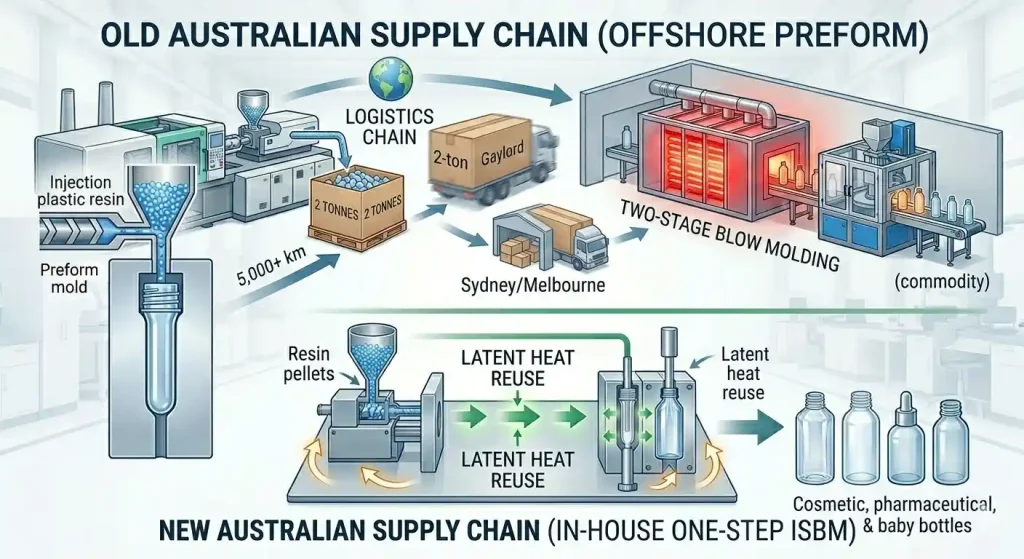
What Australian Buyers Actually Save
Reduction in cost per bottle vs imported preform + reheat blow workflow.
Eliminated from preform-shipment lead time, replaced by 2–4 hour resin-to-bottle cycle.
Average warehouse space recovered when preform inventory is no longer required.
Time-to-market for new bottle SKU launches versus tooling new preforms offshore.
These numbers come from working with Australian cosmetic, pharmaceutical, and specialty beverage clients during 2024 and 2025. The cost-per-bottle reduction varies by application — premium cosmetic brands moving from imported PCTG bottles to in-house one-step PCTG production typically see the higher end (30–35%), while commodity household chemical brands switching from imported PET preforms see the lower end (22–28%). The lead-time compression is more uniform: replacing an 8–12 week preform shipment cycle with a 2–4 hour resin-to-bottle cycle is transformative regardless of bottle category.
Three Australian Use Cases Driving the Shift
Premium Cosmetic Brands
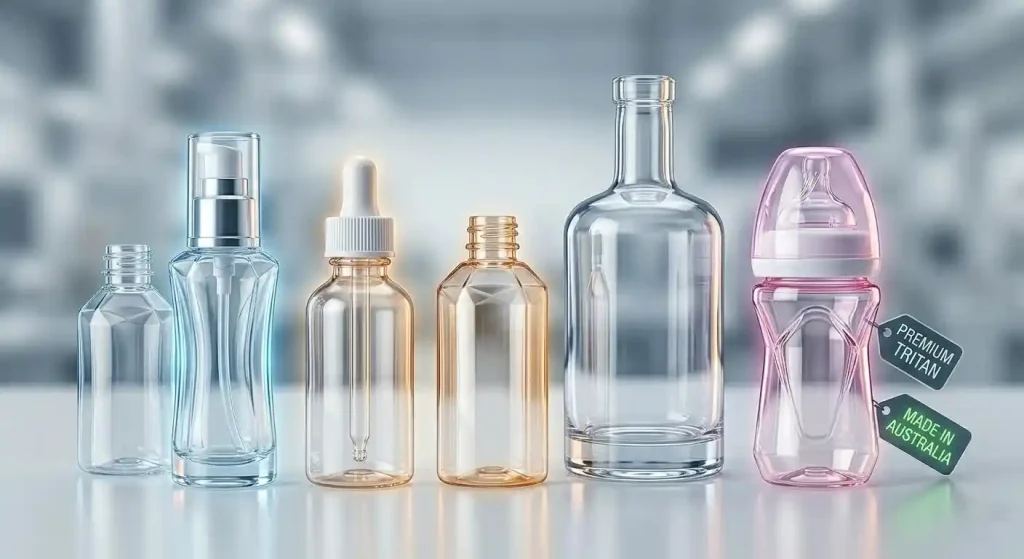
Australia’s premium cosmetic export sector — particularly skincare brands shipping to Asia, the Middle East, and the United States — needs custom bottle shapes that imported preforms cannot deliver economically in small runs. A typical premium serum or essence bottle launches at 50,000–200,000 units, which is far below the volume threshold at which offshore preform tooling becomes cost-effective. Imported preform programs in this volume range typically incur AUD 30,000–80,000 in tooling amortisation costs allocated across the small first run, plus 12–14 week lead times, plus shipping risk.
A 4-station one-step ISBM machine lets these brands produce shaped bottles in batches of 50,000 to 500,000 without offshore tooling delays. Mould tooling is sourced locally or from Australian-based mould makers, with lead times of 6–10 weeks instead of 14+. The conditioning station on a 4-station layout handles the asymmetric shoulder geometries premium cosmetic brands favour without the wall-thinning issues 3-station machines produce on the same shapes.
Pharmaceutical OEMs Serving TGA-Regulated Markets
Australian pharmacy and contract manufacturers face stringent traceability obligations under TGA regulation, with bottle batch records requiring full chain-of-custody documentation. Multi-stop supply chains — preform manufactured offshore, shipped, stored, blown, finished — create multiple audit checkpoints, each with its own documentation burden and its own potential failure mode for batch traceability.
One-step ISBM compresses the chain of custody radically. Resin enters one machine; finished bottles leave it. Batch records reduce to a single production run with a single shift log, simpler audit narratives, and faster TGA inspection sign-off. PP-grade bottles for syrup, oral liquid, dropper, eye drop, and antibiotic suspension applications all run cleanly on standard 4-station configurations. For pharmaceutical OEMs serving export markets in Asia and the Pacific, this audit simplification is often more valuable than the cost-per-bottle saving.
Specialty Beverage and Health Drink Producers
The wave of premium juice, cold-press, kombucha, protein shake, and functional beverage brands launching out of Sydney, Brisbane, and Melbourne wants bottle shapes that stand out on shelf. Two-stage reheat lines force these brands into generic bottle shapes — a bottle’s shape is locked in at the preform manufacturing stage, and preform inventory is shape-specific, so bespoke bottle shapes require dedicated preform tooling that small brands cannot economically justify.
One-step ISBM gives them shape freedom with batch-level economics. A specialty kombucha brand can run a 250 ml shaped bottle one week and switch to a 500 ml different shaped bottle the next, with mould swap times of 60–90 minutes and no offshore preform commitment. Larger producers serving multiple SKUs from one site often spec the EP-HGY650 V4 one-step ISBM machine for its higher cavity count and broader bottle size envelope (10 ml up to 1.5 L), which lets them consolidate multiple bottle programs onto one production line.
What Australian Buyers Should Verify Before Purchase
- Voltage and frequency: Australian standard is 415V/50Hz three-phase. Confirm the machine is configured for AS/NZS 3000 compliance, not 380V (Chinese standard) or 480V (North American standard). Wrong voltage configuration is the most common installation delay we see on imported machinery.
- Air compressor sizing: Sydney and Melbourne have variable summer humidity that can spike above 80% RH; specify a refrigerated air dryer rated for 35 °C ambient operation. Undersized compressed air systems cause intermittent bottle quality issues that are difficult to diagnose.
- Service coverage: Spare parts shipped from China typically take 7–14 days via air freight, longer via sea freight. Verify whether your supplier holds local stock in Australia or has a regional service office capable of dispatching technicians within 48 hours of an emergency call.
- FSANZ and TGA documentation: Resin compliance documentation should be available for any food, beverage, or pharmaceutical-grade application. Ask for migration test data and food contact compliance certificates specific to your resin grade, not generic polymer family approvals.
- Operator training: Confirm whether on-site commissioning and operator training in Sydney are included in the FOB price or quoted separately. Adequate training is typically 5–10 days on-site, with first-bottle production sign-off as the completion milestone.
- Warranty and after-sales: 12 months minimum warranty is standard; 24 months from a reputable supplier with local service coverage is increasingly common. Verify what is and is not covered — wear items like seals are typically excluded.
Local Service Reality
The biggest practical advantage Australian buyers have today is access to local technical support that does not depend on international shipping for spare parts and emergency response. Our Sydney office at 05 Harley Crescent, Condell Park NSW 2200 holds spare parts inventory for cross kits, hot runners, stretch rod assemblies, and high-wear items — meaning emergency stoppages are resolved in 24–48 hours rather than the 2–3 weeks typical of unsupported imports.
For brand owners who are operating production lines that cannot afford extended downtime — pharmaceutical batch deadlines, cosmetic seasonal launches, contract packaging commitments — this local support is often worth a 5–10% premium over the cheapest offshore option. We have seen multiple cases where two days of avoided downtime in the first six months of operation paid back the entire premium of choosing a locally-supported machine over an unsupported import.
Considering a local one-step ISBM line?
Электрондық пошта [email protected] with your monthly volume and bottle spec — our Sydney engineering team responds within 12 working hours with a configuration recommendation tailored to Australian utility, compliance, and service requirements.