
Industry Application Series — Food & Beverage Packaging
Three-Station Blow Molding Machine for Edible Oil Bottles: PET Food-Grade Container Production for Olive Oil, Vegetable Oil & Specialty Oils
The edible oil packaging sector presents a deceptively demanding set of technical requirements that are not always fully appreciated by manufacturers transitioning from general industrial packaging to food-grade production. A PET bottle holding 500 ml of extra-virgin olive oil or 1 litre of canola oil must simultaneously provide a gas and moisture barrier sufficient to protect oil quality over a shelf life of 12–24 months, maintain dimensional stability under the weight of stacking in palletised distribution, deliver optical clarity that allows the consumer to assess oil colour and clarity as a quality indicator, and remain chemically inert to lipid compounds over the entire product shelf life — all while being produced at a competitive per-unit cost on a food-contact-certified manufacturing platform.
The Үш станциялы үрлеу қалыптау машинасы HGY50-V3-EV from AUS isbmblowmolding Co., Ltd addresses each of these requirements through the combination of PET/PETG material processing, one-step ISBM production, and full-servo precision control. This article provides a detailed technical analysis of why three-station ISBM is well-suited to edible oil bottle production, covering material selection, regulatory compliance, production economics, and market context.
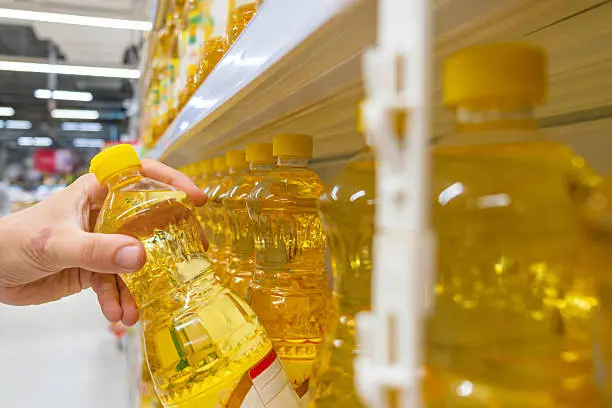
Why PET Is the Right Material for Edible Oil Bottles
The global edible oil industry has progressively migrated from glass and PVC packaging to PET over the past three decades, driven by PET’s superior combination of mechanical, optical, and barrier properties for food liquid applications. Understanding this migration explains why PET produced through ISBM represents the optimal material-process combination for edible oil bottles.
Oxygen Barrier Performance
Oxidative rancidity is the primary quality degradation mechanism in edible oils — especially in premium oils such as extra-virgin olive oil, cold-pressed avocado oil, and unrefined flaxseed oil that contain high concentrations of unsaturated fatty acids susceptible to oxidation. The oxygen transmission rate (OTR) of the bottle wall is therefore a critical packaging performance specification. Biaxially oriented PET produced through the stretch-blow process has significantly lower OTR than non-oriented PET or HDPE. The biaxial molecular orientation induced during the stretch-blow stage of the ISBM process — axial stretching by the mechanical stretch rod, radial expansion by blow air — organises the PET polymer chains into an aligned, dense layer that is inherently more resistant to gas diffusion.
This means that a PET oil bottle produced on the HGY50-V3-EV’s three-station ISBM platform has superior oxygen barrier performance to a comparable bottle produced by extrusion blow moulding without biaxial orientation — directly translating to longer product shelf life without the need for secondary barrier treatments or active oxygen scavengers.
Chemical Compatibility with Lipid Compounds
PET demonstrates excellent chemical resistance to edible oils, fats, and lipid compounds at the ambient temperatures at which cooking oils are stored and used. Unlike certain plasticised PVC materials used in older oil packaging, food-contact PET does not leach plasticisers into lipid-based food products. This makes PET the universally accepted material for direct food contact oil packaging under EU Regulation 10/2011 on plastic materials and articles intended to contact food, FDA 21 CFR for the United States market, and equivalent Australian food safety standards under FSANZ.
Optical Clarity for Product Quality Communication
Premium edible oils — extra-virgin olive oil, sesame oil, truffle oil — are products where the consumer’s quality assessment begins with the visual inspection of the product through the bottle. The golden-green colour of high-quality olive oil, the rich amber of sesame oil, the pale clarity of premium avocado oil — these visual cues communicate product provenance and quality at point of sale. The crystal clarity of biaxially oriented PET produced by ISBM allows these visual product attributes to be communicated without the optical distortion or surface scratching that affects glass bottles in handling and retail environments.
Food Safety and Regulatory Compliance Across Key Markets
| Market / Jurisdiction | Applicable Standard | PET/ISBM Compliance Status |
|---|---|---|
| European Union / Netherlands | EU Regulation 10/2011 | PET fully listed; migration limits met by food-contact grade resins |
| Australia / New Zealand | FSANZ Food Standards Code | PET approved for food contact; major food-contact resin grades available |
| United Kingdom | GB SI 2012/2619 (retained EU law) | Aligned with EU 10/2011; food-contact PET fully compliant |
| Brazil | ANVISA RDC 331/2019 | PET regulated and approved; certificate of conformity required from resin supplier |
| Colombia | Resolution 683/2012 MINSALUD | PET listed for food contact applications including edible oils |
A critical point for food packaging manufacturers is that the machine’s production process — specifically the use of oil-free compressed air in the blow stage — is non-negotiable for food-contact compliance. The HGY50-V3-EV’s all-servo design eliminates hydraulic oil from the production system, and the specification of an oil-free air compressor (as detailed in the machine’s auxiliary equipment layout) ensures that the compressed air that directly contacts the interior of the bottle during the blow stage carries no hydrocarbon contamination. This is an explicit food safety requirement for oil bottles, and one that must be verified during equipment specification.
Production Engineering: Edible Oil Bottle Specifications on the HGY50-V3-EV
Edible oil bottles produced on the three-station ISBM machine cover the standard retail oil volume range efficiently. Key engineering considerations include:
Volume Range and Cavity Configuration
The most common retail edible oil bottle formats — 250 ml, 500 ml, 750 ml, and 1,000 ml — all fall within the HGY50-V3-EV’s production range. At 500 ml, two to four cavities per cycle are typically configured depending on bottle diameter and the available injection shot weight. At 250 ml, higher cavity counts (four to six) are achievable. The machine’s theoretical injection volume of 239 cm³ and screw diameter of 40 mm support the preform weights required for these bottle sizes in food-contact PET grades.
Neck Finish and Closure Compatibility
Standard edible oil bottles in European and Australian markets use 28 mm, 30 mm, or 38 mm neck finishes, accepting dispensing caps with integrated drip-stop mechanisms or pour spouts. The injection-stage neck formation of the ISBM process produces these neck dimensions with high precision, ensuring consistent closure engagement and leak-free performance throughout the product’s distribution and retail life. Bottle height for standard 500 ml oil bottles is typically 230–260 mm, well within the machine’s bottle height capability.
Wall Thickness and Stacking Strength
Edible oil bottles must survive palletised distribution stacking loads. The biaxial molecular orientation produced during the stretch-blow stage increases PET’s tensile strength and top-load resistance significantly compared to unoriented material. A properly designed and correctly processed 500 ml PET oil bottle produced on the HGY50-V3-EV will typically exceed the top-load resistance requirements for standard palletised distribution — 30–50 kg per bottle — with wall thicknesses of 0.35–0.45 mm.
Production Economics: In-House ISBM vs. Imported Oil Bottles
For edible oil manufacturers in Australia, South America, and southern Europe who currently source PET oil bottles from external suppliers, the economics of in-house ISBM production deserve careful evaluation. The primary financial drivers are:
- Eliminate bottle purchase cost: The per-unit cost of producing PET oil bottles in-house on the HGY50-V3-EV — resin cost plus energy plus labour amortised — is typically lower than the delivered cost of equivalent purchased bottles, especially when accounting for shipping, minimum order quantities, and inventory carrying costs.
- Reduce inventory and logistics complexity: Preforms, which are the feedstock for in-house ISBM production, are significantly smaller and lighter than finished bottles — enabling substantial reduction in warehouse space requirements and inbound logistics cost compared to storing finished bottle inventory.
- Improve supply chain resilience: The supply chain disruptions of 2020–2022 exposed the vulnerability of food manufacturers dependent on imported packaging. In-house bottle production with locally sourced PET resin eliminates a critical supply chain dependency.
- Faster response to SKU changes: In-house ISBM production allows an oil manufacturer to respond to market opportunities — a new premium product line, a seasonal promotion, a private-label retailer contract — with new bottle specifications without long supplier lead times or minimum order quantity constraints.
Bring Your Edible Oil Bottle Production In-House
Our engineers will assess your oil bottle volume requirements, FDA/EU/FSANZ food contact compliance needs, and production scale to recommend the right ISBM configuration for your facility. Response within 24 hours guaranteed.
Frequently Asked Questions
editor:WM