
From 90,000 to 850,000 Bottles per Month — A Sydney Cosmetic Brand’s First Year With In-House ISBM
An ISBM machine case study documenting the operational and financial transition of a Western Sydney cosmetic contract manufacturer, anonymised at the client’s request.
Client: Cosmetic contract manufacturer, Western Sydney
Industry: Skincare and personal care, primarily serving Australian and Asia-Pacific brand owners
Products: 30 ml serum, 100 ml toner, 250 ml lotion bottles (PET and Tritan)
Project span: 14 months from PO to current state (commissioning + full production scale-up)
The Situation Before
The client had built a respectable contract cosmetic packaging business serving 14 brand owners across Sydney, Melbourne, Brisbane, and Auckland, filling and assembling bottles purchased from a Sydney-based bottle distributor. Monthly volume averaged 90,000 bottles across 22 SKUs. Margin per bottle was thin — around AUD 0.04–0.06 — because the bottle distributor’s markup absorbed most of the upside that flowed through to higher retail price points. Their core business was assembly, labelling, and filling; bottle supply was a cost pass-through with limited room to compete on.
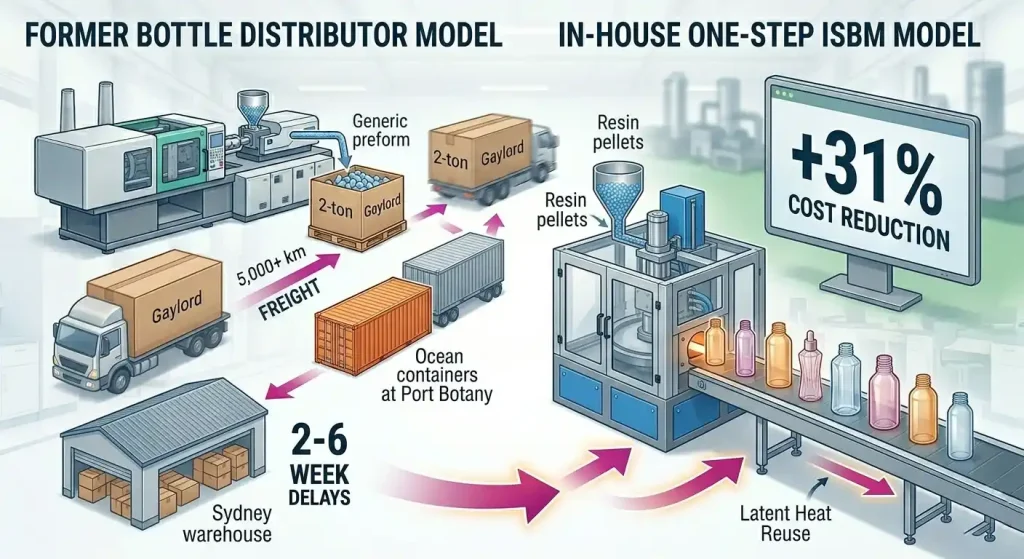
Three pressures accumulated through 2024 and early 2025 that forced a reconsideration of the supply model. Container freight from Asia became unreliable, with the bottle distributor passing through delays of 2–6 weeks on stock replenishment. The bottle distributor announced a 14% price rise effective Q3 2024, citing freight and resin cost pressures. And two important client brands threatened to take their business to competitors who could turn around custom bottle shapes faster — bottle shapes that the distributor’s stock catalogue did not include and that custom-tooled imports took 14+ weeks to deliver.
The choice crystallised: lose accounts and accept margin compression, or invest in in-house bottle production. The brand owners involved had clearly signalled willingness to pay more for faster turnaround on custom bottle shapes — meaning the upside of in-house production was not just cost reduction but new revenue capture from contract work the existing model could not service.
The Specification Process
Initial conversations explored three machine configurations: a single 6-station for maximum throughput, two 3-station machines for redundancy, and a single 4-station for balance. The 6-station option was ruled out fast — too much idle capacity at 90k–300k bottles per month, and changeover time too long for a 22-SKU operation. Capital cost (estimated AUD 750k+ all-in) was also outside the client’s investment authority threshold. The 3-station pair would cover volume but lacked the wall-thickness consistency needed for the Tritan baby-grade serum bottles one important client required.
The fit was a single HGYS150-V4 four-station one-step ISBM machine with a 6-cavity quick-change mould system. Capital outlay including auxiliaries (chiller sized for Western Sydney summer ambient at 40 °C, dryer for PET and Tritan, air compressor, conveyor, and basic vision inspection): AUD 412,000. Lead time from PO to commissioning: 88 days, including ocean freight from China to Sydney with 2 days customs clearance through Port Botany.
Mould tooling was sourced separately for the three primary bottle formats — 30 ml serum, 100 ml toner, 250 ml lotion. Total mould investment for the launch SKU set: AUD 78,000 across three 6-cavity moulds. The plan included budget for adding 4 more moulds during year 1 as additional client SKUs migrated onto the line.
Commissioning and First 90 Days
Installation took 6 days at the client’s Western Sydney facility. Two of our engineers travelled from Condell Park (about 35 km away) and stayed on-site through first-bottle production sign-off. The first SKU validated was a 100 ml PET toner bottle — line ran at 2,950 BPH against a target of 2,800 BPH, with wall deviation measured at ±3.2% on third-party QC inspection. First-bottle sign-off was achieved on day 5; commercial production started on day 7.
The first 90 days delivered 480,000 bottles across 8 SKUs, with two unplanned stoppages — both resolved within 4 hours by our local technician dispatched from the Sydney office. The first stoppage was a hot runner heater failure on the third week, replaced from local spares stock; the second was a stretch rod alignment drift on the eighth week, corrected during a planned changeover window. Operator training (3 staff) was completed in two phases of 4 days each, with documented training records cross-referenced to the client’s ISO 9001 quality management system.
12-Month Performance Data
| Monthly volume (month 12) | 850,000 bottles |
| Active SKUs running | 34 |
| Average wall thickness deviation | ±3.4% |
| Scrap rate | 0.6% |
| Average changeover time | 78 minutes |
| Cost per bottle (vs former distributor) | −31% |
| First-pass optical inspection rate | 99.4% |
| Payback achieved | Month 16 (forecast) |
The volume scale-up curve outpaced the original investment case by a meaningful margin. The plan submitted to the client’s board projected 350,000 bottles per month by month 6 and 600,000 by month 12. Actual performance hit 480,000 by month 4 and 850,000 by month 12 — driven primarily by new brand-owner accounts that came on board specifically because in-house bottle production unlocked custom shapes the previous supply chain could not support.
What Surprised the Client
Two things ran ahead of plan and reshaped the long-term strategy. First, new brand acquisition: with custom bottle shapes available in 6–8 weeks instead of 14 weeks via the previous import chain, the client added 5 new brand-owner accounts in the first 9 months. Three of those accounts had previously been quoted by the client and lost to competitors precisely because of bottle supply lead times — the same accounts came back when the lead-time constraint was removed.
Second, the conditioning station on the four-station machine handled Tritan baby-grade bottles cleanly without the calibration headaches the client had been warned to expect. The original commissioning plan budgeted 6–8 weeks of process refinement to dial in the Tritan bottle SKU; actual time to commercial production was under 3 weeks, with first-pass clarity inspection coming back at 99.4%. The brand owner running the Tritan bottle program subsequently increased monthly volume by 60% on the strength of consistent quality — a contract expansion the client had not modelled in their original investment case.
The original plan had been to add a second machine — likely the HGYS200 4-station ISBM machine for slightly larger bottle formats — in year 3. Current trajectory has that decision pulled forward to month 18, with capital approval already committed.
Lessons For Other Australian Brands Considering the Same Move
- Underestimate first-year volume by 15–25%. Contract work tends to grow once supply constraint is removed, often more than the original planning team expects. Build the investment case at the conservative volume number, but provision capital and operator capacity for the upside scenario.
- Budget for two operators trained, not one. Holiday cover, sick leave, and shift coverage matter more than the initial capital plan suggests. The marginal cost of training a second operator at commissioning is far lower than training someone in month 8 when production is fully ramped.
- Spec the chiller for Australian summer ambient (35–40 °C in Western Sydney during peak summer days) — a chiller sized for European ambient struggles in February and creates intermittent cycle-time issues that are difficult to diagnose without Australian field experience.
- Local service coverage is worth a 5–10% premium over the cheapest imported option. The two unplanned shutdowns in the first 90 days repaid that premium investment in the first six months — a single 2-week stoppage waiting for international spare parts shipment would have erased the cheapest-option saving entirely.
- Plan for SKU growth in the mould tooling budget. The client’s investment case assumed 8 SKUs by month 12; actual was 22. Provision capital for 50–80% more mould tooling than the launch plan calls for.
Have a similar project on your roadmap?
이메일 [email protected] with your monthly target and SKU list. Our Sydney team replies with a configuration recommendation, ROI projection, and case study reference within 12 working hours from our office at 05 Harley Crescent, Condell Park NSW 2200.