
Industry Application Series — Cosmetics & Personal Care Packaging
Three-Station Blow Molding Machine for Premium Haircare & Body Wash Bottles: High-Clarity PETG Personal Care Packaging
The premium haircare and body wash segment occupies a distinctive position within the personal care packaging industry. Unlike mass-market shampoo bottles, which are predominantly produced from HDPE using extrusion blow moulding, premium haircare products — salon-grade shampoos, colour-protecting conditioners, sulfate-free cleansers, and botanical body washes — are positioned as luxury or professional goods whose packaging must communicate that value clearly from the shelf. A thick-walled PETG bottle with glass-like optical clarity, a precisely moulded pump neck, and consistent wall uniformity that catches bathroom lighting speaks to quality in a way that a conventional HDPE bottle simply cannot.
This is the market segment where the Driestations blaasvormmachine HGY50-V3-EV from AUS isbmblowmolding Co., Ltd delivers clear competitive advantage. By processing PETG through a one-step injection-stretch-blow cycle, the machine produces premium haircare and body wash bottles with optical and dimensional characteristics that extrusion blow moulded HDPE cannot match — while doing so with the production efficiency and energy economy that make it commercially viable for mid-to-large-scale personal care manufacturers.
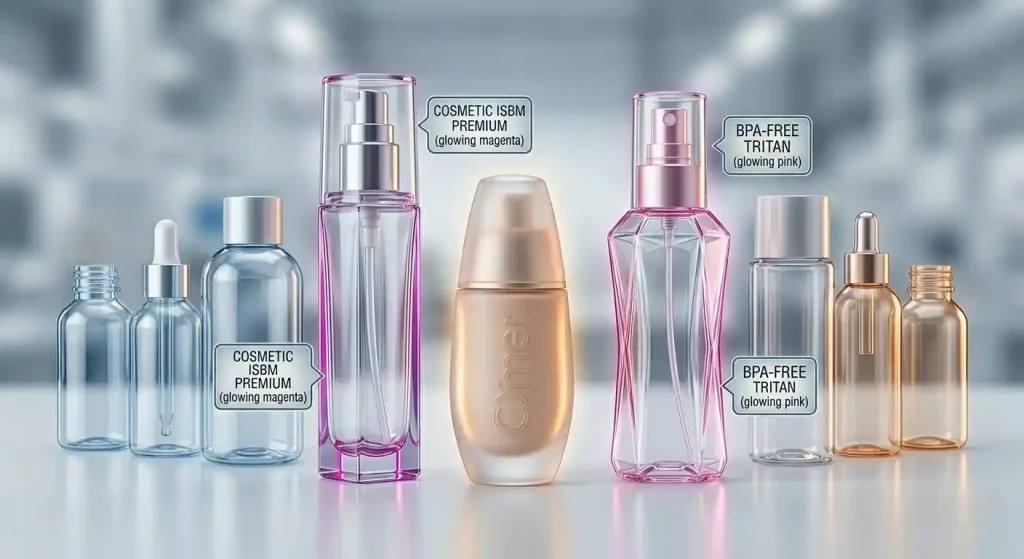
Why Premium Haircare Brands Are Moving from HDPE to PETG Bottles
The shift from HDPE to PETG in the premium personal care segment is driven by three market forces that have converged over the past several years: consumer premiumisation, sustainability messaging, and the growth of direct-to-consumer haircare brands competing on packaging aesthetics as a key brand differentiator.
HDPE, while functional and cost-effective, is an opaque or semi-translucent material in standard formulations. Premium shampoo and conditioner brands operating in the Australian natural haircare segment, the UK professional salon channel, and the Korean K-beauty export market require packaging that is crystal clear — allowing the consumer to see the colour, texture, and volume of the product inside. This visual transparency communicates freshness, purity, and premium ingredient quality in a way that is impossible to achieve with HDPE but comes naturally to PETG processed through one-step ISBM.
PETG also offers superior chemical resistance to the range of cosmetic actives used in premium haircare formulations — keratin, argan oil, biotin complexes, and acidic pH-balanced conditioners. These formulations can cause stress cracking or surface degradation in standard-grade plastics over the product shelf life. PETG’s chemical stability ensures that the bottle maintains its optical clarity and structural integrity throughout the retail and in-use period, reflecting well on the brand it represents.
Technical Advantages of Three-Station ISBM for Premium Personal Care Bottles
Glass-Substitute Clarity
PETG processed in a one-step ISBM cycle maintains its amorphous molecular structure throughout production, achieving optical clarity values close to glass — far exceeding what biaxially oriented PET or standard HDPE can deliver for personal care packaging.
Precision Pump Neck Finish
Premium haircare bottles accept dispensing pumps with 24/410, 28/410, or 28/415 neck finishes. The injection-stage neck formation of ISBM produces these dimensions with ±0.1 mm accuracy — ensuring clean, leak-free pump engagement on every bottle.
Thick-Wall Capability
PETG ISBM can produce bottles with body wall thicknesses of 1.0–2.5 mm — the “heavy glass feel” that premium brands in the salon channel and luxury retail segment require to communicate premium quality through tactile weight and rigidity.
No Visible Parting Line
ISBM mould tolerances of ±0.02 mm at the mould parting line eliminate the visible weld line that appears on EBM-produced bottles — essential for the seamless, premium surface finish that haircare brands specify for retail packaging.
Typical Product Formats and Volume Range
The HGY50-V3-EV produces premium haircare and body wash bottles across the full consumer format range. The most common bottle formats for this segment include:
- Travel and sample sizes (50 – 100 ml): Hotel amenity bottles, airline travel sizes, and salon sample packs in PETG round format. High cavity count per cycle (4–6) makes small-format production economical.
- Standard retail (200 – 300 ml): The primary consumer shampoo and conditioner format for premium brand positioning. PETG round shoulder bottles with lotion pump or disc-top closure neck finish.
- Salon/professional size (500 ml): Larger format for salon use or professional retail. Round body with wide-diameter pump neck. The HGY50-V3-EV accommodates 1–3 cavities per cycle at this volume.
- Body wash (250 – 500 ml): Slightly wider body than shampoo for the same volume, accommodating the higher viscosity of body wash formulations. PETG maintains full clarity across the thicker body wall profiles used in this format.
- Luxury/gift set bottles (100 – 200 ml): Premium presentation bottles for gift packaging, often featuring embossed surface texturing (achievable through mould surface treatment) and heavy wall construction.
Auxiliary Equipment: The Role of the Screw Air Compressor in PETG Bottle Production
A critical and sometimes underspecified element of any ISBM production line is the high-pressure air supply used in the blow moulding stage. During the blow stage of the three-station cycle, compressed air at 25–40 bar is injected into the preform to expand it against the blow mould cavity. For PETG haircare and body wash bottles, where optical clarity is the primary commercial requirement, the quality of this blow air directly influences the quality of the finished bottle surface.
Any oil mist or particulate contamination in the blow air will deposit on the interior surface of the bottle during the blow stage — creating micro-haze, surface irregularities, or contamination that degrades optical performance and may trigger cosmetic quality rejections. The correct auxiliary equipment for a PETG personal care bottle production line is a dedicated high-pressure 20–40 bar micro-oil screw air compressor, which delivers the blow pressure required by the ISBM process while maintaining the air cleanliness standard that premium PETG bottle production demands.
Specifying the correct compressor at the equipment procurement stage — rather than adapting existing lower-pressure plant air infrastructure — ensures that the premium optical quality of PETG bottles is consistently maintained across production runs, protecting both the bottle manufacturer’s quality reputation and the cosmetic brand’s product presentation.
Market Context: Premium Personal Care Packaging in Australia, South Korea, and the UK
Three key export markets for premium PETG haircare packaging illustrate the commercial opportunity that drives investment in three-station ISBM production capability:
Australia has developed a premium natural and organic personal care sector that rivals European markets in sophistication. Australian haircare brands — particularly those positioning around native botanical ingredients such as kakadu plum, tea tree, and macadamia — routinely specify crystal-clear packaging to communicate the naturalness and purity of their formulations. Local bottle production via ISBM reduces the minimum order quantity constraints and long lead times of imported PETG bottles, allowing Australian brands to respond faster to the rapid product development cycles characteristic of the premium haircare sector.
South Korea’s K-beauty sector has established global standards for cosmetic packaging aesthetics. Korean haircare brands — from mass-premium to genuine luxury — specify packaging with the glass-substitute clarity, heavy-feel construction, and seamless surface finish that PETG ISBM production delivers. Korean packaging manufacturers investing in three-station ISBM capability are positioned to serve both domestic brands and the significant Korean OEM export packaging market that supplies global haircare brands.
The UK salon professional haircare channel — brands sold through professional salons, beauty academies, and professional retail — consistently demands premium packaging that communicates salon credibility. Clear PETG bottles with heavy-wall construction and precision pump mechanisms satisfy this market’s packaging specification requirements while meeting the UK’s increasingly stringent packaging sustainability requirements under the Extended Producer Responsibility (EPR) framework for plastic packaging.
Production Economics: When PETG ISBM Makes Financial Sense for Haircare Packaging
The decision to invest in PETG ISBM production for haircare and body wash bottles is financially justified when three conditions are met: sufficient production volume to amortise machine and tooling investment, a product positioning that supports the higher per-unit material cost of PETG versus HDPE, and a premium brand that demands the optical and surface quality that only ISBM can deliver.
For a personal care manufacturer producing 500,000 premium PETG haircare bottles per month across multiple SKUs, the HGY50-V3-EV’s combination of multi-cavity production, rapid mould changeover (2–4 hours), and 40% energy saving versus two-stage production delivers a compelling total cost of ownership compared to sourcing equivalent PETG bottles from external suppliers with long lead times, minimum order quantities, and import logistics costs.
Elevate Your Haircare Packaging with Premium PETG ISBM Production
Share your bottle design, volume range, and production scale with our team. We will return a machine configuration, cavity count, and output estimate within 24 hours.
Frequently Asked Questions
editor:WM