Beschrijving
ZQ40 Injection Blow Molding Machine — Full European Structure, 400 kN Clamping Force
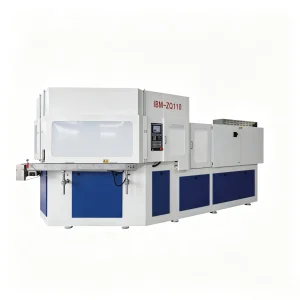
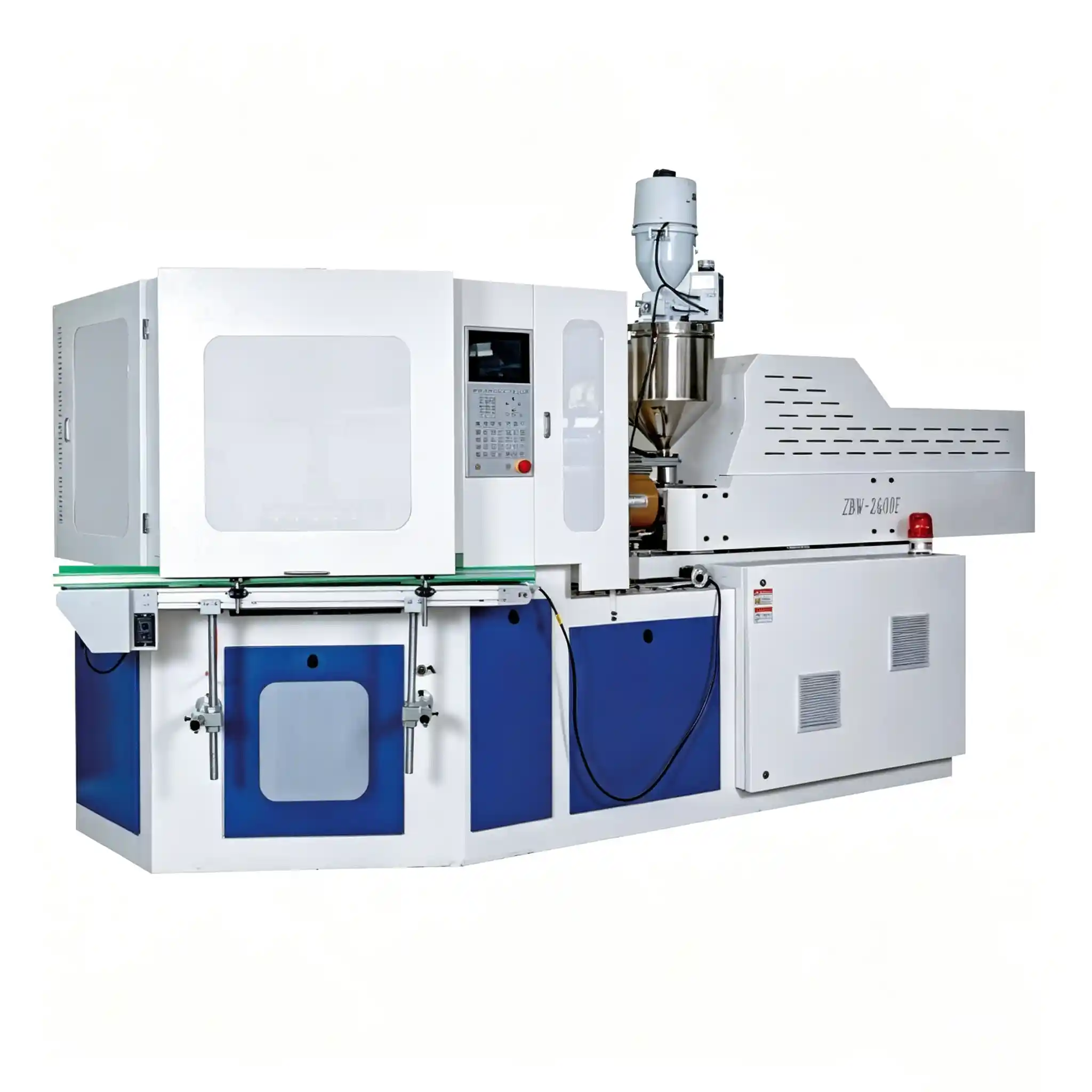
The ZQ40 Injection Blow Molding Machine is a one-station, three-position IBM machine built on a full European-style frame. Injection molding, blow molding, and ejection run as a single continuous cycle — delivering flash-free, dimensionally consistent hollow containers from 10 ml to 1,500 mm bottle height with no secondary trimming at any stage. At 400 kN injection clamping force and a 3.5-second dry cycle, the ZQ40 ibm injection blow molding machine is sized for production lines where part quality, machine uptime, and energy overhead all have to be managed together.
The ZQ40 accepts PP, HDPE, LDPE, PET, PC, PS, SAN, PMMA, and PETG. Dual screw diameter options (40 mm / 45 mm) cover a shot-weight range of 190 g to 260 g, and the mould can be configured from 1 to 6 cavities depending on container volume — making it a practical fit for pharmaceutical, cosmetic, food, and personal-care packaging operations. As an injection blow molding machine manufacturer with long-term export experience, we supply the ZQ40 to buyers in North America, Europe, Southeast Asia, and beyond.
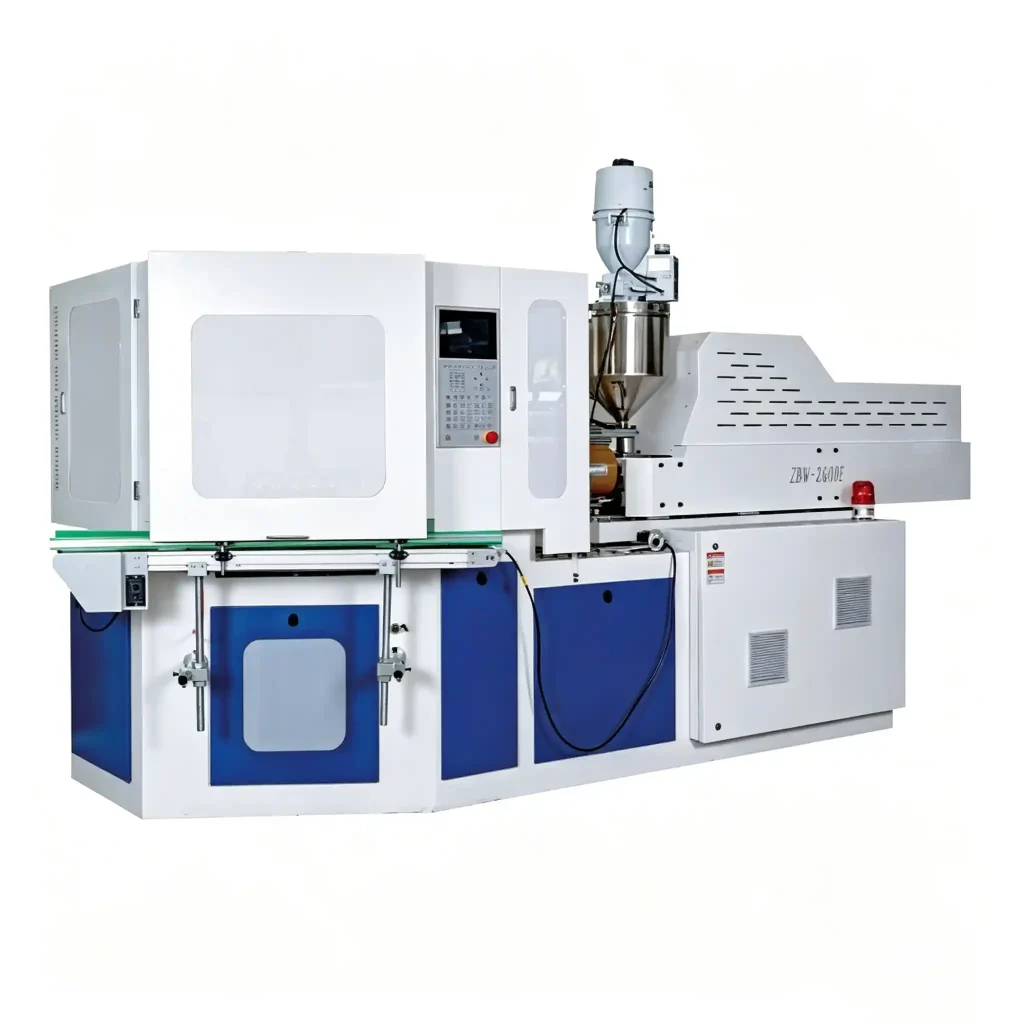
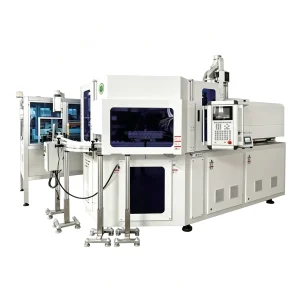
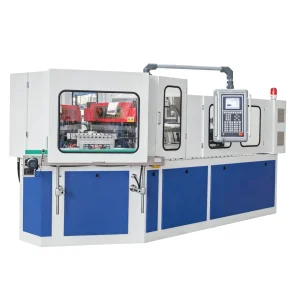
ZQ40 Injection Blow Molding Machine
Key Features of the ZQ40 IBM Injection Blow Molding Machine
- Full European-style frame: The entire clamping and platen system is built to European structural standards. The 400 kN injection clamping force sits 17%–18% above the Jomar IBM40 (340 kN) and 4% above the SUMA 40iB (386 kN), giving the ZQ40 a measurable advantage in mould locking stability, flash control, and mould service life — with no increase in machine footprint.
- Standard servo rotation system: The indexing table is servo-driven as standard equipment. Servo positioning provides repeatable accuracy across every cycle, lower wear on the rotation mechanism, and simpler field maintenance compared to pneumatic or cam-driven indexing — reducing unplanned stops on multi-shift pharmaceutical and cosmetic lines.
- Pressurized clamping architecture — booster decoupled from open/close stroke: The booster cylinder is mechanically isolated from the mould opening and closing motion. It engages only at the clamping stage, which means the hydraulic system only works at full pressure for the fraction of the cycle that actually requires it. Measured at 52%–70% operating power utilisation against a 20 kW installed total, this design runs 10%–20% below the energy draw of conventional layouts where the booster participates in the full stroke.
- 3.5-second hydraulic dry cycle: The ZQ40 achieves 3.5 s dry cycle time — enabling competitive throughput rates on short-cycle formats such as pharmaceutical vials, eye-drop bottles, and small cosmetic containers.
- Dual screw diameter — 40 mm / 45 mm: Shot weights of 190 g and 260 g respectively, with a 22:1 L/D ratio and 3 + N heating zones (7.5 kW) for uniform plasticisation across the full material compatibility range. The wider 45 mm option covers higher-viscosity resins such as PC and high-density HDPE without compromising melt consistency.
- Up to 6 cavities for small-volume containers: The 480 × 340 mm platen — wider than the Jomar IBM40 (394 × 508 mm in landscape) and close in footprint to the SUMA 40iB (470 × 350 mm) — supports 6 cavities at 10 ml, scaling to 1 cavity at 1,000 ml+. For buyers evaluating the ZQ40 as a cost-effective alternative to the Uniloy UIB70 or the BLOMA IBM45, the cavity flexibility is a key production-economics factor.
- Zero-scrap neck formation: The IBM process fully forms the bottle neck and thread in the injection stage. Unlike extrusion blow molding, there is no flash to trim and no secondary handling required — reducing material loss and labour cost on every production run.
ZQ40 Technical Specifications
| Parameter | Unit | ZQ40 Value |
|---|---|---|
| Injection System | ||
| Screw Diameter | mm | 40 / 45 |
| Screw L/D Ratio | — | 22:1 |
| Injection Weight | g | 190 / 260 |
| Heating Power | kW | 7.5 |
| Number of Barrel Zones | — | 3 + N |
| Injection Stroke | mm | 120 |
| Clamping System | ||
| Injection Clamping Force | kN | 400 |
| Opening Stroke (Injection) | mm | 165 |
| Blow Clamping Force | kN | 60 |
| Opening Stroke (Blowing) | mm | 140 |
| Rotary Table Lifting Height | mm | 70 |
| Mould | ||
| Max. Platen Size (L × W) | mm | 480 × 340 |
| Mould Thickness | mm | 180 |
| Max. Bottle Diameter | mm | 120 |
| Max. Bottle Height | mm | 220 |
| Suitable Bottle Height Range | mm | 1 – 1,500 |
| Stripping Stroke | mm | 220 |
| Hydraulic System | ||
| Hydraulic Pressure | MPa | 14 |
| Motor Power | kW | 11 |
| Dry Cycle | s | 3.5 |
| Total Power | kW | 20 |
| Operating Power | % | 52 – 70 |
| Others | ||
| Min. Compressed Air Pressure | MPa | 0.7 – 1.2 |
| Compressed Air Capacity | m³/min | 0.7 |
| Water Flowage | m³/h | 3.5 |
| Cooling Water Pressure | MPa | 0.3 – 0.4 |
| Machine Dimensions (L × W × H) | m | 3.5 × 1.3 × 1.7 |
| Net Weight | Ton | 3.8 |
ZQ40 vs. Comparable Injection Blow Molding Machines — Specification Reference
The table below lists models from other brands for reference purposes only, to assist buyers in model selection. ZI-QIANG does not manufacture, sell, or service any third-party brand’s equipment. All third-party model names are trademarks of their respective owners.
| Parameter | ZQ40 (ZI-QIANG · China) |
IBM40 Jomar · USA |
40iB SUMA · Taiwan |
UIB70 Uniloy · USA |
IBM45 BLOMA · Korea |
|---|---|---|---|---|---|
| Screw Diameter (mm) | 40 / 45 | 35 / 40 | 40 | — | 45 |
| Injection Weight (g) | 190 / 260 | 180 | 169 | — | 180 |
| Injection Clamping Force (kN) | 400 | 340 | 386 | — | 350 |
| Mould Platen Size (mm) | 480 × 340 | 394 × 508 | 470 × 350 | — | 450 × 390 |
| Machine Footprint (m) | 3.5 × 1.3 × 1.7 | 2.72 × 1.9 × 2.75 | 3.8 × 1.5 × 2.3 | — | 4.05 × 1.52 × 2.55 |
| Origin | China | USA | Taiwan | USA | Korea |
* Third-party model data sourced from publicly available technical documentation. Specifications may vary by production year and configuration. Contact ZI-QIANG for current ZQ40 data sheets.
What the numbers show:
- Clamping force: The ZQ40’s 400 kN leads all five models in this comparison. The gap versus the Jomar IBM40 (340 kN) is 18%; versus the BLOMA IBM45 (350 kN) is 14%. This directly affects mould locking integrity, flash generation, and the ceiling for cavity count on high-pressure materials.
- Injection weight: At 190 g / 260 g (screw-dependent), the ZQ40 offers a higher upper-end shot capacity than the Jomar IBM40 (180 g), SUMA 40iB (169 g), and BLOMA IBM45 (180 g) — relevant when running larger containers or higher-density resins.
- Machine footprint: The ZQ40 stands at 3.5 × 1.3 × 1.7 m, which is shorter in height than the SUMA 40iB (2.3 m high) and considerably more compact in height than the Jomar IBM40 (2.75 m) and BLOMA IBM45 (2.55 m) — an advantage for facilities with standard ceiling clearances or clean-room height constraints.
Mould Cavity Reference — Container Volume Guide
For reference only. Actual cavity count depends on container geometry, wall thickness, and material selection.
| Container Volume | 10 ml | 30 ml | 60 ml | 100 ml | 250 ml | 500 ml | 1,000 ml |
|---|---|---|---|---|---|---|---|
| Max. Cavities | 6 | 4 | 3 | 2 | 2 | 1 | 1 |
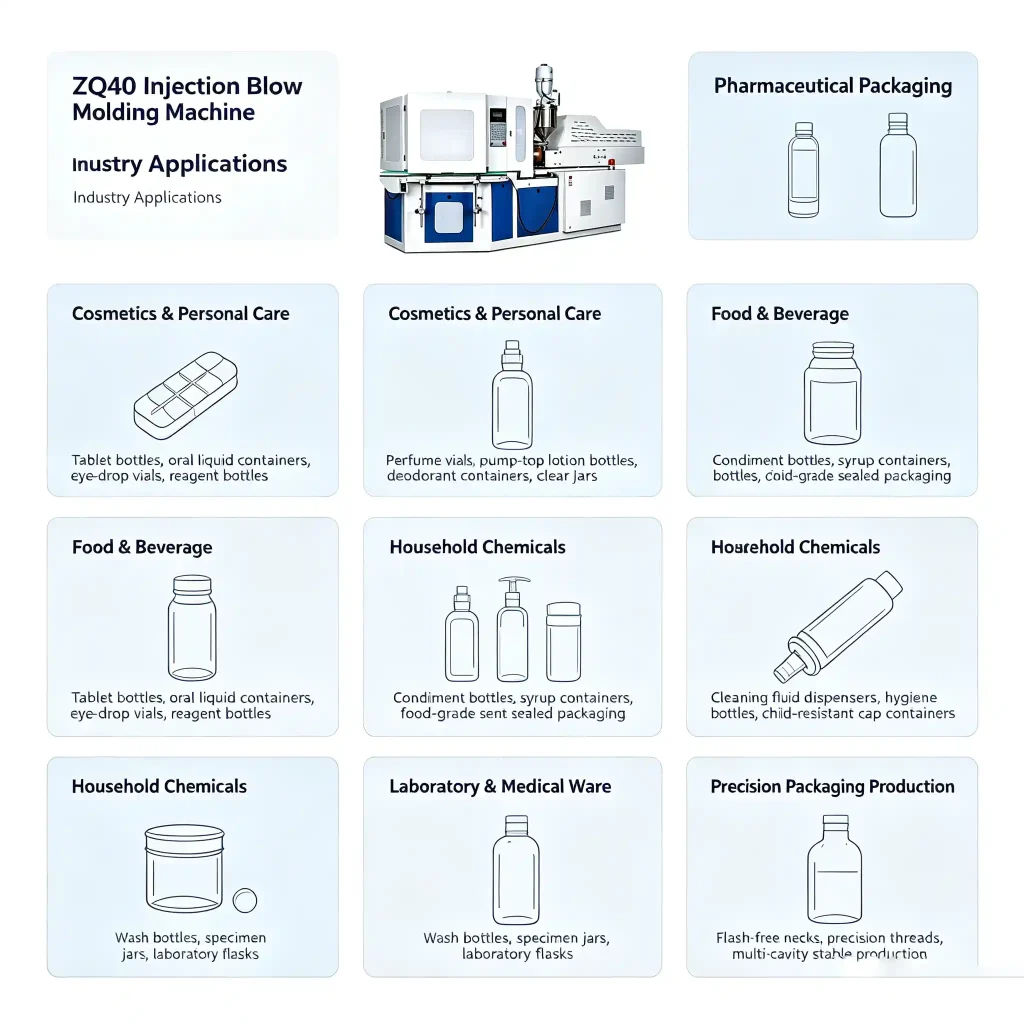
Applications: Industries the ZQ40 Injection Blow Molding Machine Serves
The ZQ40 is suited to B2B packaging manufacturers, contract fillers, and OEM production operations that need flash-free, precision-neck containers across multiple shifts. Its compact height (1.7 m) and 3.5 m floor length allow installation in standard production bays without ceiling modifications — a practical detail for buyers evaluating it as an injection blow molding machine supplier alternative in Ontario, the UK, Australia, or the Netherlands.
- Pharmaceutical packaging: Tablet bottles, oral liquid containers, eye-drop vials, and reagent bottles in PP or HDPE. The IBM process forms the neck finish entirely in the injection stage — thread dimensions are set by the injection mould, not a post-blow trimming step, making neck tolerances repeatable across every cavity and every cycle.
- Cosmetics and personal care: Perfume vials, pump-top lotion bottles, deodorant containers, and compact jars in SAN, PS, PMMA, or transparent PET. Wall thickness uniformity and surface clarity are controlled at the preform stage rather than corrected after forming.
- Food and beverage: Single-serve condiment bottles, syrup containers, and barrier-sealed food-grade packaging in PP or HDPE. Zero scrap on the neck eliminates the trimming and regrind management that extrusion blow molding lines require.
- Household chemicals: Cleaning fluid dispensers, personal hygiene bottles, and child-resistant cap-compatible containers where complex neck geometries (tamper bands, plug seals, bayonet finishes) need to be formed in a single injection step.
- Laboratory and medical ware: Wash bottles, specimen jars, and laboratory flasks up to 1,000 ml in PC or PETG, where dimensional repeatability and clean-room compatibility are both requirements. The servo rotation system minimises particulate generation during indexing.
Frequently Asked Questions of Injection Blow Molding Machine
Q1: What materials does the ZQ40 IBM injection blow molding machine support?
PP, HDPE, LDPE, PET, PC, PS, SAN, PMMA, and PETG. The 22:1 L/D screw ratio combined with multi-zone barrel heating (3 + N zones, 7.5 kW) maintains a consistent melt temperature across materials with significantly different viscosity profiles — from low-viscosity LDPE to engineering-grade PC — without requiring screw changes.
Q2: How does the ZQ40 clamping force compare to the Jomar IBM40 and BLOMA IBM45?
The ZQ40 delivers 400 kN injection clamping force. The Jomar IBM40 is rated at 340 kN (a 18% difference) and the BLOMA IBM45 at 350 kN (a 14% difference). In practical terms, higher clamping force means less mould deflection under injection pressure, lower flash generation per cycle, and the ability to maintain quality on higher-cavity configurations running shorter cycle times.
Q3: How does the ZQ40’s footprint compare to the SUMA 40iB and BLOMA IBM45?
The ZQ40 measures 3.5 × 1.3 × 1.7 m. The SUMA 40iB stands 2.3 m tall and the BLOMA IBM45 reaches 2.55 m, while the Jomar IBM40 is 2.75 m high. The ZQ40’s 1.7 m height fits under standard 2.4 m suspended clean-room ceilings without modification — which is not the case for any of the three reference models listed above.
Q4: Can I use the ZQ40 as a direct replacement if I currently run a Jomar IBM40 or SUMA 40iB?
In most cases, yes — subject to mould compatibility review. The ZQ40’s platen size (480 × 340 mm) is comparable to the SUMA 40iB (470 × 350 mm), and the injection shot range (190 g / 260 g) exceeds what the Jomar IBM40 (180 g) and SUMA 40iB (169 g) deliver. Existing moulds designed for those platforms may require minor adaptation. We recommend sharing your current mould drawings during the enquiry stage so our engineering team can confirm fitment before order placement.
Q5: What is the measured energy saving from the pressurized clamping system?
The booster cylinder on the ZQ40 is isolated from the open/close stroke — it only engages at the clamping phase. This means the hydraulic system operates at full load only for the clamping portion of the cycle rather than the full stroke. In production, the machine runs at 52%–70% of its 20 kW installed capacity, representing a 10%–20% energy reduction versus conventional designs where the booster participates in every mould movement.
Q6: Is the ZQ40 available to buyers sourcing as an injection blow molding machine supplier in North America or Europe?
Yes. We export the ZQ40 to buyers in Ontario and across Canada, the USA, the UK, the Netherlands, Australia, South Korea, and Brazil. Export documentation, CE-compatible electrical specifications, and English-language operation manuals are available as standard. Lead time and shipping terms are confirmed at order stage. Contact us with your production requirements and we will provide a detailed commercial and technical proposal.
Get Technical Specifications and Factory Pricing for the ZQ40
Share your container volume, material, target cavitation, and production shift requirements. Our engineering team will respond with a matched ZQ40 configuration, cavity reference data, and a commercial proposal within 2 business days. If you are evaluating the ZQ40 as an alternative to the Jomar IBM40, SUMA 40iB, Uniloy UIB70, or BLOMA IBM45, we can provide a side-by-side comparison against your current spec sheet.