
4-Station ISBM ROI by Monthly Output
Most procurement teams overestimate machine cost and underestimate operating savings. The honest 4-station ISBM ROI picture often shows payback inside 18 months at moderate utilisation — here is how the math actually works for typical Australian and APAC bottle programs.
The Five Inputs That Determine Payback
Every ROI calculation reduces to five numbers. Get these right and the rest is arithmetic; get them wrong and the resulting investment case is unreliable regardless of how sophisticated the financial model looks. Most buyers focus too much attention on the first input (capital cost) and not enough on the operating inputs that compound over the asset’s 7–12 year life.
- Capital cost. Machine + moulds + auxiliaries (chiller, dryer, compressor, conveyor, vision inspection if required) + freight + installation. Typical range USD 200k–550k for a 4-station with one mould set. Add 8–12% for international freight and import duties on top of FOB pricing.
- Production output. BPH × operating hours × utilisation = monthly bottles produced. Realistic utilisation in year 1 sits at 70–80% (commissioning curve, operator training, mould refinements); years 2+ should reach 85–92% with disciplined planning.
- Cost per bottle produced. Resin (50–60% of cost) + energy (5–8%) + labour (12–18%) + maintenance allowance (3–5%) + scrap allowance (2–4%) + facility allocation (5–10%). The cost per bottle for a 100 ml PET bottle in Australia typically lands between AUD 0.04 and 0.07 fully loaded.
- Sale price or saving per bottle. Either you sell finished bottles to a brand owner, or you save versus buying preforms or finished bottles externally. The saving calculation needs to include freight, customs, warehousing, and inventory carrying costs — not just the unit price differential.
- Margin per bottle. Sale price (or saving) minus cost per bottle. This is the per-bottle contribution to ROI, and small differences compound massively across a 30M+ annual bottle output.
Three Realistic Scenarios
The numbers below assume a typical 4-station ISBM machine such as the HGY250-V4-B 4-station ISBM machine, two-shift operation (16 hours/day, 26 days/month), 85% mechanical utilisation, and Australian energy and labour rates as of 2025–2026.
Scenario A — 100 ml Cosmetic Bottle, Mid-Volume Premium Brand
An Australian premium skincare brand transitioning from imported PET bottles to in-house production. Currently buying 100 ml PET serum bottles from an Asian supplier at AUD 0.072 landed cost (including freight and warehousing). Targeting in-house production at AUD 0.044 per bottle, capturing a saving of AUD 0.018 per bottle after accounting for the cost of running their own line.
| Capital outlay (machine + 6-cav mould + auxiliaries) | USD 280,000 |
| Output | 3,200 BPH × 16h × 26d × 85% = 1.13M/month |
| Cost per bottle (all-in) | USD 0.044 |
| Saving vs imported bottles | USD 0.018/bottle |
| Monthly contribution | USD 20,340 |
| Payback period | ~14 months |
Scenario B — 250 ml Pharma Bottle, Higher Volume Contract Manufacturer
A pharmaceutical contract manufacturer producing 250 ml PP oral suspension bottles for multiple TGA-regulated brand owners. Currently outsourced through a two-stage line operated by a third party at AUD 0.091 per bottle. In-house one-step production targets AUD 0.062 per bottle, with an additional commercial benefit from compressed batch traceability that strengthens audit performance.
| Capital outlay (machine + 4-cav mould + auxiliaries) | USD 320,000 |
| Output | 2,400 BPH × 16h × 26d × 85% = 850k/month |
| Cost per bottle (all-in) | USD 0.062 |
| Saving vs imported preforms + reheat blow | USD 0.029/bottle |
| Monthly contribution | USD 24,650 |
| Payback period | ~13 months |
Scenario C — 500 ml Beverage Bottle, High-Volume Single SKU
A specialty beverage brand running a single 500 ml PET SKU on a 24/7 schedule. Volume sustained at 2.7+ million bottles per month. Tighter margins per bottle (AUD 0.014) but compensated by much higher monthly volume.
| Capital outlay (large-frame machine + 8-cav mould + auxiliaries) | USD 480,000 |
| Output | 5,000 BPH × 24h × 26d × 88% = 2.74M/month |
| Cost per bottle (all-in) | USD 0.038 |
| Margin per bottle | USD 0.014 |
| Monthly contribution | USD 38,360 |
| Payback period | ~12.5 months |
Larger-format projects often look at the EP-HGY650 V4 one-step ISBM machine for bottles in the 500–1500 ml range, where its higher cavity count and broader bottle envelope improve per-bottle economics further. The break-even between the smaller HGY250 and larger EP-HGY650 typically lands around the 1.8–2.2 million bottles per month threshold, depending on bottle weight and changeover frequency.
Hidden Variables That Improve or Worsen ROI
The three scenarios above use static assumptions. Real-world ROI is driven by several variables that change over the machine’s life and that buyers often miss in their initial models:
- Energy cost trend. Australian industrial electricity rates have risen 4–8% annually since 2020 and are projected to continue rising as grid transition costs flow through. A modern all-servo machine that consumes 25% less than a hydraulic equivalent delivers progressively larger savings each year.
- Resin price volatility. Buying resin direct rather than buying preforms removes a layer of supplier markup — typically 8–15% per bottle. It also gives you better leverage during resin price negotiations, and makes recycled-content (rPET) sourcing easier to verify.
- Tooling reuse. Each new SKU adds mould cost. ROI improves if you can amortise the machine across multiple SKUs over time. A line that runs 3 SKUs in year 1 and grows to 12 SKUs by year 5 sees per-SKU mould cost effectively halve over the asset’s life.
- Scrap rate. Every 1% reduction in scrap improves payback by roughly 4–5 weeks at typical margins. Operator skill, mould condition, and process discipline are the three largest drivers; investing in operator training is one of the highest-ROI activities in the first year.
- Downtime. A 4-station machine running 92% utilisation pays back 6 months sooner than the same machine at 78% utilisation. Local service coverage, spare parts availability, and preventive maintenance discipline all affect this metric directly.
- Currency exposure. Importing the machine in USD or EUR while billing customers in AUD creates currency risk. A 5% AUD weakening between PO and delivery can erase 3 months of payback gain. Consider forward currency hedges for FOB payments above USD 200k.
A Simplified Formula for First-Pass Estimates
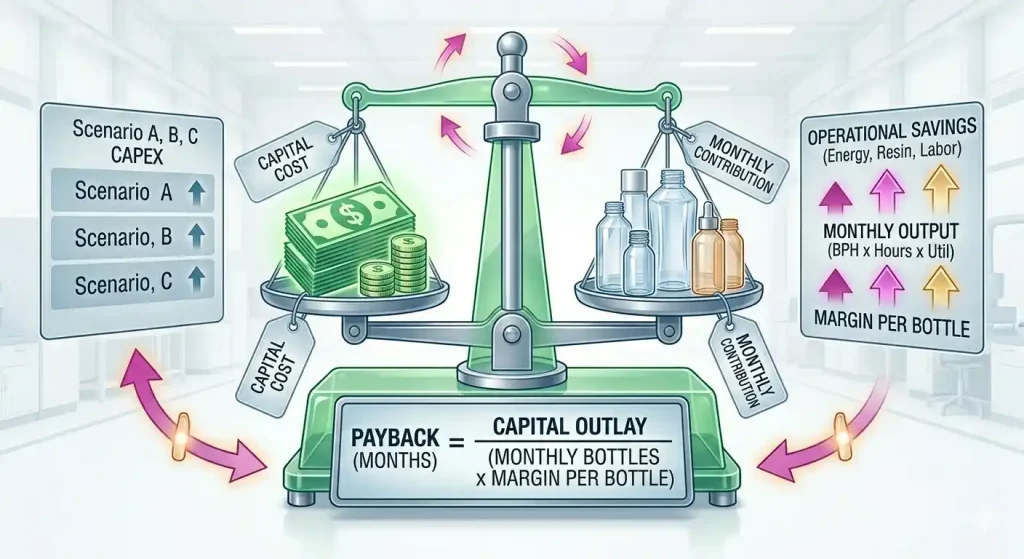
Payback (months) = Capital Outlay ÷ (Monthly Bottles × Margin per Bottle)
Use this for first-cut feasibility. For project-level investment cases, a five-year DCF model with energy, labour, and resin price escalators is the right tool — and we provide one to every quoted client. The DCF model also captures the residual value of the machine at year 5 (typically 30–45% of original capital cost for a well-maintained 4-station ISBM), which improves the apparent ROI on shorter-horizon comparisons against alternative capital deployments.
Want a project-specific ROI model?
Send your bottle spec, monthly target, and resin to [email protected]. Our Sydney engineering team returns a custom 5-year ROI worksheet within one working day, including currency-hedged capital scenarios and energy escalator sensitivity.