
Why Material Selection Is the First Critical Decision in Baby Bottle Manufacturing
The global baby bottle market exceeded USD 3.2 billion in 2024 and continues to grow on the back of rising consumer awareness around BPA-free and food-safe plastics. For manufacturers producing feeding bottles at scale, the material choice — Tritan copolyester, PPSU, PP, or PES — fundamentally determines which machine configuration is needed, what processing temperatures must be maintained, and how the final bottle performs across dishwasher cycles, sterilisation regimens, and drop-test standards. This guide focuses on one-step ISBM as the production process and examines how machine configuration must be adapted for Tritan and PPSU, the two premium materials in modern baby bottle manufacturing.
Tritan Copolyester: Processing Characteristics on ISBM Equipment
Eastman Tritan (TM) copolyester has become the benchmark BPA-free, dioxin-free material for premium baby bottles sold into European, North American, and Australian markets. Tritan delivers glass-like clarity, impact resistance comparable to polycarbonate, and the ability to withstand steam sterilisation at 120°C without stress whitening or cracking — a critical performance requirement for infant feeding equipment. Understanding its processing profile on ISBM machines is essential for achieving production yields above 97%.
Injection Temperature and Barrel Configuration
Tritan requires processing temperatures in the range of 260°C–290°C, significantly higher than standard PET (255°C–270°C). The injection barrel must be specified for high-temperature duty with appropriate screw geometry — a general-purpose screw with a compression ratio of 2.5:1 to 3.0:1 is typical. Residence time in the barrel must be carefully managed; Tritan is sensitive to thermal degradation if held at melt temperature for extended periods. Machines with small-volume injection units matching the shot weight of baby bottle preforms (typically 15g–45g per cavity) minimize residence time and preserve material clarity.
Conditioning Station Requirements for Tritan
This is where the four-station ISBM architecture provides a decisive advantage over three-station designs when processing Tritan. Tritan has a narrower stretch window than PET — the temperature range between insufficient softening and thermal degradation is tighter. The dedicated conditioning station in a four-station machine allows precise, zone-controlled thermal profiling of the preform: the body can be brought to an ideal stretch temperature (around 110°C–130°C for Tritan) while the neck, which must retain its thread dimensions, is actively cooled. This level of thermal decoupling is very difficult to achieve on a three-station machine where conditioning and injection are tightly coupled.
Blow Pressure and Mold Temperature for Tritan
Tritan benefits from higher blow pressures than standard PET — typically 25–35 bar — to achieve complete mold filling and good surface replication. Mold temperature for Tritan baby bottles is typically 10°C–25°C, controlled via dedicated mold temperature controllers (MTCs) integrated with the machine. Cooling channel design in the blow mold is critical: baby bottles have substantial wall thickness and require thorough, even cooling to prevent post-mold deformation.
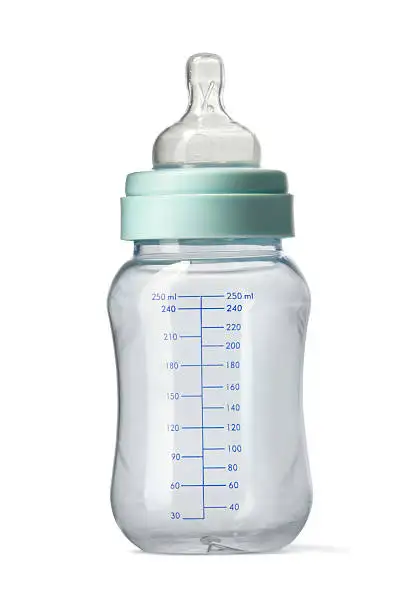
PPSU Baby Bottles: When Tritan Is Not Enough
Polyphenylsulfone (PPSU) is the highest-performance thermoplastic used in baby bottle manufacture. With a continuous use temperature of 180°C and resistance to repeated autoclave sterilisation at 134°C, PPSU is the choice of hospital nurseries, neonatal units, and premium brands targeting markets with the most demanding sterilisation standards. The material’s amber/amber-brown colour has become a recognisable premium visual cue in the category. PPSU is significantly more expensive than Tritan — typically 3 to 4 times the material cost per kilogram — so processing efficiency and low scrap rates are commercially critical.
PPSU on ISBM: Key Configuration Requirements
PPSU processing on ISBM differs fundamentally from PET and even from Tritan. The material must be dried to below 0.02% moisture before processing — typically in a desiccant hopper dryer at 150°C for 4–6 hours. Melt temperatures of 330°C–360°C are required, with a correspondingly high-temperature barrel specification. PPSU is amorphous and does not crystallise, so the stretch blow window is thermally wide; however, the high viscosity of PPSU melt requires higher injection pressures than PET. Stretch rod speed and pre-blow pressure profiles must be carefully tuned to avoid whitening in the shoulder region of the bottle.
PPSU is typically processed on ISBM machines with 1–4 cavities due to the high material cost and the relatively premium market volumes involved. Cycle times are longer than PET production — typically 18–25 seconds for a 150ml baby bottle — reflecting the higher thermal mass of the material and the thorough cooling required.
Machine Configuration Guide: Selecting the Right ISBM for Baby Bottle Production
Servo Drive Architecture
For baby bottle manufacturing — whether in Tritan, PPSU, or PP — servo-driven ISBM machines offer important advantages over hydraulic or servo-hydraulic designs. The precision of servo injection allows exact shot weight repeatability, which is directly linked to consistent wall thickness distribution. For premium baby bottles where wall thickness variation of more than ±0.1mm is commercially unacceptable, servo injection precision is not optional. Servo-driven index table rotation ensures precise, shock-free transfer between stations, protecting the hot preform geometry at each transfer point.
The one-step ISBM machine range includes servo-configured options specifically suited to high-value thermoplastic processing, offering the temperature control precision and injection accuracy that Tritan and PPSU demand.
Hot Runner System Requirements
For Tritan and PPSU baby bottle production, a hot runner system with independent zone temperature control is strongly recommended. The ability to set individual zone temperatures within ±1°C of setpoint ensures consistent gate opening and closing, prevents material degradation at the gate, and maintains cavity-to-cavity weight uniformity across multi-cavity molds. Without independent zone control, gate vestige height variability can cause problems with teat and collar assembly in the downstream bottle filling step.
Neck Finish and Assembly Compatibility
Baby bottle neck finishes must mate precisely with teat retaining collars, most of which follow standardised dimensions per brand specification. The most common formats are 28mm PCO (similar to beverage), 38mm wide-neck for orthodontic teats, and brand-proprietary formats. ISBM machines must hold neck finish thread height, pitch, and ovality within tight tolerances — typically ±0.1mm — to ensure leak-free, contamination-free assembly. Neck ring cooling design within the mold is the primary control lever for this.
Quality Standards for Baby Bottle Production
Manufacturers supplying baby bottles into Australian retail channels must meet the requirements of the Australian Consumer Law, AS/NZS 8124 toy safety standards (for items targeted at infants), and relevant food contact material regulations under FSANZ Standard 1.4.3. For export markets, EN 14350 (European baby feeding equipment standard) and FDA 21 CFR 177.1520 (for PP) or the appropriate Tritan food-contact notification are typically required.
The HGY50-V3-EV all-servo 3-station ISBM machine is an effective entry-level configuration for small-batch baby bottle production, offering the all-electric cleanliness and process precision required for food-grade and infant-safe manufacturing without the capital cost of a larger four-station platform.

Downstream Considerations: Decoration, Assembly, and Quality Control
Baby bottles require downstream processing steps that must be planned alongside machine selection. Pad printing, sleeve labelling, and UV offset printing are common decoration methods; the bottle surface must be clean, corona-treated if necessary, and dimensionally consistent for decoration registration accuracy. Automated visual inspection systems — checking for gates, shorts, wall thickness anomalies, and neck finish defects — are standard on professional baby bottle lines. Finally, automated assembly of teat, collar, and cap components is typically performed on dedicated assembly machines, requiring that the ISBM line consistently delivers bottles within tight dimensional windows.
Selecting the right ISBM machine configuration for Tritan and PPSU baby bottle production is a multi-variable decision that spans material science, machine specification, mold engineering, and downstream quality management. Getting the specification right upfront avoids costly process development iterations and delivers the consistency that premium infant feeding brands demand.
editor:WM