
Quick definition: Injection Stretch Blow Molding (ISBM) is a single-cycle plastic bottle production process that combines injection of a preform, axial stretching, and radial blowing into one machine — producing finished PET, PP, or Tritan bottles directly from resin pellets, with no separate preform handling step.
A Process That Replaced Two Machines With One
Before injection stretch blow molding became commercially viable in the late 1970s, plastic bottle production required two distinct machines: an injection molding press to make preforms, and a separate reheat stretch blow machine to inflate them into bottles. Preforms had to be packaged, stored, transported between facilities (sometimes across continents), and reheated through infrared ovens before they could be turned into bottles. The logistics chain consumed energy and floor space at every step, and added 6–10 weeks of inventory turnover to most bottle programs.
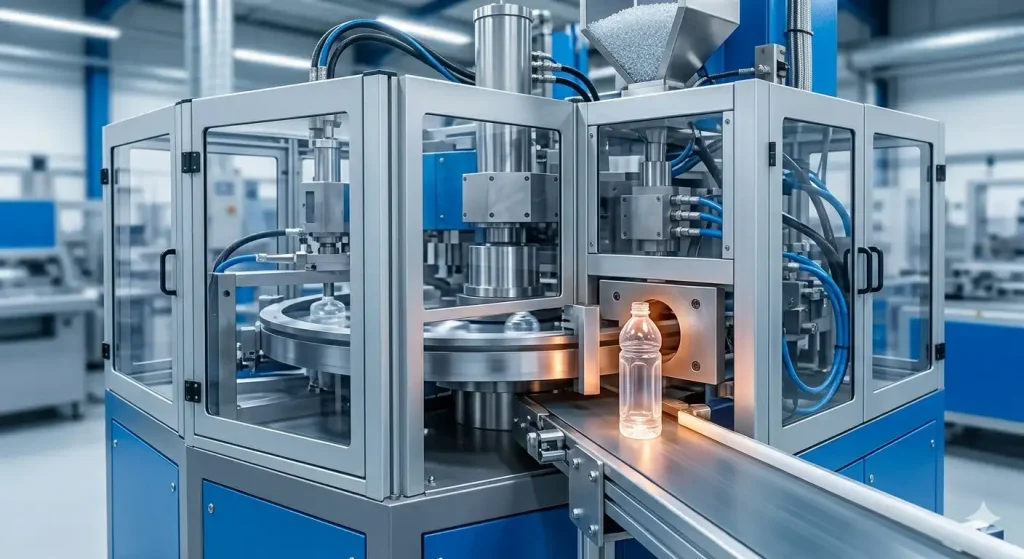
Injection stretch blow molding collapsed that two-stage workflow into one continuous cycle. Inside a modern ISBM machine, molten resin is injected into a preform-shaped cavity. While the preform is still warm and dimensionally stable — never fully cooled, never re-handled — a rotary indexing system carries it through stretching, blowing, and ejection stations, typically completing the full bottle in 8 to 14 seconds. The latent heat from the injection step is reused for the stretch-blow phase, eliminating the energy cost of reheating that two-stage processes incur. The result is a bottle that comes out of one machine, ready for filling, with no preform inventory, no IR oven, and no warehouse buffer between the two stages.
The economic ripple of that simplification reshaped the global packaging industry. Premium cosmetic, pharmaceutical, baby care, and specialty beverage brands — sectors where bottle quality matters more than raw bottles-per-hour — moved decisively toward one-step ISBM through the 1990s and 2000s. The two-stage process retained dominance in commodity beverage where 40,000–60,000 BPH lines justify the additional capital footprint, but for projects under roughly 30 million bottles annually, one-step ISBM delivers a lower total cost per bottle and tighter quality control.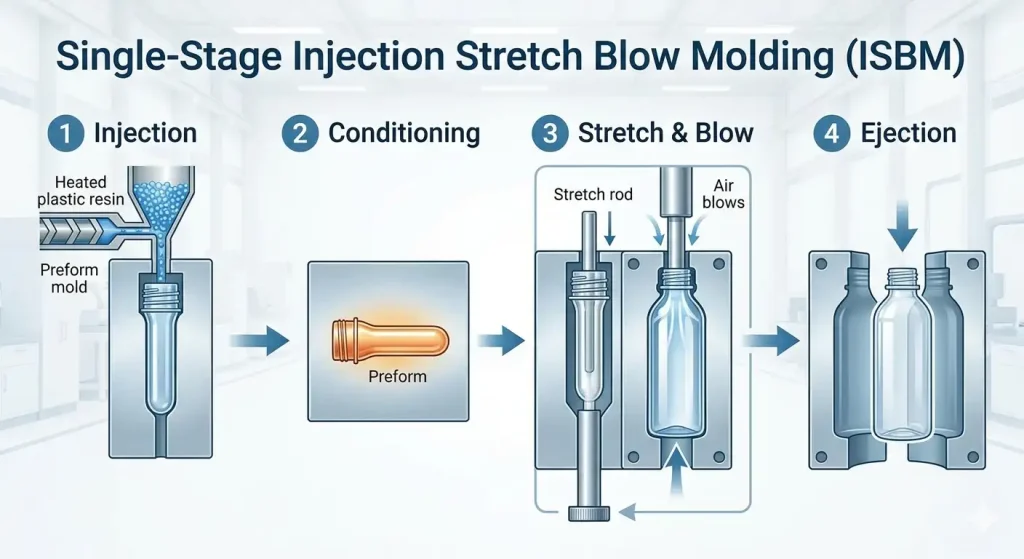
The Four Stages Inside Every ISBM Cycle
Every injection stretch blow molding machine — whether 3-station, 4-station, or 6-station — works through four mechanical stages, with stations splitting the cycle into manageable slices. Understanding what happens at each stage is the foundation for evaluating any machine quotation, sizing tooling, or troubleshooting bottle defects.
Injection. PET, PP, or Tritan resin is plasticised in a heated barrel and injected into a multi-cavity preform mould at 240–280 °C. The preform takes shape with its final neck threads already formed.
Conditioning. The preform’s temperature profile is equalised — the outer skin (which cools faster) is allowed to catch up with the warmer core. Critical for wall consistency on shaped bottles.
Stretch & Blow. A stretch rod elongates the preform axially while compressed air at 30–40 bar inflates it radially against the bottle mould. Biaxial orientation locks in mechanical strength.
Ejection. The cooled bottle is gripped by a robot or drops onto a conveyor for downstream filling, capping, labelling, or packaging — all integrated into a single production cell.
Why Biaxial Stretching Matters
The “stretch” in injection stretch blow molding is not a casual word. When PET is heated to its glass transition zone (around 90–110 °C) and then stretched in two directions simultaneously — vertically by the rod and horizontally by the air — its molecular chains align into a cross-hatch pattern. This biaxial orientation increases tensile strength by roughly 2× and barrier performance against gas and water vapour by 30–60%. It is the engineering reason a 12 g PET bottle can hold 2 L of carbonated water at 4 bar internal pressure without rupturing.
Biaxial orientation also delivers the optical clarity that makes PET bottles look almost like glass. Unaligned PET scatters light at the molecular boundary; oriented PET transmits it cleanly. The same physics governs the difference between a budget-grade water bottle and a premium cosmetic bottle made from the same resin — the orientation profile, controlled by stretch ratio and conditioning temperature, is what separates them.
Bottles made by simple extrusion blow molding skip the stretch step entirely. They are formed by inflating a molten plastic tube (parison) without any axial stretching, which means molecules stay randomly oriented. The bottles are cheaper to produce, but they are heavier per unit volume, weaker in top-load and burst pressure tests, and visibly less transparent — which is why premium cosmetic, beverage, and pharmaceutical bottles all migrated to ISBM decades ago. Extrusion blow remains the right choice for industrial containers, jerry cans, and large-format bottles above 5 L where biaxial strength is less critical than capacity.
One-Step vs Two-Step ISBM
Injection stretch blow molding splits into two industrial flavours that are often confused but represent very different operational realities. One-step (also called single-stage) ISBM does the entire process inside one machine: injection, conditioning, blowing, ejection — all in one continuous cycle, with the preform never leaving the rotary indexing table between injection and blow. Two-step (also called two-stage) ISBM uses two completely separate machines, with cooled preforms produced first on an injection molding press, then stored or shipped, then reheated through an infrared oven and blown into bottles on a downstream stretch blow molder.
One-step is preferred for premium and small-batch production: cosmetics, pharmaceuticals, baby bottles, specialty beverages — anywhere bottle quality, neck precision, and material flexibility matter more than raw throughput. Energy consumption per 1,000 bottles is 30–45% lower than two-stage because no reheat oven is required. Wall thickness consistency is tighter because the preform never fully cools and reheats. Capital footprint is smaller because two machines collapse into one. Two-step dominates the high-volume water and CSD beverage market because it can hit 50,000+ BPH per line and decouples preform manufacturing from bottle blowing — which lets brand owners buy preforms from third-party suppliers, store them centrally, and blow bottles close to the filling site.
A typical buyer evaluating either approach should also weigh how compact one-step layouts can be. A four-station one-step ISBM machine occupies 12–18 m² and produces finished bottles directly from resin without any preform inventory. The same volume of bottles produced two-stage would require 30–50 m² across an injection press, preform storage, an IR reheat oven, and a stretch blow molder.
What Materials Run on ISBM Machines
The dominant material is PET (polyethylene terephthalate) — about 80% of global ISBM output. PET stretches beautifully under biaxial orientation, is FDA and EFSA approved for direct food contact, and recycles cleanly through established rPET streams. But modern injection stretch blow molding machines run a wide envelope of thermoplastics: PP (polypropylene, dominant in food and pharma); PC (polycarbonate, used in 5-gallon water cooler bottles and some technical containers); PCTG and PETG (premium cosmetic clarity); Tritan (BPA-free baby and sports bottles); PMMA (cosmetic jars); and PEN (high-temperature pasteurisable bottles).
Switching between materials usually requires only a mould change and adjustment to the temperature profile — not a different machine. This material flexibility is one of the most under-appreciated advantages of one-step ISBM versus two-stage reheat. A two-stage line is typically PET-only because the reheat oven is calibrated for PET’s specific infrared absorption spectrum. A one-step machine can run PET in the morning and switch to Tritan or PP in the afternoon with a mould swap and a recipe load. For contract manufacturers serving multiple industries, this single attribute is often the deciding factor in machine selection.
Industries That Run on ISBM Today
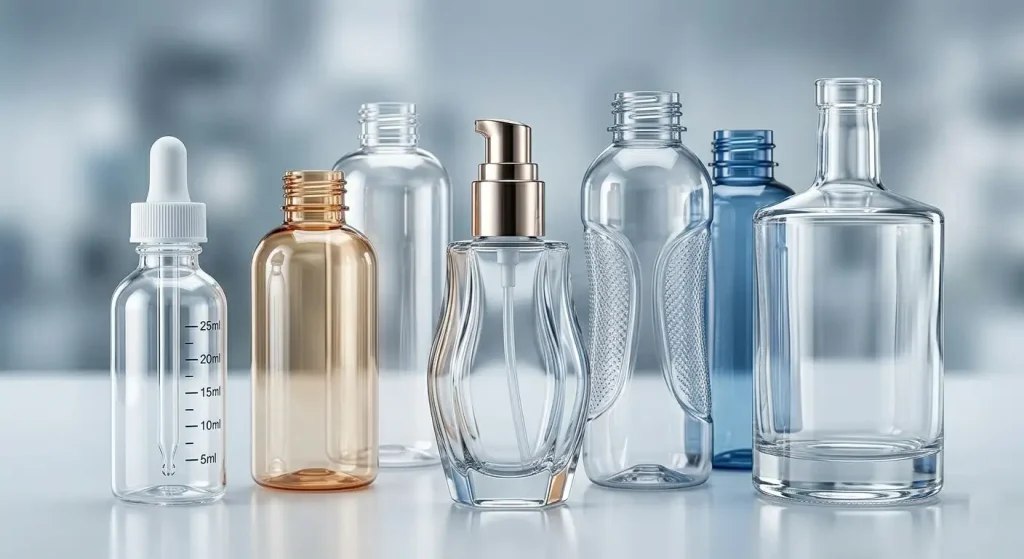
- Pharmaceutical: dropper bottles, oral liquid bottles, syrup bottles, eye drop bottles, nasal spray bottles, antibiotic suspension bottles. PP and PET dominate; clarity and FDA/TGA compliance are non-negotiable.
- Cosmetic & personal care: serum bottles, lotion bottles, shampoo bottles, foundation bottles, mist bottles, jars and pots. PET, PCTG, and PETG most common; shaped geometries and clarity are commercially critical.
- Food & beverage: juice, milk, edible oil, sauces, dressings, baby food jars, premium spirits. PET standard; PP for hot-fill applications above 65 °C.
- Baby & infant care: baby bottles, training cups, formula containers. Tritan and PP for BPA-free positioning.
- Household chemical: cleaners, detergents, sanitisers, disinfectants, agrochemicals. PET and HDPE-grade compatibility, often with trigger-sprayer necks.
- Industrial & specialty: lab reagent bottles, lampshades, LED housings, decorative bottles. Often run in low-volume batches with frequent SKU changes.
Where to Start If You Are Evaluating ISBM
The quickest way to know whether injection stretch blow molding fits your project is to send three pieces of information to a supplier: a sketch or sample of your target bottle, your monthly output requirement, and the resin you intend to use. From those three inputs, machine configuration (3, 4, or 6 station), cavity count, mould complexity, auxiliaries needed, and approximate capital cost can be quoted with reasonable confidence within one working day.
For producers running smaller batches and high SKU diversity, a 3-station all-servo ISBM machine typically gives the fastest payback — lowest capital outlay, smallest footprint, fastest changeovers between SKUs. For premium cosmetic, pharmaceutical, and baby care work where bottle quality is non-negotiable, four-station configurations are the industry standard. For high-volume single-SKU operations exceeding 15 million bottles per month, six-station machines start to justify their higher capital cost. The honest answer for most mid-volume Australian, New Zealand, and APAC producers lands on four-station — flexible enough to handle SKU diversity, capable enough to deliver the wall consistency premium brands demand, and economical enough to pay back inside 18 months at typical utilisation.
Talk to our engineering team
E-Mail [email protected] with your bottle drawing and target volume — we reply within 12 working hours from our Sydney office at 05 Harley Crescent, Condell Park NSW 2200, with a configuration recommendation tailored to your project.