
The number of stations on your ISBM machine is not a marketing detail — it determines bottle quality, cycle time, capital cost, and whether the line can grow with your business over the next 5 to 10 years.
Why Station Count Decides Almost Everything
An ISBM machine carries preforms on a rotary indexing table. Each rotation moves the preforms through a sequence of stations — and the number of stations sets how the production cycle is split. Three stations means injection, blow, eject. Four stations adds a conditioning step between injection and blow. Six stations adds further conditioning and cooling slots. The mechanical difference looks small. The operational difference is dramatic: ISBM machine station configurations are the single most important spec on a buyer’s quotation, ahead of cavity count or brand of PLC.
The geometry behind station count is straightforward: 360 degrees divided by number of stations equals the angle between each station. A 3-station layout positions stations 120° apart; a 4-station layout positions them 90° apart; a 6-station layout positions them 60° apart. Each additional station gives the machine one more chance to do something useful to the preform — typically to bring its temperature profile, wall distribution, or cooling curve closer to ideal. More stations also split the total cycle time into smaller slices, so adding stations usually shortens the time per slice and lifts throughput. But they cost more to build, consume more floor space, and add mechanical complexity that affects spare-parts cost and operator training requirements.
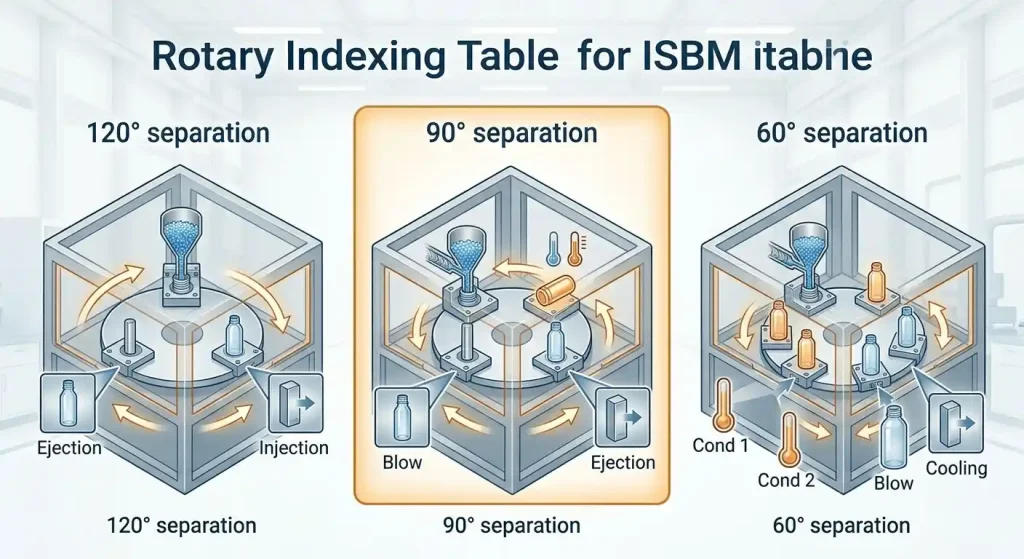
Three Configurations Side by Side
| Aspect | 3-Station | 4-Station | 6-Station |
|---|---|---|---|
| Output (BPH) | 1,500–3,500 | 3,000–5,500 | 6,000–12,000 |
| Wall thickness deviation | ±6–8% | ±3–4% | ±2–3% |
| Footprint (m²) | 8–12 | 12–18 | 28–40 |
| Capital cost (relative) | 1.0× | 1.8–2.2× | 2.5–4.0× |
| SKU changeover speed | Fast | Moderate | Slow |
| Typical cavity count | 2–8 | 4–16 | 6–24 |
| Best-fit annual volume | <25M | 25–45M | 50M+ |
When to Choose 3-Station
The three-station layout is the lean workhorse of the ISBM industry — best when your monthly volume sits below 3 million bottles, your bottle geometry is straightforward (cylindrical, gentle shoulders, no asymmetric features), and your SKU mix is wide enough that fast changeovers matter more than peak throughput. Pharmaceutical dropper bottles, oral liquid bottles, eyedropper bottles, cosmetic sample sizes, household chemical bottles below 500 ml, and laboratory reagent bottles all run cleanly on this configuration.
The economic profile is attractive for first-time ISBM buyers. Capital outlay typically lands between USD 80k and 180k for the machine itself, with mould tooling adding another USD 18k–35k for an 8-cavity equivalent. Total project cost including auxiliaries (chiller, dryer, compressor, conveyor) typically stays under USD 250k. Payback inside 16 months is realistic at moderate utilisation, which makes this configuration popular among startups, contract packagers, and brand owners moving from outsourced bottle supply to in-house production for the first time.
A modern all-servo 3-station ISBM machine brings energy savings of around 30% versus older hydraulic models, narrowing the gap with 4-station efficiency. All-servo indexing also delivers smoother, more repeatable rotation than hydraulic equivalents — which translates to tighter wall consistency on shaped bottles and fewer line rejects on optical inspection. For pharma producers who need TGA-grade traceability and audit simplicity, the all-servo 3-station has become the practical default for dropper, oral liquid, and small syrup bottle programs.
When 4-Station Becomes the Right Answer
Adding a conditioning station between injection and blowing changes the bottle. Preform temperature uniformity is the largest single driver of wall thickness consistency, top-load strength, and clarity — and the 90° conditioning slot exists specifically to deliver that uniformity. After injection, the preform’s outer skin cools faster than its core. Blowing immediately would produce a bottle with thicker walls where the skin was already firm and thinner walls where the core was still soft. The conditioning station holds the preform for the time needed to equalise its temperature profile across the wall thickness, so when it enters the blow station every part of the preform stretches consistently.
The measurable result: wall thickness deviation typically drops from ±6–8% (3-station) to ±3–4% (4-station) on the same bottle spec. Top-load strength becomes more predictable; drop test failure rates fall by half or more on shaped bottles; clarity improves visibly under retail lighting. For cosmetic, pharmaceutical, and baby care brands where bottle quality is part of the brand promise, this gap is commercially decisive.
Premium cosmetic brands, GMP pharmaceutical OEMs, baby care manufacturers, and producers running asymmetric or shaped bottles almost universally choose four-station for this reason. Output sits in the 3,000–5,500 BPH band, and the configuration handles cavity counts from 4 up to 16 depending on bottle size. This is also the configuration that scales across product portfolios. If you produce 8 ml dropper bottles today and 250 ml lotion bottles next year, a four-station machine accepts both with a mould swap.
The HGYS200 4-station one-step ISBM machine is one example designed specifically for this kind of mid-volume, mixed-SKU operation, with quick mould-change tooling and PET, PP, PC, and Tritan compatibility built in. Around 80% of buyers comparing all three configurations end up choosing four-station — it is genuinely the operational sweet spot for the majority of premium and mid-volume bottle programs worldwide.
-1-1024x559.webp "ISBM Machine Stations: 3, 4, or 6 – Which to Choose?")
When 6-Station Earns Its Cost
Six-station machines are not “better” 4-station machines — they serve a different problem. The extra stations allow parallel processing: injection, conditioning, cooling, and ejection all happen simultaneously on different preforms. Throughput climbs to 6,000–12,000 BPH per machine on mid-size bottles. The extra cooling slot lets six-station machines handle thicker-walled bottles and larger formats (1.5 L to 5 L) cleanly, where 4-station machines would struggle to cool the preform in cycle time.
But capital cost steps up 2.5–4× versus a 4-station equivalent. Mould tooling adds 40–60% because more cavity plates and neck rings are needed. Floor space requirements push past 30 m² including auxiliaries. Changeovers take longer because more stations mean more re-tooling per SKU swap. And below 60–65% sustained utilisation, the ROI collapses — fixed costs eat the margin.
The math only works at high, sustained utilisation. Bottled water plants producing 20+ million bottles per month, single-SKU edible oil bottlers, beverage majors running dedicated lines per SKU, and large pharmaceutical operations serving multiple regional markets from one plant are the typical buyers. For most premium and mid-volume producers — including virtually all premium cosmetic, baby care, and contract pharmaceutical manufacturers — two or three 4-station lines deliver more flexibility at lower total investment than one 6-station line, and provide redundancy for planned and unplanned maintenance.
-1024x559.webp "ISBM Machine Stations: 3, 4, or 6 – Which to Choose?")
A Quick Decision Test
If you want a fast directional answer before commissioning a deeper feasibility study, work through these three questions honestly:
- Monthly volume below 3M bottles + simple geometry → 3-station
- Monthly volume 3–15M + complex geometry or premium quality requirement → 4-station
- Monthly volume above 15M + 1–3 SKUs running constantly → 6-station
Beyond the directional answer, the right machine for your specific project depends on bottle weight, neck finish, resin choice, utility infrastructure, operator skill availability, and capital runway. The honest 80/20 rule across our Sydney engineering team’s experience: roughly 80% of mid-volume premium bottle programs land on four-station, with the remaining 20% split between three-station (for small pharma and startup brands) and six-station (for large beverage and water bottling operations).
Send your bottle specification, target monthly output, and SKU list to [email protected]. Our Sydney engineering team replies with a recommendation, ROI worksheet, and tooling quotation within 12 working hours from our Condell Park office.