
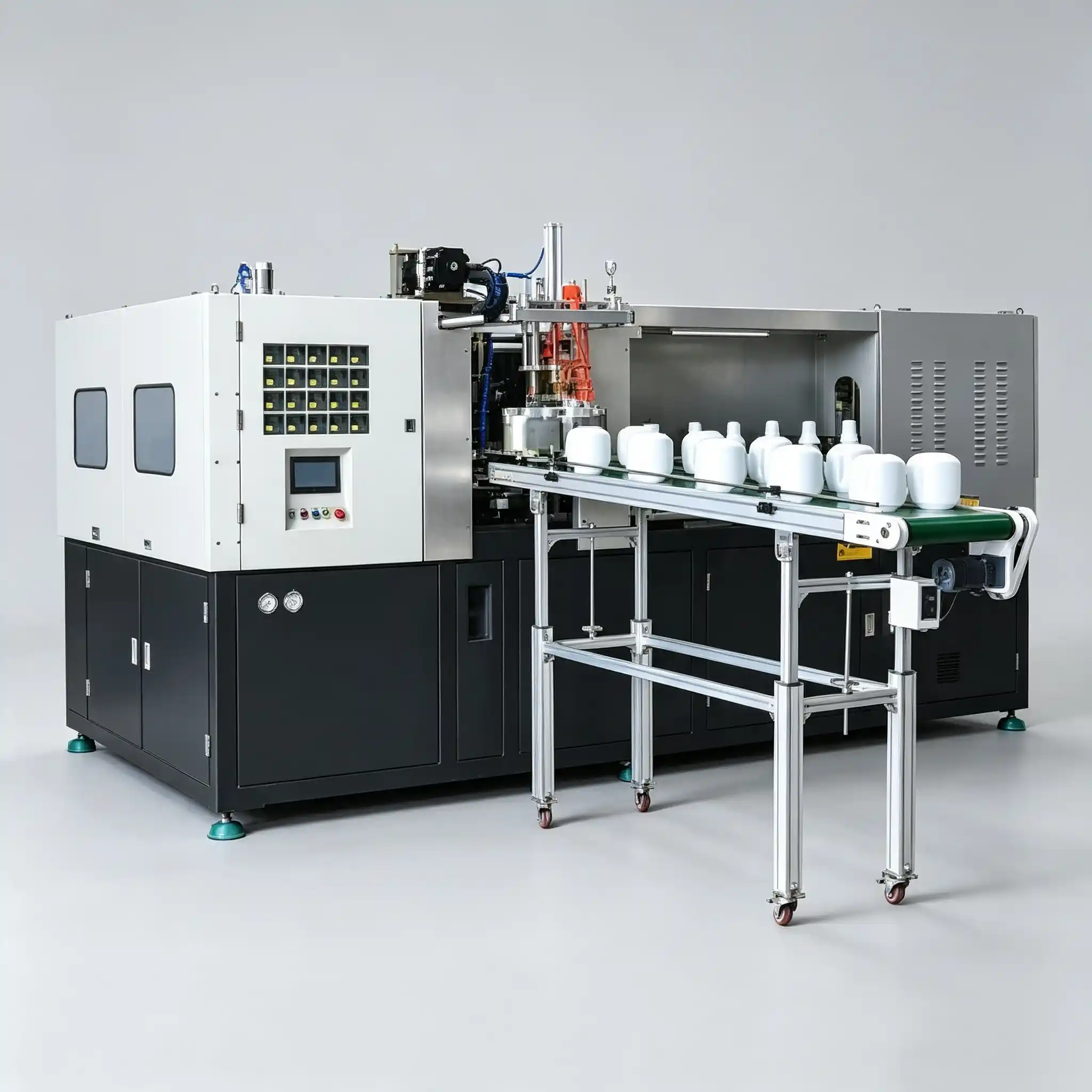
Penerangan
One-Step ISBM · Food-Grade Certified · 9 Models
Food Jars & Cans Series
Blow Molding Machine
Wide-mouth PET jar blow molding machine series covering 1,000 ml to 15,000 ml. From honey jars and peanut butter cans to 15-litre bulk storage containers — one platform, nine model configurations.
Max. Neck Ø 168 mm
FDA-Compliant PET / PP
15,000
ml Max Container Vol.
4,600
BPH Theoretical Output
168 mm
Max Wide-Mouth Neck Ø
9
Model Configurations
What Makes a Food Jar Blow Molding Machine Different from a Standard Bottle Machine?
PET wide-mouth jar production · food-grade container manufacturing · injection stretch blow molding
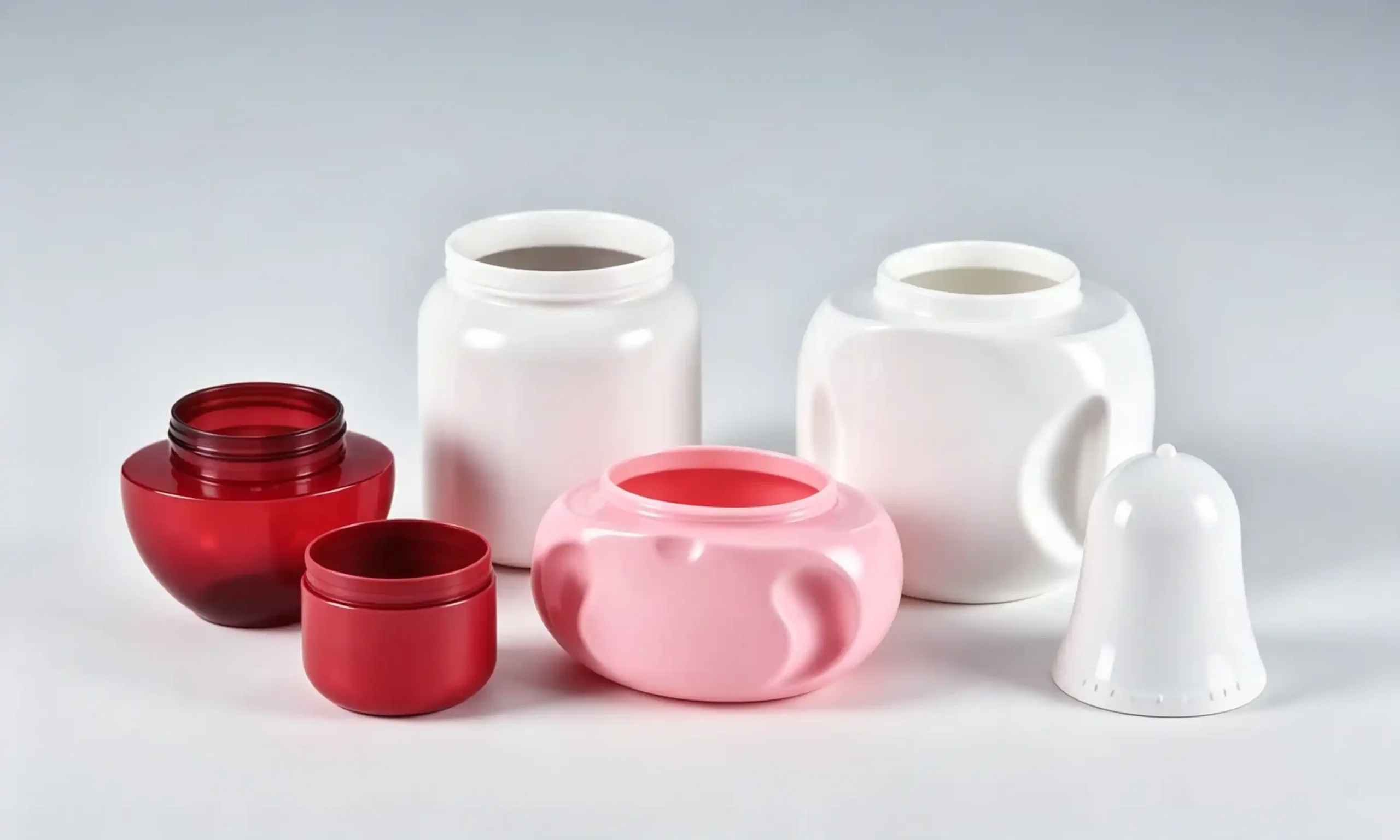
Wide-mouth food jars and PET cans have a fundamentally different set of engineering requirements compared to narrow-neck beverage bottles. A jar neck opening can be anywhere from 63 mm to 168 mm in diameter — far beyond what standard bottle blow molding machines are designed to handle. The preform geometry is shorter and thicker, the blow ratio is lower, and the wall thickness distribution requirement is more demanding because the jar body needs uniform rigidity for lid torque and stacking load, not just burst pressure.
This series uses single-stage injection stretch blow molding (ISBM) technology — meaning the machine injects the preform, conditions it, stretches it, and blows it into the final jar shape all within one thermal cycle. There’s no secondary reheating stage, no preform storage, and no inter-station contamination risk. For food-contact packaging, that closed-process advantage is significant: every jar comes out of the mold at food-grade cleanliness without additional handling between stages.
The nine models in the series span container volumes from 1,000 ml (HGA.ES-1C130) all the way to 15,000 ml (HGA.ES-2C260) with neck openings from 98 mm up to 168 mm. Output rates range from 900 bph on the largest-volume configurations to 4,600 bph on the 4-cavity mid-volume model (HGA.ES-4C100).
Full Technical Specifications — Food Jars & Cans Series (All 9 Models)
HGA.ES-1C130 · HGA.ES-2C130 · HGA.ES-2C150 · HGA.ES-2C200 · HGA.ES-2C260 · HGA.ES-4C100 · HGA.ES-4C130 · HGA.ES-4C150 · HGA.FS-1CG220
| MODEL | ||||||||||
|---|---|---|---|---|---|---|---|---|---|---|
| Parameter Group | Unit | ES-1C130 | ES-2C130 | ES-2C150 | ES-2C200 | ES-2C260 | ES-4C100 | ES-4C130 | ES-4C150 | FS-1CG220 |
| Molding Group | ||||||||||
| Clamping Stroke | mm | 150 | 160 | 190 | 215 | 275 | 128 | 148 | 165 | 225 |
| Mold-Open Distance | mm | 350 | 360 | 440 | 499 | 635 | 328 | 378 | 415 | 509 |
| Mold-Close Distance | mm | 200 | 200 | 250 | 284 | 360 | 200 | 230 | 250 | 284 |
| Stretching Stroke | mm | 350 | 350 | 450 | 500 | 550 | 350 | 400 | 400 | 500 |
| Preform Holder | — | 38 | 60 | 60 | 50 | 42 | 92 | 92 | 86 | 40 |
| Cavities | — | 1 | 2 | 2 | 2 | 2 | 4 | 4 | 4 | 1 |
| Container Specifications | ||||||||||
| Max. Container Volume | ml | 1,000 | 1,500 | 2,500 | 5,000 | 15,000 | 800 | 1,500 | 2,500 | 5,000 |
| Max. Neck Diameter | mm | 98 | 98 | 110 | 138 | 168 | 68 | 98 | 110 | 138 |
| Max. Container Diameter | mm | 110 | 110 | 130 | 180 | 240 | 80 | 110 | 130 | 190 |
| Max. Container Height | mm | 260 | 250 | 250 | 350 | 450 | 250 | 250 | 230 | 330 |
| Theoretical Output | bph | 1,000 | 1,800 | 1,800 | 1,600 | 900 | 4,600 | 3,200 | 4,000 | 600 |
| Electrical System | ||||||||||
| Max. Heating Power | kW | 31.5 | 42.5 | 42.5 | 85 | 68 | 62.5 | 68 | 78 | 36 |
| Normal Heating Power | kW | 12 | 8–13 | 18 | 35 | 35 | 21 | 30 | 32 | 14 |
| Air System | ||||||||||
| Operating Pressure | kg/cm² | 7 | 7 | 7 | 7 | 7 | 7 | 7 | 7 | 7 |
| Blowing Pressure | kg/cm² | 35 | 26–35 | 26–35 | 30 | 35 | 35 | 35 | 35 | 30 |
| Cooling Water | ||||||||||
| Operating Pressure | kg/cm² | 6 | 5–6 | 5–6 | 5–6 | 5–6 | 5–6 | 5–6 | 5–6 | 5–6 |
| Temperature | °C | 8–12 | 8–10 | 8–10 | 8–12 | 8–10 | 8–10 | 8–12 | 8–12 | 8–12 |
| Flow Rate | ltr/min | 30 | 30 | 30 | 91.4 | 50 | 30 | 40 | 60 | 30 |
| Machine Dimensions | ||||||||||
| Size (L×W×H) | mm | 2525×1525×1995 | 3600×1800×1980 | 4290×1800×2220 | 4300×2100×2500 | 5570×2090×2500 | 4170×1930×2340 | 5450×2070×2320 | 6200×2150×2050 | 4200×2070×2000 |
| Machine Weight | kg | 2,500 | 3,000 | 3,500 | 4,500 | 7,500 | 4,000 | 6,500 | 8,000 | 3,200 |
High-pressure air max 16,000 ltr/min (ES-2C260) · Low-pressure air 600–1,200 ltr/min · All models: 7 kg/cm² operating pressure
Why This PET Food Jar Blow Molding Machine Series Handles Wide-Mouth Production Better Than Standard Machines
PET wide-mouth jar machine · food-grade container blow molding · single-stage ISBM for food packaging
Neck Diameters from 68 mm to 168 mm in One Platform
Standard blow molding machines cap out at narrow-neck bottles (28–38 mm). This series is purpose-engineered for wide-mouth food containers — the mold stations accommodate neck openings up to 168 mm (HGA.ES-2C260 and HGA.FS-1CG220), which covers standard 70-400, 83-400, and 110-400 food jar closures as well as the large-diameter lug-cap formats used on bulk condiment and supplement containers.
No Seam Line — Critical for Hot-Fill and Pressure-Seal Lids
Extrusion blow molded jars have a visible parting seam running vertically down the body. ISBM jars have no such seam because the preform is injection-molded concentrically and blown symmetrically. For products sealed with vacuum lids (pickles, jams, baby food) this matters: a seam line creates a pressure differential point that can compromise the hermetic seal during hot-fill and pasteurization cycles.
Metal-Look PET Can Capability
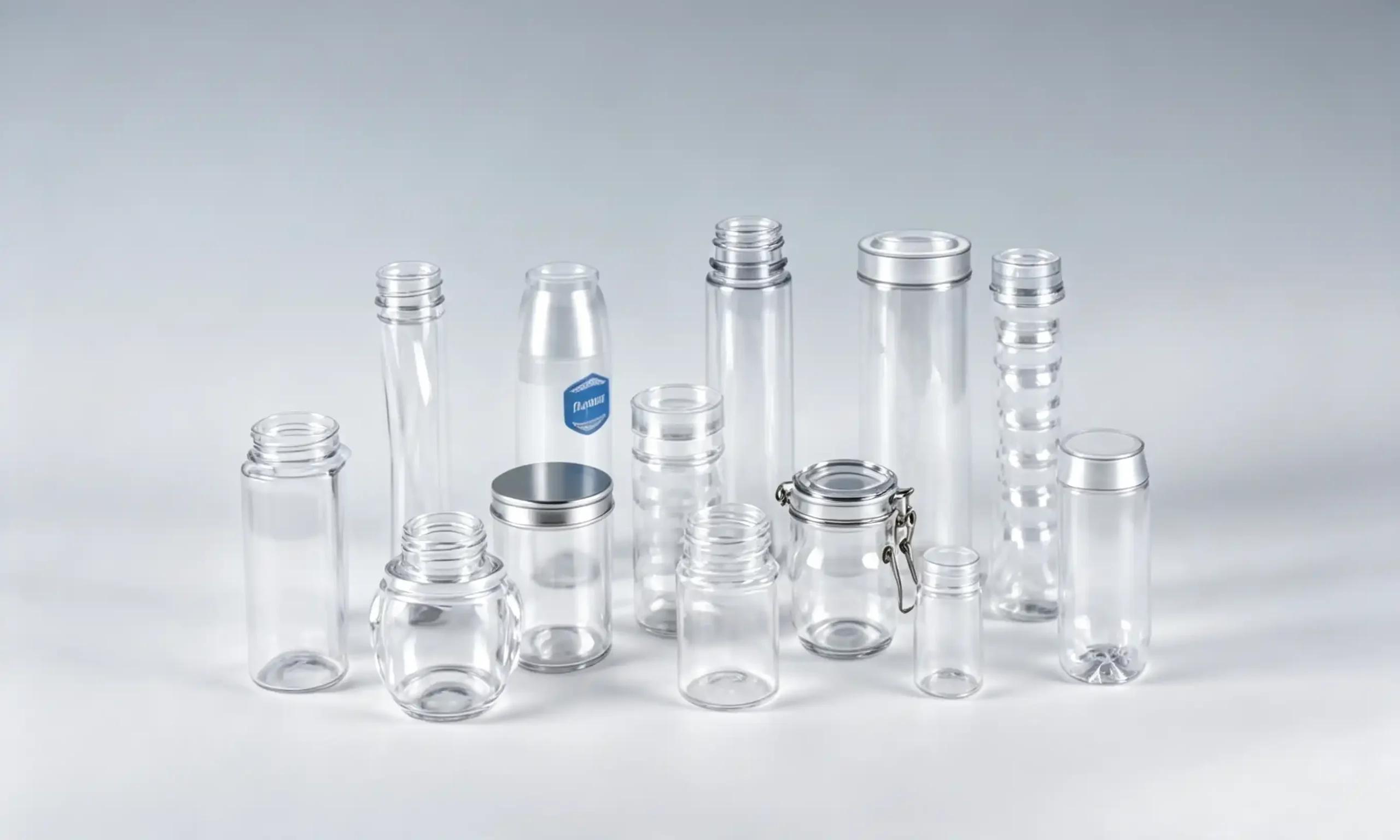
The series can produce cylindrical PET cans with straight vertical sidewalls and embossed bead patterns that visually replicate tin can aesthetics — a growing format in premium snack, coffee, and protein powder packaging. The straight-wall geometry requires tighter preform temperature uniformity, which the ISBM single-stage thermal control handles more reliably than a reheated two-stage process where preform temperature gradients can cause wall-thinning on the shoulder.
15-Litre Bulk Container Production on ES-2C260
The HGA.ES-2C260 is the largest-volume model in the series, handling containers up to 15,000 ml with a 168 mm neck — that puts 5-gallon water-dispenser jars, large protein supplement containers, and bulk pickle jars within range. At 900 bph on a 2-cavity setup, this targets specialty and mid-volume food producers rather than high-speed commodity lines, where the economics justify a premium, seamless, optically clear container over an extrusion-blown alternative.
4-Cavity High-Output for Medium-Volume Food Jar Lines
The HGA.ES-4C100 and ES-4C130 deliver 3,200–4,600 bph on containers up to 1,500 ml — these are the production workhorses for peanut butter jar blow molding machine applications, honey jar lines, and dry-food canister production where volumes justify the 4-cavity tooling investment but maximum container size stays under 1.5 litres. At 62.5–68 kW installed power, the per-jar energy cost is competitive with two-stage lines at comparable throughput.
Closed Single-Stage Process — No Preform Handling or Storage
For food-contact packaging, the ISBM closed-process advantage is straightforward: PET granules go in, finished food-grade jars come out, with no intermediate preform storage where environmental contamination could occur. This simplifies compliance with FDA 21 CFR 177.1630 (PET food contact), EU 10/2011 migration regulations, and BRC/IFS food packaging supplier audits — auditors can trace the full production chain within a single machine perimeter.
Application Breakdown: Food Categories and Container Formats This Series Covers
wide-mouth PET jar machine for food packaging · plastic can blow molding · food storage container production
Condiments & Spreads
- Peanut butter jars (500 g / 1 kg wide-mouth, 70-400 neck)
- Honey jars (250 ml–2 L, high-clarity PET)
- Jam and preserve jars with vacuum-seal lid compatibility
- Tomato paste and ketchup cans (metal-look PET format)
- Tahini and nut butter containers
Dry Food & Snacks
- Candy and confectionery jars (clear PET, stackable)
- Coffee and ground spice canisters (hermetic wide-mouth)
- Protein powder containers (1–5 L, scoop-access wide neck)
- Nut and dried fruit packaging (food-safe PET)
- Cookie and biscuit tins (metal-look PET can format)
Beverages & Fermented Foods
- Kimchi and pickle jars (wide-mouth for easy packing)
- Juice and smoothie PET jars with tamper-evident closures
- Yogurt and dairy product containers
- Kombucha cans (PET with carbonation pressure rating)
Supplements & Bulk Food
- Vitamin and supplement capsule jars (pharmaceutical-adjacent)
- Pet food and treat containers
- Bulk spice jars for food service (1–2 L)
- 5-gallon water dispenser jugs (ES-2C260, 15,000 ml)
How to Match the Right Model to Your Food Jar Production Requirements
food jar blow molding machine selection guide · wide-mouth PET container capacity planning
Frequently Asked Questions — PET Food Jar and Can Blow Molding Machines
food jar ISBM machine buyer questions · wide-mouth blow molding machine FAQ · PET can production
Can this machine produce both a food jar and a standard beverage bottle on the same platform?
Yes — with mold changes. The ES-4C series models can switch between wide-mouth jar tooling and narrower-neck bottle molds provided the neck diameter is within the machine’s rated range. Practically speaking, if you need to run both 1-litre honey jars (98 mm neck) and 500 ml beverage bottles (28 mm neck) on the same machine, you’d need separate injection and blow mold sets for each, but the machine platform handles both. Changeover time on a 4-cavity model runs 4–6 hours with pre-staged tooling.
Is PET the right material for hot-fill food products like jams and sauces?
Standard PET softens at around 70–74 °C, so it’s not suitable for high-temperature hot-fill (85–95 °C) without heat-setting treatment. For hot-fill food jars, you have two options: (1) use heat-set PET (HSPET) with a modified crystallization step, which requires specific mold temperature control that we can configure; or (2) switch to PP (polypropylene), which is rated to 120 °C and handles retort-level temperatures. Both options are available on this machine series. Cold-fill and ambient-fill products — peanut butter, honey, dry goods — run standard PET without modification.
What’s the minimum order quantity for custom food jar molds?
There’s no minimum production quantity for mold orders — we supply a complete mold set (injection mold + blow mold) for any volume. What changes with volume is the economics: for high-volume production runs over 2 million jars per year, the tooling cost is recovered quickly. For low-volume specialty producers (under 500,000 units per year), we recommend starting with a 1- or 2-cavity mold set on the ES-1C130 or ES-2C130 to keep tooling investment proportionate. Custom molds take 35–50 days from drawing approval to first samples.
How do PET food jars compare to glass jars in terms of weight, cost, and consumer acceptance?
A 500 ml glass jam jar weighs approximately 200–250 g empty; a PET equivalent weighs 25–35 g — roughly 85% lighter. That weight difference directly reduces shipping cost and breakage loss in transit. On clarity, PET achieves >90% light transmission, which is visually comparable to glass for most retail formats. Consumer acceptance for PET jars has grown significantly in food categories where glass historically dominated — peanut butter, honey, and dry goods — particularly in export markets where breakage risk during long-haul shipping makes glass economically impractical. The main limitation remains hot-fill suitability, as noted above.
What does “metal-look” PET can mean, and how is it achieved on this machine?
A metal-look PET can is a plastic container with a cylindrical, straight-walled profile and embossed surface features (horizontal beads, stepped shoulders, or base ring) that mimic the visual appearance of a tin can. The effect is achieved through mold design — the blow mold cavity includes the bead and shoulder geometry — combined with downstream labelling or in-mold labelling (IML) processes that apply metallic or printed sleeves. The ISBM process is better suited to this format than extrusion blow molding because the seamless body and uniform wall thickness give a cleaner cylindrical geometry that holds embossed detail more precisely.
Get the Right Machine for Your Food Packaging Line
Tell Us Your Jar Size, Neck Diameter, and Daily Output —
We’ll Recommend the Exact Model and Mold Configuration
Whether you’re starting a peanut butter jar line, scaling up honey container production, or sourcing a machine for large-format food storage containers — bring us the numbers and we’ll match you to the right setup.
9 model configurations · Custom mold design available · Worldwide shipment · Response within 24 hours


