
A reference guide to the eight most common preform defects troubleshooting situations operators encounter on injection stretch blow molding lines — with root causes, corrective actions, and the diagnostic sequence that separates a 30-minute fix from a 4-hour stoppage.
Most preform and bottle defects on a well-configured ISBM line are not random. They emerge from a small set of root causes that experienced operators learn to recognise within minutes. The diagnostic skill that separates good operators from average ones is not memorising every possible defect — it is recognising which family of root causes a defect belongs to, and working through the diagnostic sequence in the right order. The eight defects below cover roughly 90% of unplanned production stops on PET, PP, and Tritan bottle lines.
1. Short Shot (Incomplete Preform Fill)
Symptom: Preform comes out incomplete, with missing material near the threads or base. Visible voids; some preforms ejected without being fully formed; bottles blown from these preforms burst or fail to form.
Likely causes: Insufficient injection pressure for the cavity volume; barrel temperature too low for the resin grade; resin not fully dried (moisture causes flow inconsistency); injection time too short to fill complex cavity geometries; cavity venting blocked, preventing air escape.
Fix: Raise injection pressure in 5% increments while monitoring flash and clamp force; verify barrel zone temperatures are within the resin manufacturer’s recommended spec window; check resin dryer dew point (PET should be ≤ −40 °C, Tritan ≤ −50 °C); inspect and clear cavity vents during the next mould opening cycle. Persistent short shots after these corrections suggest a worn check ring on the screw or a blocked nozzle, which require maintenance intervention.
2. Flash on Preform Parting Line
Symptom: Thin film of plastic protruding along the preform mould parting line; preforms must be trimmed before blowing; mould parting surfaces show wear marks.
Likely causes: Clamp force too low for the cavity projected area; mould parting surface worn from accumulated wear; injection pressure too high for the available clamp force; debris or accumulated resin on the parting surface preventing full closure.
Fix: Verify clamp tonnage matches projected area calculation (multiply cavity projected area by injection pressure to confirm clamp adequacy); clean parting surfaces and inspect for wear at every scheduled maintenance interval; reduce injection pressure if material flow allows without causing short shots; check tie bar parallelism using a precision feeler gauge. Mould parting surface refurbishment becomes economical when flash exceeds 0.3 mm consistently.
3. Stress Whitening on Bottle Shoulder
Symptom: White or hazy zone on the shoulder of the blown bottle, especially on shaped or angled shoulders. The whitening is most visible against backlit inspection and reduces the bottle’s commercial appeal even when mechanical properties remain acceptable.
Likely causes: Preform too cold at blow station (cold spots cause forced stretching beyond the polymer’s natural drawability); insufficient conditioning time on machines that have a conditioning station; stretch ratio too aggressive for the resin grade; preform wall too thick in the shoulder area, leading to incomplete heating during conditioning.
Fix: Increase conditioning station temperature by 2–4 °C while monitoring crystallisation risk; extend conditioning time slightly; if problem persists, redesign preform with thinner shoulder geometry. The conditioning station on a 4-station ISBM machine exists specifically to prevent this defect — running a 3-station for shaped shoulder bottles often produces this issue chronically because there is no thermal equalisation step before stretching. Brands producing premium cosmetic bottles with shaped shoulders should specify 4-station from the outset rather than try to retrofit conditioning logic into a 3-station layout.
4. Uneven Wall Thickness (Lopsided Bottle)
Symptom: One side of the bottle visibly thicker than the other; bottle leans or rocks when placed upright; top-load test results vary significantly between samples from the same cavity.
Likely causes: Preform off-centre in blow mould (positioning fault); preform temperature gradient (one side warmer than the other due to non-uniform conditioning); stretch rod misaligned with cavity centreline; uneven mould cooling causing differential solidification.
Fix: Verify neck plate centring with a dial gauge; check preform infrared heater zones for failed elements (a single failed element shifts temperature distribution detectably); align stretch rod within ±0.1 mm of cavity centreline; inspect mould cooling channels for blockage with a flow meter. Uneven wall thickness across all cavities simultaneously points to machine alignment; uneven wall thickness in only some cavities points to mould-specific issues like worn neck rings or differential cavity wear.
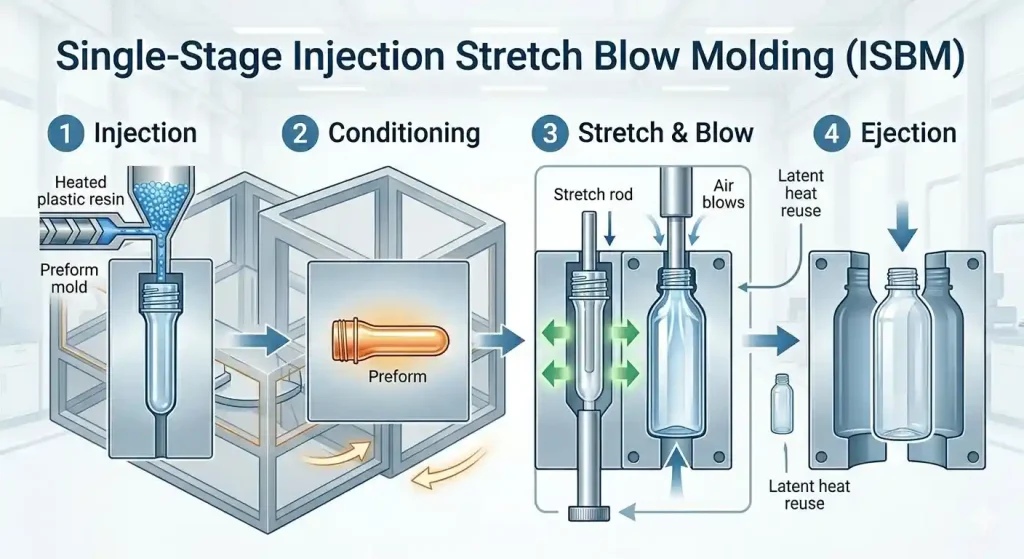
5. Crystallisation (Pearlescent or Milky Appearance)
Symptom: Bottle appears milky or has small white spots, especially near the gate or in thicker sections. Brittleness increases; impact resistance drops; commercial rejection rate climbs.
Likely causes: Preform held too long at high temperature before blowing (extended dwell allows PET crystals to nucleate and grow); resin moisture content too high; cooling rate too slow allowing crystallisation during solidification; recycled resin contamination introducing nucleation sites.
Fix: Reduce conditioning time to minimum needed for thermal equalisation; verify dryer dew point and replace desiccant if degraded; check chiller setpoint (mould temperature should be 8–12 °C for clarity-grade PET; lower temperatures accelerate cooling and prevent crystallisation); inspect resin batch for contamination by visual inspection and IV testing. Crystallisation issues that recur across multiple shifts often indicate that the resin batch itself is at fault and should be returned to the supplier.
6. Bottle Burst During Blowing
Symptom: Loud pop during the blow stage; bottle ruptures during blowing; partial or full bottle blowout with material ejected from the mould; cycle interrupts and operator must clear the mould before resuming.
Likely causes: Preform too thin at gate (insufficient material to carry blow pressure); blowing pressure ramp too fast for the preform thickness; preform temperature too low making the polymer brittle rather than ductile; cavity surface defect creating a stress concentration where rupture initiates.
Fix: Inspect preform wall thickness profile with a digital caliper — gate area should not be thinner than 1.0 mm for 30 g preforms; reduce primary blow pressure ramp rate (most modern HMIs allow ramp profile editing); verify infrared heater output if temperature is suspect. Persistent bursts often indicate preform design issues, not machine problems — in which case consult with the mould designer rather than continuing to adjust process parameters.
7. Gate Vestige / Tail Excess
Symptom: Visible plastic stub or tail at the bottle base where the injection gate sat on the preform. Vestige height above 0.5 mm is typically rejected by retail QC inspection on premium cosmetic bottles.
Likely causes: Hot runner valve gate closing too late, allowing material to drool after the cycle; gate insert worn from accumulated cycles; injection pressure decay too slow, leaving residual pressure pushing material into the gate area.
Fix: Adjust valve gate close timing using the hot runner controller (target close 0.1–0.2 seconds before screw retraction); replace gate insert if vestige height exceeds 0.5 mm consistently across multiple cavities; inspect hot runner controller calibration and recalibrate if temperature drift is detected. Gate vestige tends to worsen gradually over thousands of cycles, so trending vestige measurements over time helps schedule preventive gate insert replacement before it becomes a quality issue.
8. Neck Distortion (Out-of-Round Threads)
Symptom: Bottle neck threads do not match the cap; cap cross-threads or fails leak test; neck geometry measurements show out-of-round condition exceeding ±0.05 mm.
Likely causes: Neck plate worn from accumulated cycles; clamp force releases too early before the neck has cooled to dimensional stability; preform ejected before sufficient cooling; inconsistent preform handling robot grip pressure.
Fix: Inspect neck plate for wear (replace at >0.05 mm wear measured with a precision pin gauge); extend clamp dwell time to ensure neck has cooled below 60 °C before opening; lower neck cooling temperature to accelerate solidification; verify robot grip pressure on the neck does not exceed 2–3 N. The all-servo indexing on machines like the HGY50-V3 all-servo 3-station ISBM reduces neck distortion versus older hydraulic indexers because the rotation profile is more controlled and acceleration profiles can be tuned to minimise mechanical shock during indexing.
A General Diagnostic Approach
When a defect appears, work through this sequence rather than jumping to conclusions or making multiple changes simultaneously. The biggest mistake operators make is changing three parameters at once — which makes it impossible to know which change resolved the issue, and creates a recipe drift that the next shift inherits.
- Confirm the defect appears in every cavity or only specific cavities. Cavity-specific defects mean tooling; universal defects mean machine or material. This single check eliminates 50% of diagnostic confusion.
- Check resin dryer dew point and barrel temperatures before changing anything else. 60% of injection defects trace to material moisture or temperature drift.
- Review the last operating change — recipe edit, mould swap, resin batch change, shift handover. Most defects appear within 30 minutes of a change, so the timeline of recent changes points to the likely root cause.
- Document the fix in the recipe so the same defect is solved faster next time. A defect log that captures symptom, root cause, and fix becomes the most valuable training resource for new operators.
- If the defect persists after one full diagnostic cycle, escalate. Continuing to adjust parameters without a clear diagnostic narrative typically makes the problem worse and creates downstream defects that take longer to unwind.

When to Call Your Supplier
If a defect persists after a full diagnostic cycle, escalate. Persistent defects often indicate a hardware issue — worn cross kit bearing, hot runner heater drift, valve gate actuator failure, infrared heater element failure — that operator-level adjustment cannot resolve. Continuing to chase the defect at the recipe level after hardware has failed wastes production time and increases the chance of introducing secondary defects that complicate eventual repair.
For machines under our service coverage in Australia and APAC, Sydney-based engineers are typically on-site within 24–48 hours of an escalation call. Remote diagnosis via shared photos, recipe parameter exports, and live video can often resolve defects within hours without requiring on-site service — particularly during normal AEST business hours when our engineering team is available for direct technical support.
Need a defect diagnosed remotely?
Send photos and the recipe parameters to [email protected]. Our Sydney engineers respond within 4 working hours during AEST business days from 05 Harley Crescent, Condell Park NSW 2200, with diagnostic recommendations and (if hardware intervention is needed) a service dispatch timeline.