
Choosing the right resin is the most consequential decision in any bottle project — it determines clarity, chemical resistance, regulatory approval, and machine compatibility. This blow molding material selection guide walks through the four resins that account for 95% of injection stretch blow molded bottles worldwide, with practical guidance on when each is the right answer and what trade-offs each imposes.
PET — Polyethylene Terephthalate
Best for: Beverages, cosmetics, household chemicals, pharmaceuticals where clarity matters.
Process temperature: 250–280 °C injection · 95–110 °C blow.
Approximate share of ISBM market: ~80%.
PET is the dominant resin in injection stretch blow molding for one fundamental reason: it stretches beautifully. When biaxially oriented during the stretch-blow stage, PET develops a tight molecular network that delivers high clarity, excellent gas barrier properties, and a strength-to-weight ratio nothing else matches. A 30 g PET bottle holds 1.5 L of carbonated water at 4 bar internal pressure without flexing or rupturing. The same wall weight in HDPE would deflect under load; in glass, it would weigh 8× more.
PET is also recyclable through established rPET streams that now span every developed economy, FDA and EFSA approved for direct food contact, FSANZ approved for the Australian market, and compatible with virtually all ISBM machine platforms without specialised hardware. The resin grade matters: bottle-grade PET typically has an intrinsic viscosity (IV) of 0.78–0.85 dL/g, which provides the right balance of flow during injection and strength after biaxial orientation. Lower IV PET is cheaper but produces weaker bottles; higher IV PET is harder to process and yields diminishing returns above 0.85 dL/g for most bottle applications.
The only meaningful drawback is heat resistance — standard PET softens above 65 °C, which is why hot-fill applications require either specialised heat-set bottles (a more expensive heat-set mould holding the bottle at 130 °C briefly to crystallise the wall and lock in dimensional stability) or a switch to PP or PEN. For room-temperature and refrigerated applications — beverages, cosmetics, household chemicals, oral pharmaceuticals — standard PET is universally the right starting point. For carbonated drinks specifically, PET’s combination of strength under pressure, oxygen barrier, and clarity is irreplaceable.
PP — Polypropylene
Best for: Hot-fill foods, sauces, baby bottles, pharma syrup, microwave-safe containers.
Process temperature: 200–230 °C injection · 130–150 °C blow.
Approximate share of ISBM market: ~9%.
PP fills the gap PET cannot — applications where the bottle must survive hot filling, pasteurisation, microwave heating, or autoclave sterilisation. It withstands 100 °C continuous service and 121 °C short exposure (autoclave-grade), which makes it the only viable thermoplastic for hot-fill juice, ketchup, sauce, and pharmaceutical syrup bottles. Clarity is lower than PET because PP’s semi-crystalline structure scatters light at the molecular boundary, though modern clarified PP grades using nucleating agents come close to PET in optical performance.
Chemical resistance is excellent across acids, alkalis, and most solvents — PP outperforms PET in environments containing aggressive cleaning chemicals or pH extremes. This is why PP dominates household chemical bottles for products like bleach, oven cleaner, and drain cleaner, where the bottle must resist its own contents for 18–24 months on the retail shelf. PP also has an environmental advantage: it is widely recycled in the #5 plastic stream, has lower production carbon footprint than PET on a per-bottle basis, and can be reprocessed multiple times without significant property loss.
PP is the standard choice for baby bottles (BPA-free, dishwasher-safe, microwave-safe), pharmaceutical syrup bottles (autoclave-compatible), food packaging that needs hot-fill capability, and any container that will be sterilised before use. It runs cleanly on any well-configured 4-station ISBM machine — the HGYS150 4-station ISBM machine handles PP bottles up to 500 ml without configuration changes beyond mould and temperature profile. The conditioning station on a 4-station layout is particularly valuable for PP because PP has a narrower processing window than PET, and temperature uniformity is harder to achieve.
PC — Polycarbonate
Best for: 5-gallon water cooler bottles, returnable beverage bottles, lampshades, technical containers.
Process temperature: 280–310 °C injection · 130–155 °C blow.
Approximate share of ISBM market: ~3%.
PC offers extreme impact strength (250× that of glass), high heat tolerance up to 130 °C, and optical clarity comparable to PET. It is the resin of choice for 5-gallon (18.9 L) water cooler bottles that must survive hundreds of fill-and-deliver cycles, drop tests onto warehouse floors, washdown chemicals at filling plants, and the abuse of commercial water dispensers. A PC water cooler bottle typically lasts 4–6 years and 80–120 fill cycles before being recycled — economics that no other thermoplastic can match for that specific application.
The drawback is BPA content in standard PC grades. Bisphenol A is used as a monomer in conventional PC manufacturing, and trace amounts can leach into bottle contents over time, particularly under high temperature exposure. Regulatory and consumer pressure has effectively banned PC for baby and food contact applications in most consumer markets — the EU, Canada, China, Japan, and Australia all restrict PC in baby bottles. This is why PC has lost market share to Tritan and PP in baby bottles since 2010, and why most premium beverage brands have moved away from PC despite its mechanical advantages.
For non-food technical applications — lab bottles, industrial sample containers, lighting components, pharmaceutical compound bottles where the contents do not contact the inner wall in solution — PC remains an excellent choice. It does require higher injection pressures and tighter temperature control than PET, so the machine must be specified accordingly. PC processing also demands rigorous resin drying — moisture content above 0.02% causes hydrolysis during injection, leading to bottle weakness and yellowing.
Tritan — Eastman Tritan Copolyester
Best for: BPA-free baby bottles, sports drink bottles, premium cosmetic packaging.
Process temperature: 270–300 °C injection · 100–130 °C blow.
Approximate share of ISBM market: ~3% and growing.
Tritan is Eastman Chemical’s BPA-free copolyester, designed specifically to replace PC in food and beverage applications without compromising on mechanical or optical properties. It combines the impact strength and clarity of PC with full BPA-free certification, dishwasher safety, and excellent chemical resistance to acidic foods, juices, fragrances, and detergents. Tritan also resists stress cracking from kitchen oils, sports drinks, and citrus-based contents — failure modes that compromise PET sports bottles after 50–100 wash cycles.
It has effectively replaced PC in the premium baby bottle market and is the default for BPA-free reusable sports bottles, water filtration bottles, and high-end blender containers. The downside: raw material cost is roughly 3–4× that of PET, which limits Tritan to applications where the BPA-free positioning, durability, or premium feel justifies the price premium. For contract cosmetic manufacturers serving brands that emphasise “clean beauty” or “sustainable packaging” claims, Tritan delivers a positioning advantage no commodity resin can match.
For premium brands willing to absorb the material premium, Tritan delivers a positioning advantage that PET cannot. A 4-station ISBM machine like the HGY250-V4-B handles Tritan with a temperature profile adjustment and the standard PET mould geometry — no specialised hardware needed. Tritan does require higher melt temperatures (270–300 °C) and more thorough drying than PET, so machine configuration must be verified before signing a tooling order.
Quick Selection Matrix
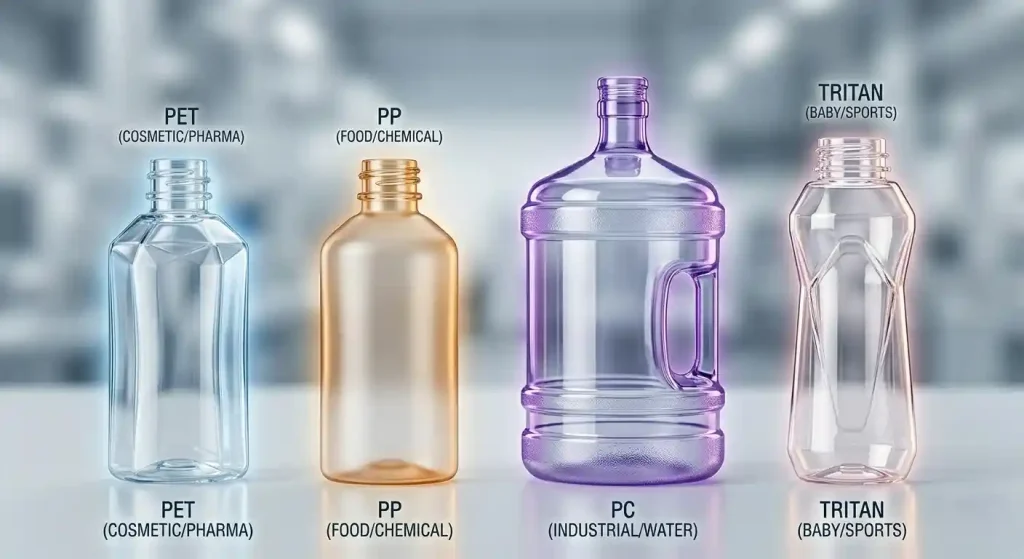
| Application | Best Choice | Alternative |
|---|---|---|
| Cosmetic serum, lotion, shampoo | PET | PCTG |
| Baby bottle (BPA-free) | Tritan | PP |
| Hot-fill juice or sauce | PP | PEN |
| Pharmaceutical oral liquid | PP or PET | PETG |
| Returnable water bottle (5-gal) | PC | Tritan |
| Carbonated beverage | PET | — |
| Sports / reusable water bottle | Tritan | PP |
| Edible oil | PET | PP |
Three Questions Before You Lock In a Resin
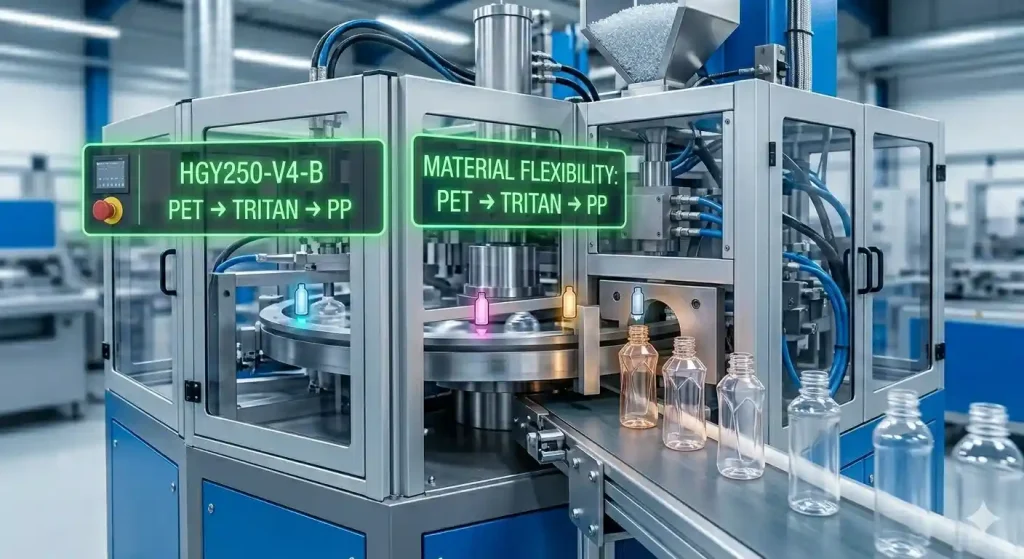
Before tooling a mould or specifying a machine, walk through these three questions with your formulation, regulatory, and marketing teams. The answers should align before purchasing decisions are made — changing resin choice after mould tooling is committed is expensive and time-consuming.
- Will the bottle be hot-filled or pasteurised? If yes, PP or PEN. Standard PET fails above 65 °C; heat-set PET adds significant cost and is only justified at high volumes.
- Is direct food or pharmaceutical contact required? Verify FDA, EFSA, and (for Australia) FSANZ approvals on the specific resin grade — not just the polymer family. Different grades within the same polymer have different additives and migration profiles.
- Will consumers see “BPA-free” as a brand differentiator? If yes, Tritan or PP. Avoid PC in any food, beverage, or baby contact application.
For applications where multiple resins could work, the secondary considerations become recyclability claims (PET has the most mature recycling infrastructure), tooling cost (different resins shrink differently, sometimes requiring different mould steel), and supply chain reliability (PET resin is available globally; specialty grades may have longer lead times).
For material recommendations on a specific bottle project, send your bottle drawing and intended fill product to [email protected]. Our materials team replies with resin grade suggestions, machine compatibility notes, and FSANZ/FDA documentation references within one working day from our Sydney office.