
4-Station One-Stage
ISBM机器
Integrate injection, temperature conditioning, stretch blow molding, and ejection into a single continuous rotary platform — producing finished PET/PETG bottles directly from raw resin with zero intermediate handling.
Technology Overview
What Is a 4-Station One-Stage ISBM Machine?
一个 4-station one-stage ISBM machine (Injection Stretch Blow Molding) consolidates the entire plastic bottle manufacturing process — from raw resin to finished container — on a single rotary platform with four dedicated workstations operating simultaneously.
Unlike two-stage (reheat-blow) systems that require separate preform production and a reheating step, the one-stage process retains residual injection heat through a precision conditioning station before stretch blow molding. This eliminates secondary heating energy, reduces contamination risk, and dramatically tightens tolerances on neck geometry and wall thickness.
Why the 4-station configuration matters: The additional temperature conditioning station — absent in 3-station designs — gives operators precise, zoned thermal control over the preform before stretching. The result is superior biaxial molecular orientation, higher tensile strength (up to +30% over traditional processes), and compatibility with complex narrow-neck bottle geometries.
Injection Molding
PET plasticized → injected into preform mold → cooled on core rod
Temperature Conditioning & Tail Trim
Gate sprue removed · Zoned reheating · Neck kept cool
Stretch Blow Molding
Axial stretch rod + radial high-pressure blow · Biaxial orientation
Cooling & Ejection
Finished container output → pristine and ready for filling line
Inside Each Station: Precision at Every Step
Each of the four workstations in a one-stage ISBM machine operates simultaneously on a separate set of core rods, enabling continuous production with zero downtime between cycles (typical cycle time: 10–30 seconds).
Preform Injection
PET granules are melted in a high-precision servo-driven screw barrel and injected under controlled pressure into the preform (parison) mold cavity. The polymer flows around the core rod, forming a threaded neck finish and a thick-walled tube body. Mold temperature is precisely controlled to manage crystallinity.
Thermal Profiling
The still-hot preform rotates to the conditioning station where a servo trim unit removes the injection gate sprue (tail). Zoned ceramic heating elements then create a deliberate temperature gradient: the bottle body is brought to the optimal blow temperature (90–110°C for PET) while the neck is actively cooled to preserve thread geometry.
Biaxial Orientation
With blow mold halves clamped around the preform, a servo stretch rod descends at up to 400 mm/s for axial elongation. Simultaneously, high-pressure air (2.0–3.5 MPa) is injected to radially expand the preform against the mold cavity wall. This simultaneous biaxial stretch aligns PET molecular chains, generating superior clarity, barrier properties, and mechanical strength.
Set & Release
Chilled water circulates through mold cooling channels to rapidly solidify the bottle in its final shape (cooling time typically 5–20 seconds). Once the mold opens, the finished container is stripped from the core rod — optionally via integrated robotic arm — and transferred to the downstream conveyor for inspection, labelling, or filling.
All 4-Station One-Stage ISBM Machine Models
Six production-ready models spanning small-batch precision to high-volume industrial output. All carry CE and ISO certification and are backed by direct factory engineering support.
-
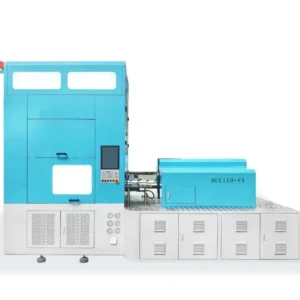
High-Efficiency HGYS150-V4 Four-Station One-Step Injection Stretch Blow Molding Machine
-
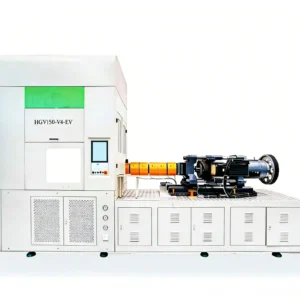
HGYS150-V4 EV Four-Station One-Step ISBM Machine for High-Efficiency PET Bottles
-
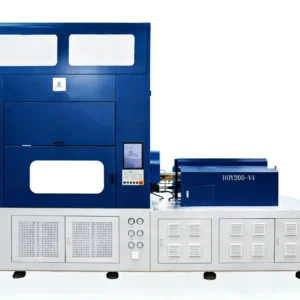
HGYS200-V4 4-Station One-Step ISBM Machine for PET & PETG Bottles
-
HGYS200-V4-B four-Station One-Step ISBM Machine for PET/PETG Bottle Production
-
PET Bottle One-Step ISBM Machine HGY250-V4 for Beverage, Cosmetic & Pharmaceutical Applications
-
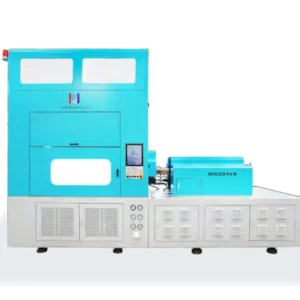
HGY250-V4-B four-Station One-Step ISBM Machine – High Precision for Cosmetic & Beverage Bottles
-
4-Station One-Step ISBM Machine | PET Bottle Production Line — EP-HGY650-V4
3-Station vs 4-Station vs 6-Station ISBM: Which Is Right for You?
All three configurations are one-stage systems — but the number of stations determines thermal flexibility, achievable bottle complexity, and production throughput. Here is how they differ.
| Feature / Criteria | 3-Station ISBM | Most Popular 4-Station ISBM | 6-Station ISBM |
|---|---|---|---|
| Station Layout | Inject → Stretch-Blow → Eject | Inject → Condition + Trim → Stretch-Blow → Eject | Inject → Condition 1 → Condition 2 → Blow 1 → Blow 2 / Cool → Eject |
| Thermal Conditioning | None (residual heat only) | 1 dedicated zone | 2 dedicated zones |
| Gate / Tail Trimming | Not standard | Servo tail trim | Servo tail trim |
| Bottle Geometry | Wide-mouth, simple shapes | Narrow-neck, complex profiles, cosmetics | High-complexity, asymmetric, multi-layer |
| Wall Thickness Control | ±8–10% | ±5% or better | ±3–5% |
| Hourly Output (single cavity) | 800–1,200 bottles/hr | 600–1,200+ bottles/hr | 1,500–3,000+ bottles/hr |
| Neck Finish Precision | Standard | High precision | High precision |
| Materials | PET, PP (wide-mouth) | PET, PETG, PP, PC | PET, PETG, PP (multi-layer possible) |
| Machine Footprint | Smallest | Compact–Medium | Large |
| Capital Investment | Lower | Medium — best ROI | Higher |
| Ideal For | Short runs, wide jars, medical caps | Beverages, cosmetics, pharma, food, household — versatile all-rounder | High-volume beverage plants, industrial output |
Why One-Stage 4-Station Technology Outperforms Alternatives
Data from production lines deploying our 4-station ISBM machines versus conventional two-stage and three-station systems.
Machine Layout & Auxiliary Equipment
A complete 4-station ISBM production line requires coordinated auxiliary systems. The diagram below shows the standard layout and equipment configuration used across our V4 series.
| Ref. | 设备名称 | Function |
|---|---|---|
| 一个 | High-Pressure Air Compressor | Supplies 2.0–3.5 MPa air for the blow molding station |
| B | 储气罐 | Buffers compressed air to stabilise blow pressure |
| C | Cold Dryer & Filter | Removes moisture and particulate from compressed air stream |
| D | 冷却塔 | Supplies circulating water to the industrial chiller |
| E | Industrial Chiller | Maintains mold temperature at 20–25°C for stable bottle formation |
| F | Low-Pressure Air Compressor | Powers pneumatic actuators and conveyors |
| G | 模具温度控制器 | Fine-tunes mold surface temperature for consistent part quality |
| H | ISBM机器 | Core 4-station production unit |
| 我 | Mechanical Arm / Robot | Automates bottle ejection and transfer to downstream conveyor |
Standard layout — exact placement varies per facility. Full layout drawings provided post-order.
Compatible Materials & Bottle Types
Our 4-station ISBM machines are engineered primarily for PET and PETG, with specific models supporting PP and PC for specialised applications.
Polyethylene Terephthalate
Beverages (CSD, water, juice), food packaging, pharma. High clarity, excellent CO2 and O2 barrier, fully recyclable. Bottle sizes 5ml–20L.
Glycol-Modified PET
Cosmetics, medical devices, laboratory bottles. Superior impact resistance, enhanced clarity vs PET, easier sterilisation compatibility.
Polypropylene
Hot-fill containers (fruit juice, tea), shampoo, conditioner, mascara. Heat-resistant to 120°C+, strong chemical resistance, good aesthetic options.
Polycarbonate
Baby bottles, reusable sports vessels, optical-quality containers. Very high impact strength, glass-like transparency, broad temperature range.