
17 Specs to Verify Before Signing the PO
Use this ISBM machine buying checklist during supplier evaluation. Tick off every item — the gaps you find will save more money than the price negotiation, and they will surface the suppliers worth working with from those who are not.
Buying an ISBM machine is a 7-to-12-year capital decision. The machine, moulds, auxiliaries, and ancillary infrastructure together represent a working asset that will produce somewhere between 80 and 600 million bottles over its operational life. Specification mistakes made during purchase compound throughout that lifespan: an undersized chiller costs you 40 minutes of cycle time per shift; the wrong PLC brand creates spare-parts headaches in year 4–5; an under-warranted machine costs you a week of production every time a major component fails. The checklist below comes from working with Australian, New Zealand, and APAC buyers across pharmaceutical, cosmetic, beverage, and contract manufacturing sectors during 2023–2025.
Mechanical & Performance (1–6)
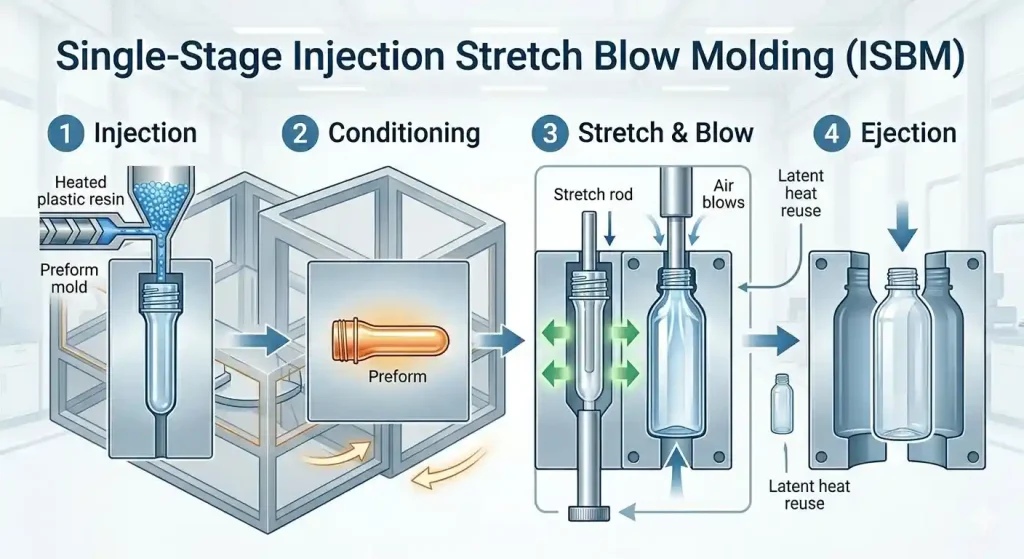
1. Station configuration. Confirm 3-station, 4-station, or 6-station — and verify it matches your bottle complexity and volume target. Asking for a 6-station because “more is better” is the most common over-spec mistake we see; idle capacity on a 6-station line bleeds margin daily and rarely recovers.
2. Cavity count. Should be sized to your monthly volume target plus 20–30% growth headroom — not the absolute peak you might reach in five years. Buyers regularly over-specify cavity count, which inflates mould tooling cost, complicates changeovers, and increases scrap during commissioning.
3. Cycle time at rated bottle. Get this in writing for your specific bottle size and resin — not a generic spec sheet number. A 12-second cycle on a 250 ml PET bottle is meaningfully different from a 12-second cycle on a 100 ml Tritan bottle, and suppliers sometimes quote cycle time at their best-case configuration rather than yours.
4. Maximum bottle volume. Most 4-station machines top out at 1.5 L. If you might need 2 L bottles later, choose a larger frame now — retrofitting to handle larger bottles after purchase is rarely possible without replacing major mechanical components.
5. Maximum neck finish diameter. Wide-mouth jars and cosmetic pots need 60–120 mm neck capability. Standard machines stop at 38 mm. Verify the maximum neck finish diameter against your full SKU roadmap, not just your launch SKUs.
6. Clamp force and injection capacity. Both must scale with cavity count. Under-spec’d clamping causes flash on the parting line and shortens mould life; under-spec’d injection causes short shots and bottle rejection during commissioning.
Drive & Control (7–10)
7. Servo vs hydraulic drive. Modern all-servo ISBM machines consume 25–35% less energy and deliver more consistent indexing than hydraulic equivalents. They also eliminate hydraulic oil leaks, reduce noise, and lower maintenance burden — which over a 10-year asset life translates to AUD 80,000–150,000 in operating cost savings on a typical mid-size machine.
8. PLC brand and HMI specification. Insist on Siemens, Mitsubishi, Omron, or equivalent. Off-brand controllers create spare-parts headaches in year 4–5 and limit your ability to integrate with downstream filling and packaging equipment. The PLC is the brain of the machine; it should be replaceable with parts you can source in your home market.
9. Recipe storage capacity. Aim for 30+ stored recipes if you run multiple SKUs. Each recipe should store all process parameters — injection profile, conditioning temperature, blow timing, ejection sequence — so changeovers become a recipe-load operation rather than a re-tuning exercise.
10. Hot runner system. Specify temperature controllers per zone, not single-zone control. Multi-zone is essential for high-cavity tooling because thermal balance across multiple cavities is the largest driver of bottle-to-bottle weight and wall consistency.
Compliance & Safety (11–13)
11. Voltage and frequency. Australia: 415V/50Hz three-phase. EU: 400V/50Hz. North America: 480V/60Hz. Confirm the machine arrives configured for your grid — voltage configuration done at the factory is far cheaper than retrofitting at site.
12. CE / AS/NZS / UL certification. Required documentation for your jurisdiction. AS/NZS 3000 compliance is mandatory for Australian installations. Get the certification documents reviewed by your in-house electrical engineer or a third-party compliance consultant before accepting delivery.
13. Resin food/pharma compliance. If running food-grade or pharmaceutical bottles, request FSANZ, FDA, EU 10/2011 documentation for the materials of construction — not just the resin. Hot runner steel grade, mould steel, neck plate alloy, and any contact surfaces all need food-contact certification for regulated applications.
Service & Support (14–17)
14. Spare parts package. Insist on a 6-month critical-spares kit included in FOB price. Cross kits, hot runner heaters, stretch rod assemblies, seal kits, valve gate actuators, and PLC backup batteries should be on the list. Without these in your spares cabinet, a single component failure can stop production for 2–4 weeks while replacement parts ship from China.
15. On-site commissioning and operator training. Should include 5–10 days at your facility, with first-bottle production sign-off as the completion milestone. Training should cover at least three of your operators across all shifts, with documented training records that satisfy ISO 9001 and (where applicable) GMP audit requirements.
16. Warranty terms. 12 months minimum. 24 months from a reputable supplier. Verify what is and is not covered — wear items like seals, bearings, and heater elements are typically excluded, and the definition of “manufacturing defect” varies widely between suppliers. Get warranty terms in writing as part of the PO, not as a verbal promise.
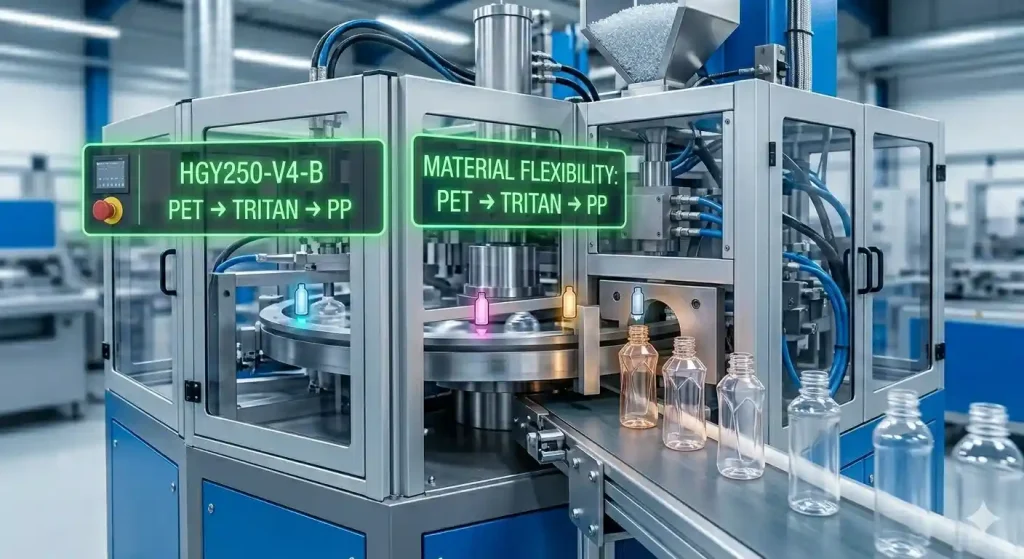
17. Local service coverage. Verify response time for service calls in your region. A supplier with a Sydney office and local parts holdings — like the HGYS200 4-station ISBM machine sold direct from our 05 Harley Crescent location — resolves emergencies in 24–48 hours instead of 2–3 weeks. For pharmaceutical and contract manufacturing operations where production deadlines are non-negotiable, local service is often the single most valuable supplier attribute.
One Bonus Item Most Buyers Forget
Total cost of ownership over 5 years. The cheapest machine is rarely the cheapest. Energy per 1,000 bottles, scrap rate, downtime cost, spare parts cost, and operator hours combined typically exceed the original capital outlay by year 3. Build a 5-year TCO model before signing the PO. A machine that costs 15% more upfront but delivers 8% lower energy consumption, 1% lower scrap rate, and 30% better uptime can pay back its premium in 18–24 months — and from year 3 onward, it generates pure operational savings.
How to Use This Checklist During Supplier Evaluation
Send the 17 items above to every supplier you are evaluating, with a request that each item be answered in writing as part of the formal quotation. Suppliers who answer crisply and specifically — with documentation references rather than marketing language — are the suppliers worth working with. Suppliers who deflect, generalise, or promise to “discuss during installation” are signalling future support quality.
Compare the answers across suppliers using a simple weighted scorecard. Mechanical and performance items typically carry 40% of the weight in the scoring; drive and control items 25%; compliance items 15%; service and support items 20%. The scorecard total surfaces the right supplier more reliably than focussing on the headline machine price, which represents only 55–65% of the real total investment when you include moulds, auxiliaries, freight, installation, and first-year operating costs.
Need a checklist filled in for your specific project?
E-Mail [email protected] with your bottle spec — we return this 17-point checklist completed for the recommended machine, plus a TCO worksheet and a comparison summary versus equivalent machines from competing suppliers.